
Contact Titan Shutters and Screens |
Schedule Your Free Assessment
Ready to protect your home or transform your outdoor space? Let's talk about what you need.
How Can We Help You?
Whether you're preparing for hurricane season, dealing with a malfunction, or ready to reclaim your patio from bugs and heat, we're here to help.
Address
3515 Agricultural Center Drive St Augustine FL, 32092
Phone Number
(904) 484-7580
Email Address
Don't wait for the next hurricane warning.
Fast installation. Storm-rated protection. Peace of mind.
Our Service Areas
We proudly serve homeowners throughout Northeast Florida's coastal and inland communities.
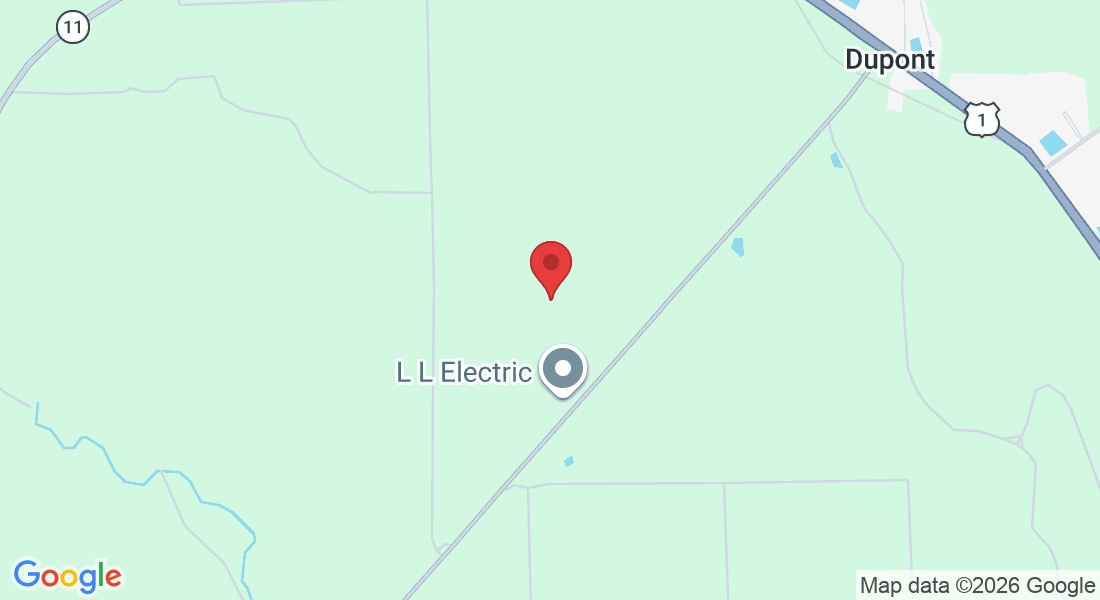
Flagler County
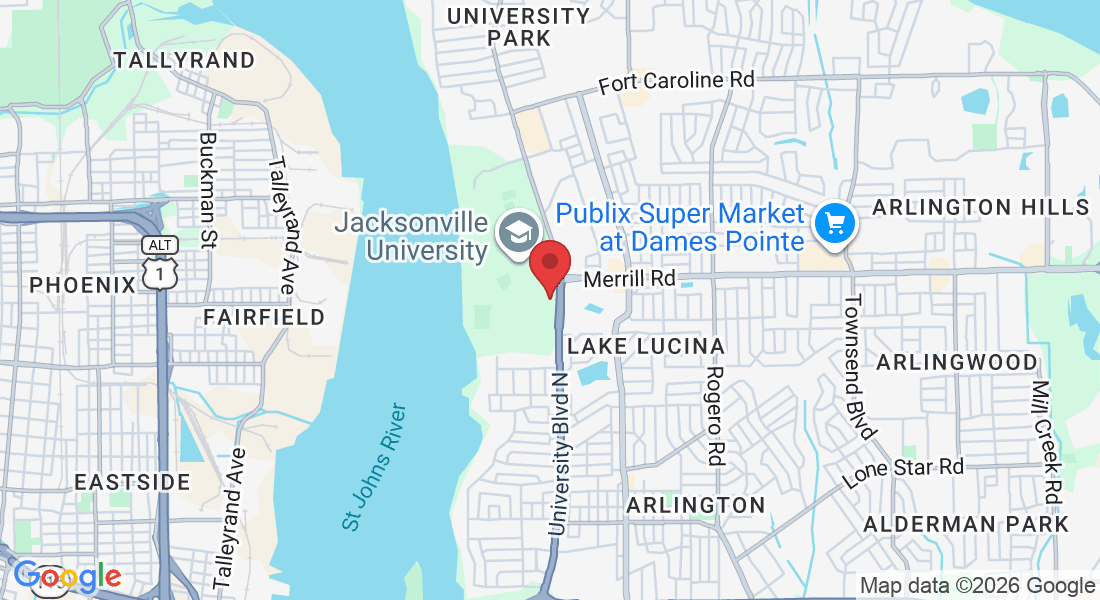
Duval County
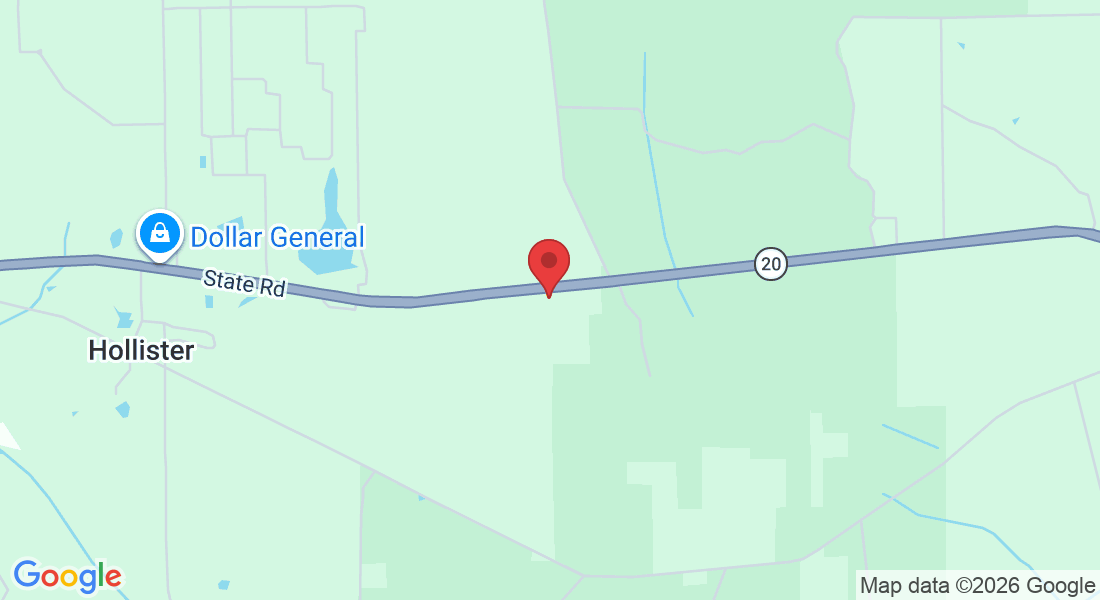
Putnam County
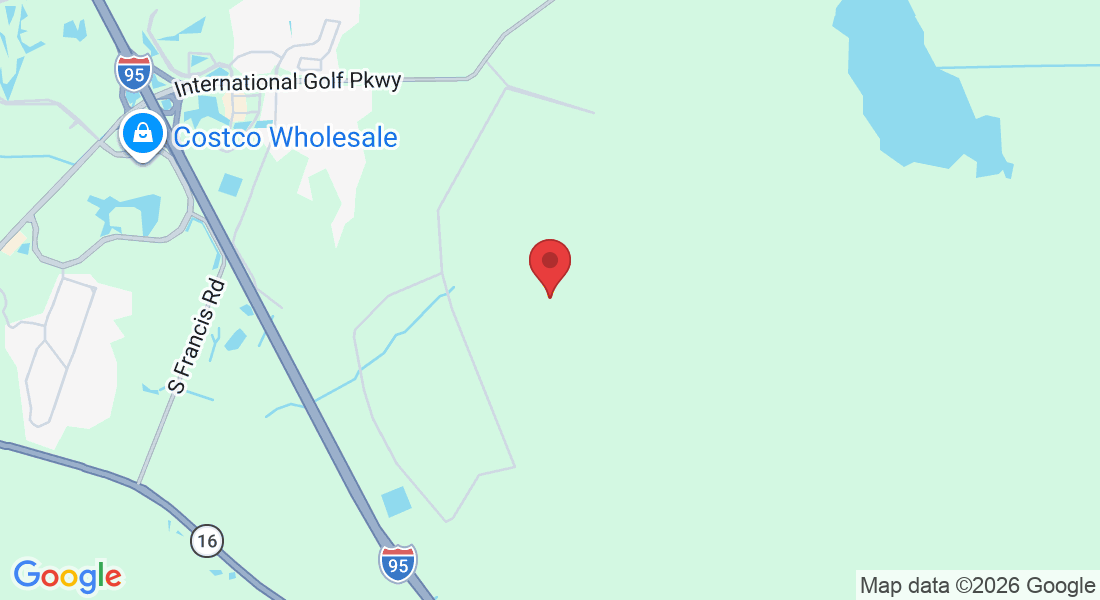
St Johns County
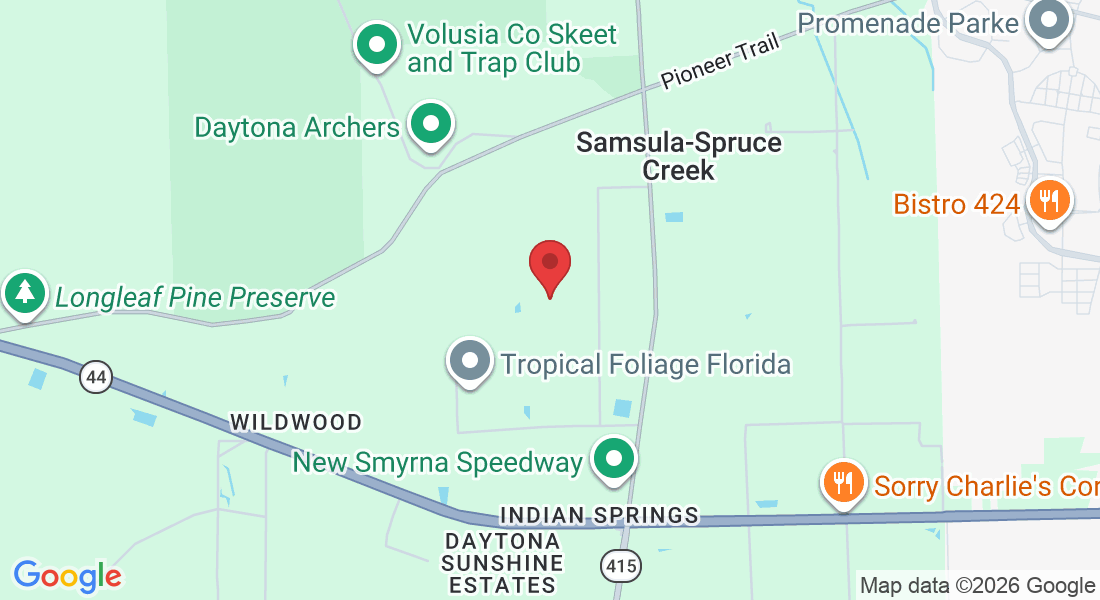
Volusia County
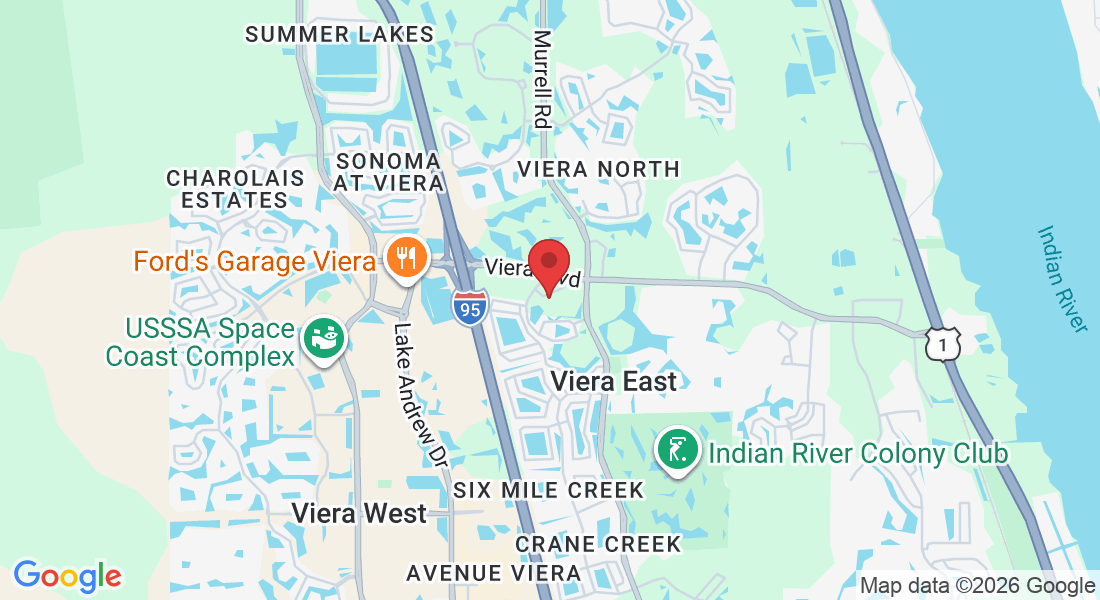
Brevard County
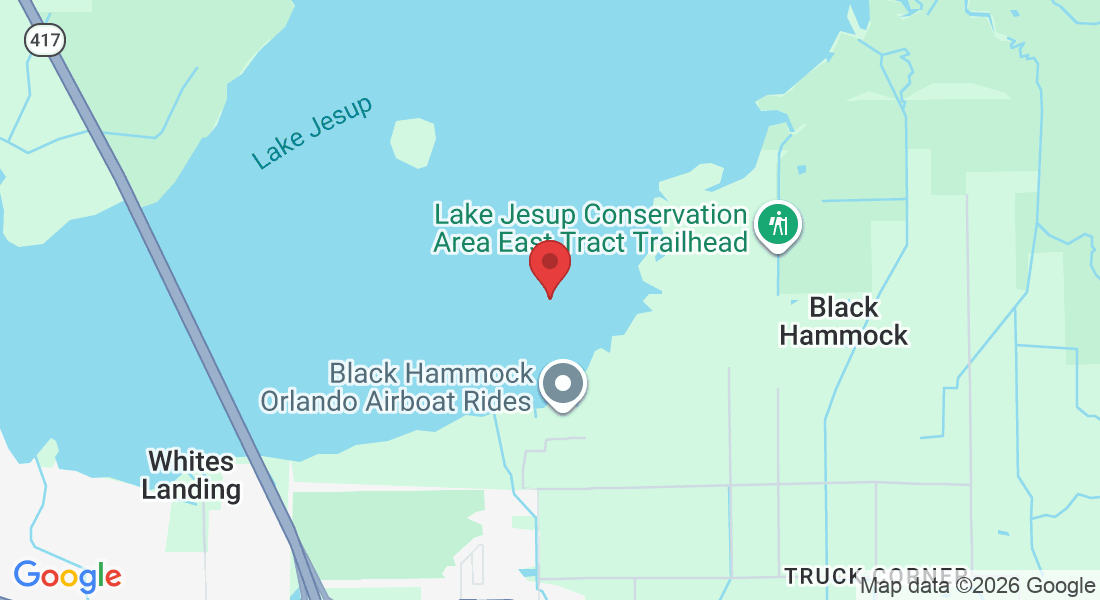
Seminole County
Nassau County
Stay Informed with Titan News
Get hurricane preparedness tips, product updates, and local insights from our blog.
The Four Threats Every Northeast Florida Pergola Faces t
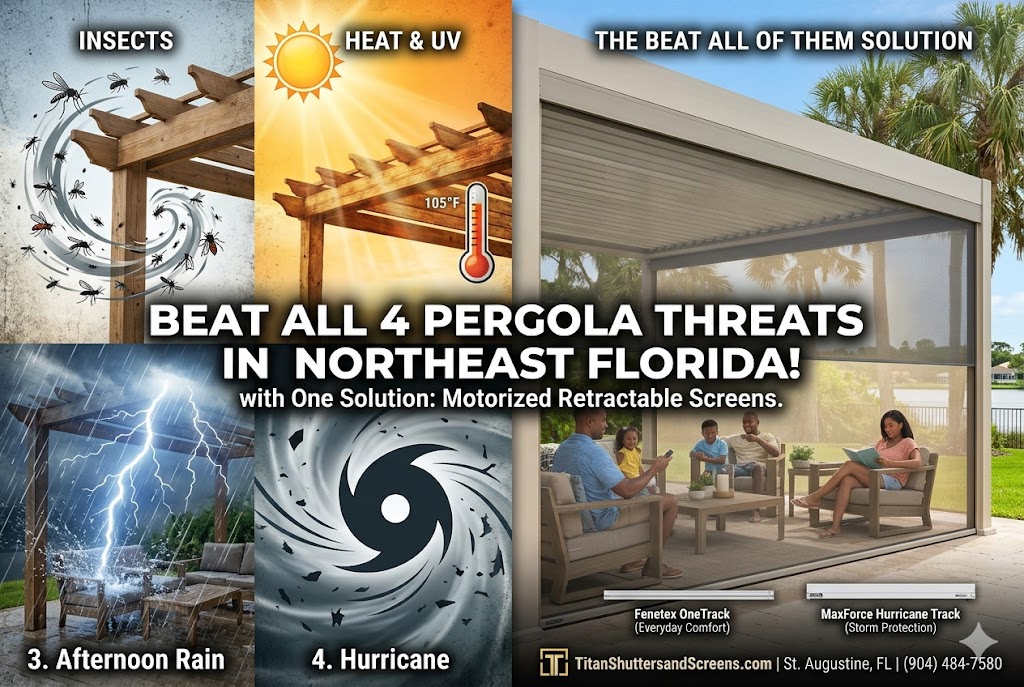
A pergola is the best investment in outdoor living a Northeast Florida homeowner can make. It is also, without the right protection, one of the most vulnerable. The four forces that define life in this part of Florida — insects, heat, afternoon rain, and hurricane season — do not spare covered outdoor spaces. They find them. They test them. And without a system designed to address each threat, the pergola that was supposed to extend your home becomes the space you avoid.
The good news is that a single product category — motorized retractable screens — answers all four. Not four different contractors, four different systems, or four separate line items on a proposal. One system, matched to the specific threat, solves every problem a Northeast Florida pergola faces from May through November.
This is the first article in a five-part series. Here, we cover all four threats and the two products — the Fenetex OneTrack screen for everyday protection and the Fenetex MaxForce Hurricane Track for storm season — that together form the most complete pergola protection plan available for homes in St. Augustine, Nocatee, Ponte Vedra Beach, and the surrounding St. Johns County communities. The subsequent articles in this series go deep on each threat individually, with installation details, product specifications, and the specific answers Northeast Florida homeowners need before they invest.
Why Northeast Florida Is the Hardest Place in America to Own a Pergola
That is not hyperbole. It is geography.
St. Johns County sits at the intersection of subtropical humidity, a 182-day hurricane season, and an insect ecosystem that the University of Florida Institute of Food and Agricultural Sciences describes as among the most diverse and active in the continental United States. Mosquitoes, no-see-ums, and biting flies are not a seasonal inconvenience here. They are a year-round presence that begins in March, peaks from May through October, and does not meaningfully subside until December — if then.
The heat is equally unforgiving. According to NOAA climate data for Northeast Florida, St. Augustine averages more than 100 days per year above 90 degrees Fahrenheit. Afternoon heat index values regularly exceed 105 degrees from June through September. A west- or south-facing pergola without solar protection does not merely become uncomfortable in the afternoon. It becomes physically hostile.
Florida's rainfall patterns add a third layer. The Florida Climate Center at Florida State University reports an average of 52 inches of annual rainfall in Northeast Florida, with most falling between June and September during fast-moving afternoon thunderstorms. These storms arrive with almost no warning, last 20 to 40 minutes, and then vanish. A pergola without rain protection means retreating inside every afternoon at exactly the time most homeowners want to be outside.
And then there is hurricane season. June 1 through November 30. One hundred and eighty-two days during which every pergola in St. Johns County is one named storm away from a structural test it may not pass. Hurricane Matthew in 2016 and the impacts in Flagler County from Hurricane Milton in 2024 both demonstrated that Northeast Florida does not need a direct hit to sustain serious damage. The margins are narrow, and the consequences are real.
Four threats. One outdoor space. And for most homeowners, a protection system that addresses none of them.
Threat One: Insects — The Enemy That Never Takes a Night Off
The mosquito situation in Northeast Florida is not an exaggeration. It is a public health concern.
The Florida Department of Health actively monitors mosquito-borne illness transmission across all 67 counties, and St. Johns County sits in a high-activity corridor between the St. Johns River and the Atlantic coast. Aedes aegypti and Aedes albopictus — the primary vectors for dengue, Zika, and chikungunya — thrive in exactly the warm, humid conditions that define Northeast Florida summers. No-see-ums, which pass through standard window screen mesh unimpeded, are active at dusk and dawn from April through November. Biting flies follow.
The consequence for pergola owners is specific and painful. The hours between 5 p.m. and 9 p.m. — the precise window most families want to use their outdoor space — are peak insect activity hours. A pergola without insect protection is not a room. It is a feeding ground.
The solution is not citronella, not professional mosquito treatment, not oscillating fans pointed at your guests. Each of those approaches manages the symptom. None of them changes the environment.
The Fenetex OneTrack motorized retractable screen physically closes the opening. The screen fabric creates a sealed barrier that insects cannot penetrate, circumvent, or wait out. When deployed, the screen locks into a fixed track system on both sides of the opening — the Keder-edge track design, borrowed from marine rigging — that eliminates gaps where insects enter traditional screen enclosures. The fabric allows airflow while blocking entry. The view remains. The breeze remains. The insects do not.
Unlike a permanent fixed screen enclosure — which blocks the view, permanently encloses the space, and carries no hurricane rating — the OneTrack system retracts completely into a flush-mounted housing when not needed. Open-air when you want it. Sealed when you don't. The transition takes seconds and is triggered by a button, a remote, or a voice command via Alexa or Google Home integration.
The article that follows this one in the series goes deep on the entomology, the specific insect threats in Northeast Florida, and the technical details of how the OneTrack screen eliminates them. But the principle is simple. Change the environment. Everything else is a workaround.
Threat Two: Heat and UV — The 100-Day Assault
Floridians do not need a scientist to tell them the sun is dangerous. They live it every summer. But the numbers are worth knowing, because they explain why a pergola without solar protection is functionally unusable for the better part of the year.
The Skin Cancer Foundation reports that up to 90 percent of skin aging and the majority of skin cancer cases are attributable to UV exposure. Florida leads all 50 states in melanoma diagnoses, according to the American Cancer Society. A west-facing pergola in Nocatee receiving direct afternoon sun does not merely make its occupants uncomfortable. It exposes them to sustained UV radiation during the highest-intensity hours of the day.
The heat compounds the problem. A pergola surface absorbing direct afternoon sun in July creates a radiant heat environment that makes the space genuinely hostile, not merely warm. Outdoor furniture becomes too hot to touch. The air temperature under the pergola exceeds the ambient outdoor temperature by 10 to 15 degrees. The family that invested in an outdoor kitchen, a fire table, and comfortable seating finds that none of it can be used between noon and 6 p.m. for five months of the year.
The Fenetex OneTrack solar screen addresses this directly. The OmegaTex fabric — engineered with aramid fiber technology — blocks 91 percent of UV radiation while maintaining outward visibility. It reduces solar heat gain under the pergola to a level that makes afternoon use genuinely comfortable. The U.S. Department of Energy notes that exterior shading solutions that block solar radiation before it enters a space are among the most effective methods for reducing cooling loads — a relevant benefit for pergolas adjacent to sliding glass doors, where solar gain directly affects interior air conditioning costs.
The same screen that eliminates insects in the evening eliminates solar heat gain in the afternoon. One system. Two threats. Every day of the year.

Threat Three: Afternoon Thunderstorms — The 20-Minute Retreat
There is a particular frustration that comes with Florida afternoon rain. It is not the rain itself — Floridians are accustomed to storms — but the timing. The storm arrives at 3:30 p.m. on a Saturday, exactly when the family is settled outside. It lasts 25 minutes. And by the time it passes, everyone has gone inside and stayed there.
Northeast Florida averages 117 thunderstorm days per year, the majority of which occur during the afternoon convective cycle between May and September. These storms are fast-moving, high-volume, and largely predictable by time of day if not by precise arrival. A pergola without rain protection means either tolerating the interruption cycle or retreating inside every afternoon during the five most active outdoor months of the year.
The Fenetex OneTrack screen manages rain the same way it manages insects and heat: by closing the opening. When deployed, the screen prevents wind-driven rain from entering the pergola space. Furniture stays dry. The outdoor kitchen remains operational. The family stays outside.
There is a practical detail worth understanding here. The OneTrack screen is not designed as a waterproof enclosure — it is a wind and rain buffer that significantly reduces moisture intrusion during a typical Florida afternoon storm. For the 25-minute fast-moving thunderstorm that characterizes most of the convective season, it provides complete functional protection. For sustained tropical weather or hurricane conditions, the MaxForce Hurricane Track system, discussed in the next section, provides a different level of engineering entirely.
The key insight is deployment speed. The OneTrack screen goes from retracted to fully deployed in seconds. A homeowner who sees afternoon clouds building can close the pergola in the time it takes to walk inside and get a glass of water. The storm passes. The screen retracts. The afternoon continues.
Threat Four: Hurricane Season — The 182-Day Reckoning
This is the threat that changes the conversation entirely.
Hurricane season runs from June 1 through November 30. According to NOAA's Atlantic Hurricane Database, the Florida peninsula is struck by a named storm or affected by tropical weather in more than half of all Atlantic hurricane seasons. Northeast Florida, positioned between the Atlantic Ocean and the Intracoastal Waterway, faces dual exposure to ocean surge to the east and river flooding to the west. Hurricane Matthew's near-miss in 2016 caused an estimated $10 billion in regional damage. Hurricane Milton's 2024 pass brought an estimated $18.8 million in damage to Flagler County alone, well east of the direct landfall location.
A pergola faces a specific hurricane threat that most homeowners underestimate. The opening itself — the unobstructed span that makes the pergola beautiful and functional — becomes a sail in high winds. Wind loading on an unprotected pergola opening can exert thousands of pounds of lateral force on the structure. The furniture, the fixtures, the outdoor kitchen, the adjacent sliding glass doors — everything behind the opening becomes exposed to wind-borne debris traveling at hurricane velocities.
The Fenetex MaxForce Hurricane Track was engineered specifically for this problem. It is not the same product as the OneTrack everyday screen. It is a purpose-built hurricane protection system that carries Florida Product Approval FL 8637 — a credential issued by the Florida Building Commission after rigorous testing for impact resistance and pressure cycling. The MaxForce is certified for use in High Velocity Hurricane Zones, including Miami-Dade County — the most demanding hurricane code jurisdiction in the country. If it passes Miami-Dade testing, it meets the requirements for every community in St. Johns County, Flagler County, and the greater Northeast Florida market.
The MaxForce fabric is OmegaTex — the same aramid fiber technology used in ballistic body armor. It resists wind-borne debris at hurricane velocities, blocks 91 percent of UV radiation, and deploys at the push of a button. The MaxForce track system uses Keder-edge retention technology that locks the screen into the track on both sides of the opening under extreme wind loads. There are no zippers to fail, no cables to snap, no hardware to pull loose. The system is designed to hold, and it is tested to prove it.
Critically, the MaxForce Hurricane Track also qualifies for insurance premium discounts under Florida Statute 627.0629, which requires carriers to offer verified wind mitigation discounts for certified hurricane protection products. Combined with aluminum hurricane shutters on windows and doors, a complete protection plan for a Northeast Florida home can reduce the wind and hurricane portion of a homeowner's annual premium by 10 to 30 percent.
For homeowners in Nocatee, Ponte Vedra Beach, Coastal Oaks, and other master-planned communities with active HOAs: Florida House Bill 293, which took effect in 2024, prohibits HOAs from denying code-compliant hurricane protection installations. HOAs may regulate color and style. They may not prevent installation. The objection that kept many homeowners from moving forward no longer applies.

The System That Answers Every Season
The most effective pergola protection plan for a Northeast Florida home is not a single product for a single problem. It is two products, each matched to the specific threat it was engineered to address, working together across the full calendar year.
The Fenetex OneTrack screen handles the everyday threats. It goes up when the mosquitoes come out in May. It blocks solar heat gain on July afternoons. It keeps the family outside through the 3:30 p.m. thunderstorm in August. From March through October — ten months of the year — it is the system that makes the pergola genuinely usable rather than theoretically available.
The Fenetex MaxForce Hurricane Track handles the existential threat. When a tropical storm watch is issued for St. Johns County, the MaxForce deploys. It protects the pergola structure, the outdoor furniture, the adjacent sliding glass doors, and the investment behind them. When the storm passes, it retracts. The outdoor space is intact.
Because Titan Shutters and Screens installs both systems, a homeowner receives a single, cohesive protection plan — not two separate proposals from two separate contractors with two separate installation schedules. The assessment is one conversation. The installation is coordinated. The result is a pergola that is protected in June from no-see-ums and in October from a Category 2.
Titan Shutters and Screens offers a free, no-obligation home assessment for all pergola and outdoor living protection consultations.
Our installation specialists walk through your property, identify every unprotected opening, and build a custom plan covering both everyday comfort and storm protection.
Call or text: (904) 484-7580|TitanShuttersandScreens.com
Serving St. Augustine · Nocatee · Ponte Vedra Beach · Palm Coast · Jacksonville · Northeast Florida
Continue Reading: Your Pergola, Every Season — The Full Series
This series was written for homeowners who want the complete picture — not a product brochure, but an honest, detailed guide to every threat a Northeast Florida pergola faces and every solution available to address it.
Article 2: No More Bug Spray — The Complete Guide to Insect Protection for Your Pergola
The entomology of Northeast Florida's insect season, why traditional solutions fail, and how the Fenetex OneTrack screen creates a permanent bug-free zone without sacrificing the open-air experience.
Article 3: Beat the Florida Heat — How to Make Your Pergola Comfortable on the Hottest Days
Solar heat gain, UV exposure, and the afternoon heat index reality for pergola owners in St. Johns County. How the OneTrack solar screen reduces heat by 91 percent and extends comfortable outdoor hours through the summer months.
Article 4: Staying Outside in the Rain — How Motorized Screens Keep Your Pergola Dry Through Florida's Afternoon Showers
The afternoon convective storm cycle, why 25 minutes of rain ends most Northeast Florida outdoor sessions, and how a screen that deploys in seconds changes the entire calculus of outdoor living in Florida.
Article 5: Hurricane-Proofing Your Pergola — What Every Northeast Florida Homeowner Needs to Know
The MaxForce Hurricane Track system in detail: OmegaTex fabric, Keder-edge technology, Florida Product Approval FL 8637, Miami-Dade certification, insurance discount eligibility, HOA rights under HB 293, and the lead time reality for the 2025 hurricane season.
Frequently Asked Questions
Can a motorized screen protect a pergola from both insects and hurricanes?
Yes — but with an important distinction. The Fenetex OneTrack motorized screen addresses everyday threats: insects, solar heat gain, and afternoon rain. The Fenetex MaxForce Hurricane Track is a separate, purpose-engineered system that carries Florida Product Approval FL 8637 and is certified for hurricane conditions. Titan Shutters and Screens installs both and designs a single protection plan that combines them, tailored to your pergola's specific architecture and exposure.
Will my HOA in Nocatee or Ponte Vedra Beach allow motorized screens on a pergola?
Under Florida House Bill 293, which took effect in 2024, homeowners' associations are prohibited from denying code-compliant hurricane protection installations. HOAs may regulate color and style to maintain community aesthetics. They may not prevent the installation itself. Titan provides all documentation needed to support the HOA approval process and has experience navigating the requirements of the major master-planned communities in St. Johns County.
Do motorized pergola screens qualify for homeowner's insurance discounts?
Hurricane-rated Fenetex motorized screens — specifically the MaxForce Hurricane Track system — carry Florida Product Approval FL 8637, which qualifies them for wind mitigation credit under Florida Statute 627.0629. After installation, a licensed wind mitigation inspector documents the system and submits a report to your carrier. When combined with aluminum hurricane shutters on windows and doors, a complete protection plan typically reduces the wind and hurricane portion of an annual premium by 10 to 30 percent in St. Johns County.
How long does it take to install motorized screens on a pergola in Northeast Florida?
Fenetex motorized screen systems are fabricated to order — every system is custom-built to the exact dimensions of your specific pergola opening. Lead times are approximately 60 to 90 days from deposit to completed installation. Permits are required for hurricane-rated installations in Florida, and they add additional scheduling time. Homeowners beginning the process in April typically have their systems installed before hurricane season opens June 1.
What is the difference between the Fenetex OneTrack and MaxForce Hurricane Track systems?
The OneTrack is the everyday protection system — designed for insects, solar heat blocking, and rain management. It retracts completely when not needed and deploys in seconds. The MaxForce Hurricane Track is a purpose-built hurricane protection system certified to Florida Product Approval FL 8637 and tested to Miami-Dade hurricane standards. It uses OmegaTex aramid fiber fabric and Keder-edge retention technology to hold under extreme hurricane wind loads. For a complete pergola protection plan, Titan installs both the OneTrack for daily use and the MaxForce for storm season.
Sources and References
University of Florida IFAS Entomology — Florida Insect Identification
Florida Department of Health — Mosquito-Borne Diseases
NOAA Climate at a Glance — Northeast Florida
Florida Climate Center, Florida State University
American Cancer Society — Melanoma Key Statistics
Skin Cancer Foundation — UV Exposure and Skin Aging
U.S. Department of Energy — Window Coverings and Solar Gain
NOAA Atlantic Hurricane Database (HURDAT2)
Miami-Dade County — Building Product Approval
Florida Statute 627.0629 — Wind Mitigation Discounts
Florida House Bill 293 (2024) — HOA Hurricane Protection Rights

The Four Threats Every Northeast Florida Pergola Faces t
A pergola is the best investment in outdoor living a Northeast Florida homeowner can make. It is also, without the right protection, one of the most vulnerable. The four forces that define life in this part of Florida — insects, heat, afternoon rain, and hurricane season — do not spare covered outdoor spaces. They find them. They test them. And without a system designed to address each threat, the pergola that was supposed to extend your home becomes the space you avoid.
The good news is that a single product category — motorized retractable screens — answers all four. Not four different contractors, four different systems, or four separate line items on a proposal. One system, matched to the specific threat, solves every problem a Northeast Florida pergola faces from May through November.
This is the first article in a five-part series. Here, we cover all four threats and the two products — the Fenetex OneTrack screen for everyday protection and the Fenetex MaxForce Hurricane Track for storm season — that together form the most complete pergola protection plan available for homes in St. Augustine, Nocatee, Ponte Vedra Beach, and the surrounding St. Johns County communities. The subsequent articles in this series go deep on each threat individually, with installation details, product specifications, and the specific answers Northeast Florida homeowners need before they invest.
Why Northeast Florida Is the Hardest Place in America to Own a Pergola
That is not hyperbole. It is geography.
St. Johns County sits at the intersection of subtropical humidity, a 182-day hurricane season, and an insect ecosystem that the University of Florida Institute of Food and Agricultural Sciences describes as among the most diverse and active in the continental United States. Mosquitoes, no-see-ums, and biting flies are not a seasonal inconvenience here. They are a year-round presence that begins in March, peaks from May through October, and does not meaningfully subside until December — if then.
The heat is equally unforgiving. According to NOAA climate data for Northeast Florida, St. Augustine averages more than 100 days per year above 90 degrees Fahrenheit. Afternoon heat index values regularly exceed 105 degrees from June through September. A west- or south-facing pergola without solar protection does not merely become uncomfortable in the afternoon. It becomes physically hostile.
Florida's rainfall patterns add a third layer. The Florida Climate Center at Florida State University reports an average of 52 inches of annual rainfall in Northeast Florida, with most falling between June and September during fast-moving afternoon thunderstorms. These storms arrive with almost no warning, last 20 to 40 minutes, and then vanish. A pergola without rain protection means retreating inside every afternoon at exactly the time most homeowners want to be outside.
And then there is hurricane season. June 1 through November 30. One hundred and eighty-two days during which every pergola in St. Johns County is one named storm away from a structural test it may not pass. Hurricane Matthew in 2016 and the impacts in Flagler County from Hurricane Milton in 2024 both demonstrated that Northeast Florida does not need a direct hit to sustain serious damage. The margins are narrow, and the consequences are real.
Four threats. One outdoor space. And for most homeowners, a protection system that addresses none of them.
Threat One: Insects — The Enemy That Never Takes a Night Off
The mosquito situation in Northeast Florida is not an exaggeration. It is a public health concern.
The Florida Department of Health actively monitors mosquito-borne illness transmission across all 67 counties, and St. Johns County sits in a high-activity corridor between the St. Johns River and the Atlantic coast. Aedes aegypti and Aedes albopictus — the primary vectors for dengue, Zika, and chikungunya — thrive in exactly the warm, humid conditions that define Northeast Florida summers. No-see-ums, which pass through standard window screen mesh unimpeded, are active at dusk and dawn from April through November. Biting flies follow.
The consequence for pergola owners is specific and painful. The hours between 5 p.m. and 9 p.m. — the precise window most families want to use their outdoor space — are peak insect activity hours. A pergola without insect protection is not a room. It is a feeding ground.
The solution is not citronella, not professional mosquito treatment, not oscillating fans pointed at your guests. Each of those approaches manages the symptom. None of them changes the environment.
The Fenetex OneTrack motorized retractable screen physically closes the opening. The screen fabric creates a sealed barrier that insects cannot penetrate, circumvent, or wait out. When deployed, the screen locks into a fixed track system on both sides of the opening — the Keder-edge track design, borrowed from marine rigging — that eliminates gaps where insects enter traditional screen enclosures. The fabric allows airflow while blocking entry. The view remains. The breeze remains. The insects do not.
Unlike a permanent fixed screen enclosure — which blocks the view, permanently encloses the space, and carries no hurricane rating — the OneTrack system retracts completely into a flush-mounted housing when not needed. Open-air when you want it. Sealed when you don't. The transition takes seconds and is triggered by a button, a remote, or a voice command via Alexa or Google Home integration.
The article that follows this one in the series goes deep on the entomology, the specific insect threats in Northeast Florida, and the technical details of how the OneTrack screen eliminates them. But the principle is simple. Change the environment. Everything else is a workaround.
Threat Two: Heat and UV — The 100-Day Assault
Floridians do not need a scientist to tell them the sun is dangerous. They live it every summer. But the numbers are worth knowing, because they explain why a pergola without solar protection is functionally unusable for the better part of the year.
The Skin Cancer Foundation reports that up to 90 percent of skin aging and the majority of skin cancer cases are attributable to UV exposure. Florida leads all 50 states in melanoma diagnoses, according to the American Cancer Society. A west-facing pergola in Nocatee receiving direct afternoon sun does not merely make its occupants uncomfortable. It exposes them to sustained UV radiation during the highest-intensity hours of the day.
The heat compounds the problem. A pergola surface absorbing direct afternoon sun in July creates a radiant heat environment that makes the space genuinely hostile, not merely warm. Outdoor furniture becomes too hot to touch. The air temperature under the pergola exceeds the ambient outdoor temperature by 10 to 15 degrees. The family that invested in an outdoor kitchen, a fire table, and comfortable seating finds that none of it can be used between noon and 6 p.m. for five months of the year.
The Fenetex OneTrack solar screen addresses this directly. The OmegaTex fabric — engineered with aramid fiber technology — blocks 91 percent of UV radiation while maintaining outward visibility. It reduces solar heat gain under the pergola to a level that makes afternoon use genuinely comfortable. The U.S. Department of Energy notes that exterior shading solutions that block solar radiation before it enters a space are among the most effective methods for reducing cooling loads — a relevant benefit for pergolas adjacent to sliding glass doors, where solar gain directly affects interior air conditioning costs.
The same screen that eliminates insects in the evening eliminates solar heat gain in the afternoon. One system. Two threats. Every day of the year.
Threat Three: Afternoon Thunderstorms — The 20-Minute Retreat
There is a particular frustration that comes with Florida afternoon rain. It is not the rain itself — Floridians are accustomed to storms — but the timing. The storm arrives at 3:30 p.m. on a Saturday, exactly when the family is settled outside. It lasts 25 minutes. And by the time it passes, everyone has gone inside and stayed there.
Northeast Florida averages 117 thunderstorm days per year, the majority of which occur during the afternoon convective cycle between May and September. These storms are fast-moving, high-volume, and largely predictable by time of day if not by precise arrival. A pergola without rain protection means either tolerating the interruption cycle or retreating inside every afternoon during the five most active outdoor months of the year.
The Fenetex OneTrack screen manages rain the same way it manages insects and heat: by closing the opening. When deployed, the screen prevents wind-driven rain from entering the pergola space. Furniture stays dry. The outdoor kitchen remains operational. The family stays outside.
There is a practical detail worth understanding here. The OneTrack screen is not designed as a waterproof enclosure — it is a wind and rain buffer that significantly reduces moisture intrusion during a typical Florida afternoon storm. For the 25-minute fast-moving thunderstorm that characterizes most of the convective season, it provides complete functional protection. For sustained tropical weather or hurricane conditions, the MaxForce Hurricane Track system, discussed in the next section, provides a different level of engineering entirely.
The key insight is deployment speed. The OneTrack screen goes from retracted to fully deployed in seconds. A homeowner who sees afternoon clouds building can close the pergola in the time it takes to walk inside and get a glass of water. The storm passes. The screen retracts. The afternoon continues.
Threat Four: Hurricane Season — The 182-Day Reckoning
This is the threat that changes the conversation entirely.
Hurricane season runs from June 1 through November 30. According to NOAA's Atlantic Hurricane Database, the Florida peninsula is struck by a named storm or affected by tropical weather in more than half of all Atlantic hurricane seasons. Northeast Florida, positioned between the Atlantic Ocean and the Intracoastal Waterway, faces dual exposure to ocean surge to the east and river flooding to the west. Hurricane Matthew's near-miss in 2016 caused an estimated $10 billion in regional damage. Hurricane Milton's 2024 pass brought an estimated $18.8 million in damage to Flagler County alone, well east of the direct landfall location.
A pergola faces a specific hurricane threat that most homeowners underestimate. The opening itself — the unobstructed span that makes the pergola beautiful and functional — becomes a sail in high winds. Wind loading on an unprotected pergola opening can exert thousands of pounds of lateral force on the structure. The furniture, the fixtures, the outdoor kitchen, the adjacent sliding glass doors — everything behind the opening becomes exposed to wind-borne debris traveling at hurricane velocities.
The Fenetex MaxForce Hurricane Track was engineered specifically for this problem. It is not the same product as the OneTrack everyday screen. It is a purpose-built hurricane protection system that carries Florida Product Approval FL 8637 — a credential issued by the Florida Building Commission after rigorous testing for impact resistance and pressure cycling. The MaxForce is certified for use in High Velocity Hurricane Zones, including Miami-Dade County — the most demanding hurricane code jurisdiction in the country. If it passes Miami-Dade testing, it meets the requirements for every community in St. Johns County, Flagler County, and the greater Northeast Florida market.
The MaxForce fabric is OmegaTex — the same aramid fiber technology used in ballistic body armor. It resists wind-borne debris at hurricane velocities, blocks 91 percent of UV radiation, and deploys at the push of a button. The MaxForce track system uses Keder-edge retention technology that locks the screen into the track on both sides of the opening under extreme wind loads. There are no zippers to fail, no cables to snap, no hardware to pull loose. The system is designed to hold, and it is tested to prove it.
Critically, the MaxForce Hurricane Track also qualifies for insurance premium discounts under Florida Statute 627.0629, which requires carriers to offer verified wind mitigation discounts for certified hurricane protection products. Combined with aluminum hurricane shutters on windows and doors, a complete protection plan for a Northeast Florida home can reduce the wind and hurricane portion of a homeowner's annual premium by 10 to 30 percent.
For homeowners in Nocatee, Ponte Vedra Beach, Coastal Oaks, and other master-planned communities with active HOAs: Florida House Bill 293, which took effect in 2024, prohibits HOAs from denying code-compliant hurricane protection installations. HOAs may regulate color and style. They may not prevent installation. The objection that kept many homeowners from moving forward no longer applies.
The System That Answers Every Season
The most effective pergola protection plan for a Northeast Florida home is not a single product for a single problem. It is two products, each matched to the specific threat it was engineered to address, working together across the full calendar year.
The Fenetex OneTrack screen handles the everyday threats. It goes up when the mosquitoes come out in May. It blocks solar heat gain on July afternoons. It keeps the family outside through the 3:30 p.m. thunderstorm in August. From March through October — ten months of the year — it is the system that makes the pergola genuinely usable rather than theoretically available.
The Fenetex MaxForce Hurricane Track handles the existential threat. When a tropical storm watch is issued for St. Johns County, the MaxForce deploys. It protects the pergola structure, the outdoor furniture, the adjacent sliding glass doors, and the investment behind them. When the storm passes, it retracts. The outdoor space is intact.
Because Titan Shutters and Screens installs both systems, a homeowner receives a single, cohesive protection plan — not two separate proposals from two separate contractors with two separate installation schedules. The assessment is one conversation. The installation is coordinated. The result is a pergola that is protected in June from no-see-ums and in October from a Category 2.
Titan Shutters and Screens offers a free, no-obligation home assessment for all pergola and outdoor living protection consultations.
Our installation specialists walk through your property, identify every unprotected opening, and build a custom plan covering both everyday comfort and storm protection.
Call or text: (904) 484-7580|TitanShuttersandScreens.com
Serving St. Augustine · Nocatee · Ponte Vedra Beach · Palm Coast · Jacksonville · Northeast Florida
Continue Reading: Your Pergola, Every Season — The Full Series
This series was written for homeowners who want the complete picture — not a product brochure, but an honest, detailed guide to every threat a Northeast Florida pergola faces and every solution available to address it.
Article 2: No More Bug Spray — The Complete Guide to Insect Protection for Your Pergola
The entomology of Northeast Florida's insect season, why traditional solutions fail, and how the Fenetex OneTrack screen creates a permanent bug-free zone without sacrificing the open-air experience.
Article 3: Beat the Florida Heat — How to Make Your Pergola Comfortable on the Hottest Days
Solar heat gain, UV exposure, and the afternoon heat index reality for pergola owners in St. Johns County. How the OneTrack solar screen reduces heat by 91 percent and extends comfortable outdoor hours through the summer months.
Article 4: Staying Outside in the Rain — How Motorized Screens Keep Your Pergola Dry Through Florida's Afternoon Showers
The afternoon convective storm cycle, why 25 minutes of rain ends most Northeast Florida outdoor sessions, and how a screen that deploys in seconds changes the entire calculus of outdoor living in Florida.
Article 5: Hurricane-Proofing Your Pergola — What Every Northeast Florida Homeowner Needs to Know
The MaxForce Hurricane Track system in detail: OmegaTex fabric, Keder-edge technology, Florida Product Approval FL 8637, Miami-Dade certification, insurance discount eligibility, HOA rights under HB 293, and the lead time reality for the 2025 hurricane season.
Frequently Asked Questions
Can a motorized screen protect a pergola from both insects and hurricanes?
Yes — but with an important distinction. The Fenetex OneTrack motorized screen addresses everyday threats: insects, solar heat gain, and afternoon rain. The Fenetex MaxForce Hurricane Track is a separate, purpose-engineered system that carries Florida Product Approval FL 8637 and is certified for hurricane conditions. Titan Shutters and Screens installs both and designs a single protection plan that combines them, tailored to your pergola's specific architecture and exposure.
Will my HOA in Nocatee or Ponte Vedra Beach allow motorized screens on a pergola?
Under Florida House Bill 293, which took effect in 2024, homeowners' associations are prohibited from denying code-compliant hurricane protection installations. HOAs may regulate color and style to maintain community aesthetics. They may not prevent the installation itself. Titan provides all documentation needed to support the HOA approval process and has experience navigating the requirements of the major master-planned communities in St. Johns County.
Do motorized pergola screens qualify for homeowner's insurance discounts?
Hurricane-rated Fenetex motorized screens — specifically the MaxForce Hurricane Track system — carry Florida Product Approval FL 8637, which qualifies them for wind mitigation credit under Florida Statute 627.0629. After installation, a licensed wind mitigation inspector documents the system and submits a report to your carrier. When combined with aluminum hurricane shutters on windows and doors, a complete protection plan typically reduces the wind and hurricane portion of an annual premium by 10 to 30 percent in St. Johns County.
How long does it take to install motorized screens on a pergola in Northeast Florida?
Fenetex motorized screen systems are fabricated to order — every system is custom-built to the exact dimensions of your specific pergola opening. Lead times are approximately 60 to 90 days from deposit to completed installation. Permits are required for hurricane-rated installations in Florida, and they add additional scheduling time. Homeowners beginning the process in April typically have their systems installed before hurricane season opens June 1.
What is the difference between the Fenetex OneTrack and MaxForce Hurricane Track systems?
The OneTrack is the everyday protection system — designed for insects, solar heat blocking, and rain management. It retracts completely when not needed and deploys in seconds. The MaxForce Hurricane Track is a purpose-built hurricane protection system certified to Florida Product Approval FL 8637 and tested to Miami-Dade hurricane standards. It uses OmegaTex aramid fiber fabric and Keder-edge retention technology to hold under extreme hurricane wind loads. For a complete pergola protection plan, Titan installs both the OneTrack for daily use and the MaxForce for storm season.
Sources and References
University of Florida IFAS Entomology — Florida Insect Identification
Florida Department of Health — Mosquito-Borne Diseases
NOAA Climate at a Glance — Northeast Florida
Florida Climate Center, Florida State University
American Cancer Society — Melanoma Key Statistics
Skin Cancer Foundation — UV Exposure and Skin Aging
U.S. Department of Energy — Window Coverings and Solar Gain
NOAA Atlantic Hurricane Database (HURDAT2)
Miami-Dade County — Building Product Approval
Florida Statute 627.0629 — Wind Mitigation Discounts
Florida House Bill 293 (2024) — HOA Hurricane Protection Rights


MOTORIZED SCREENS
HURRICANE PROTECTIONS
STORM PROTECTION GUIDE
SUPPORT
Copyright 2026. Titan Shutters and Screens.All Rights Reserved.