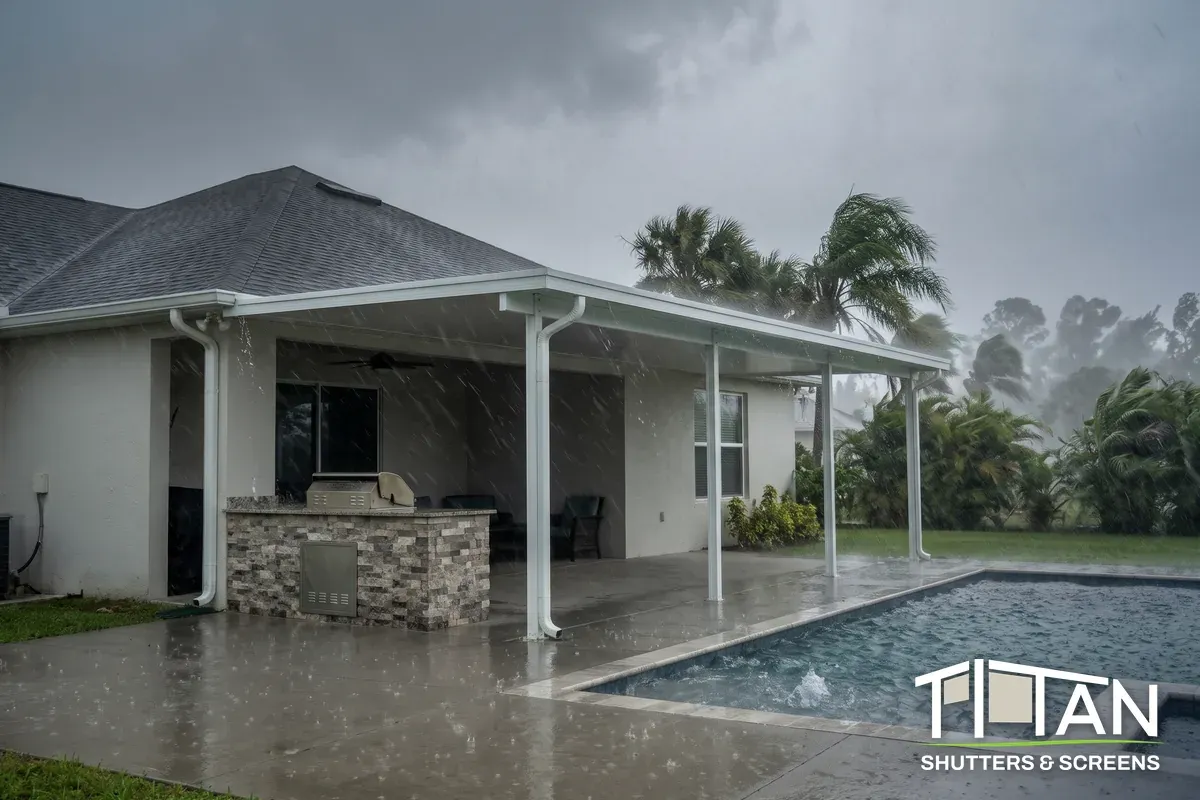
Why Does Rain Blow Under a Patio Cover or Through the Screens?
Wind-driven rain is rain that the wind gives a horizontal push, and in one full-scale test it entered through an open eave and a gable vent. In that test an open eave let in about 15 percent of the rain falling on the adjacent wall at 50 mph and a little over a third at 70 mph, and a gable vent let in nearly all of the rain that hit it. No source used here tests insect screens or patio-cover openings, so how much rain a screen or a cover lets through is not known from them.
This post is one of a series on the common causes of pergola and patio cover leaks, Water Finds a Way: The Pergola Leak Checklist.
What is wind-driven rain, and why does it get under a roof?
Wind-driven rain is rain that the wind gives a horizontal velocity component, according to a building-science review, so the drops arrive at an angle instead of straight down.
That definition comes from a 2004 review of wind-driven rain research, which calls it the most important moisture source for building facades. Drop size matters in testing: the test authors note that large drops ignore the airflow around a building because of their momentum, while tiny drops follow the flow and do not wet the surface.
How much rain got in during the full-scale test?
In the test, an open eave let in about 15 percent of the rain falling on the adjacent wall at 50 mph and a little over a third at 70 mph, and entry through the eave more than doubled between the two speeds.
The test was run by the Insurance Institute for Business and Home Safety (IBHS) and reported in Interface, March 2013. A full-scale duplex building was sprayed with simulated wind-driven rain at 8 inches an hour, a rate the authors take from ASTM E331-00, for 20 minutes at 30, 50 and 70 mph. The table below sets out the main results.
The authors call this a preliminary study. The openings were attic vents and an eave, on a test building, not a patio cover or a screen.
What does an attic test have to do with a patio cover?
Nothing in the test involved a patio cover, so the link is an analogy: the test shows that wind can drive rain into an opening, and that a larger open area lets in more.
The authors conclude that wind-driven rain will enter through open soffits and gable vents, and that the amount entering a vent depends on the size of the vent. They say more investigation is needed to quantify entry for normal construction. For how different kinds of outdoor structure handle wind and rain, see Titan’s post on what a fixed cover, a pergola and a screened structure handle in wind and rain.
Do screens stop wind-driven rain?
This article cannot say, because no source it uses tests insect screens or patio-cover openings, so it gives no percentage for screens.
The closest evidence located for this article is the attic and eave test above. A roof and a screen solve different problems on the same opening, as Titan’s post on a patio cover and a retractable screen explains.
What should I do if my patio is wet after a windy storm?
Photograph the wet areas with the date, the wind and the rain, note where the water seemed to come from, and ask the installer to check.
If the water was blown in during the storm, a useful record is the date, the wind direction if you know it, how hard it rained, and which side of the structure got wet.
What the sources do not settle
Five limits apply to everything above.
The IBHS test was a preliminary study of attic vents and an eave on a duplex test building. It did not test a patio cover or a screen.
The 8 inches an hour is the test’s chosen rate, taken from a window-testing standard. Real storms vary in both wind and rain.
No source used here tests insect screens, so this article gives no percentage for screens.
No source used here maps how often strong wind and heavy rain occur together in Florida.
This article does not describe any installer’s own findings, including Titan’s.
If your patio is wet after a windy storm
Photograph the wet areas and note the date, the wind and the rain, then contact Titan Shutters and Screens with the photos.
Sources
S. L. Quarles, T. M. Brown and A. D. Cope, Insurance Institute for Business and Home Safety. Water Entry Through Attic Vents. Interface (RCI), March 2013, pages 11 to 16. iibec.org
B. Blocken and J. Carmeliet. A Review of Wind-Driven Rain Research in Building Science. Journal of Wind Engineering and Industrial Aerodynamics 92(13), 2004. researchportal.hw.ac.uk
The image on this page is an AI-generated illustration.
