Do You Need a Patio Cover and a Retractable Screen, or Does One Make the Other Unnecessary?
Do You Need a Patio Cover and a Retractable Screen, or Does One Make the Other Unnecessary?
This series has looked at patio structures and screens as separate topics so far, comparing structure types, examining materials, explaining mechanisms. This post asks the question a lot of homeowners actually have once they've read all of that: do I need both, or does having one make the other redundant?
This is the sixth post in Built for Both Seasons, following the previous post on how a pergola's rain sensor works. It also connects directly to a post in Titan's other series, The Back-to-Back Season, comparing MaxForce to standard retractable screens, since a cover and a screen on the same opening are two products doing two different jobs at once.
What a cover alone does and doesn't solve
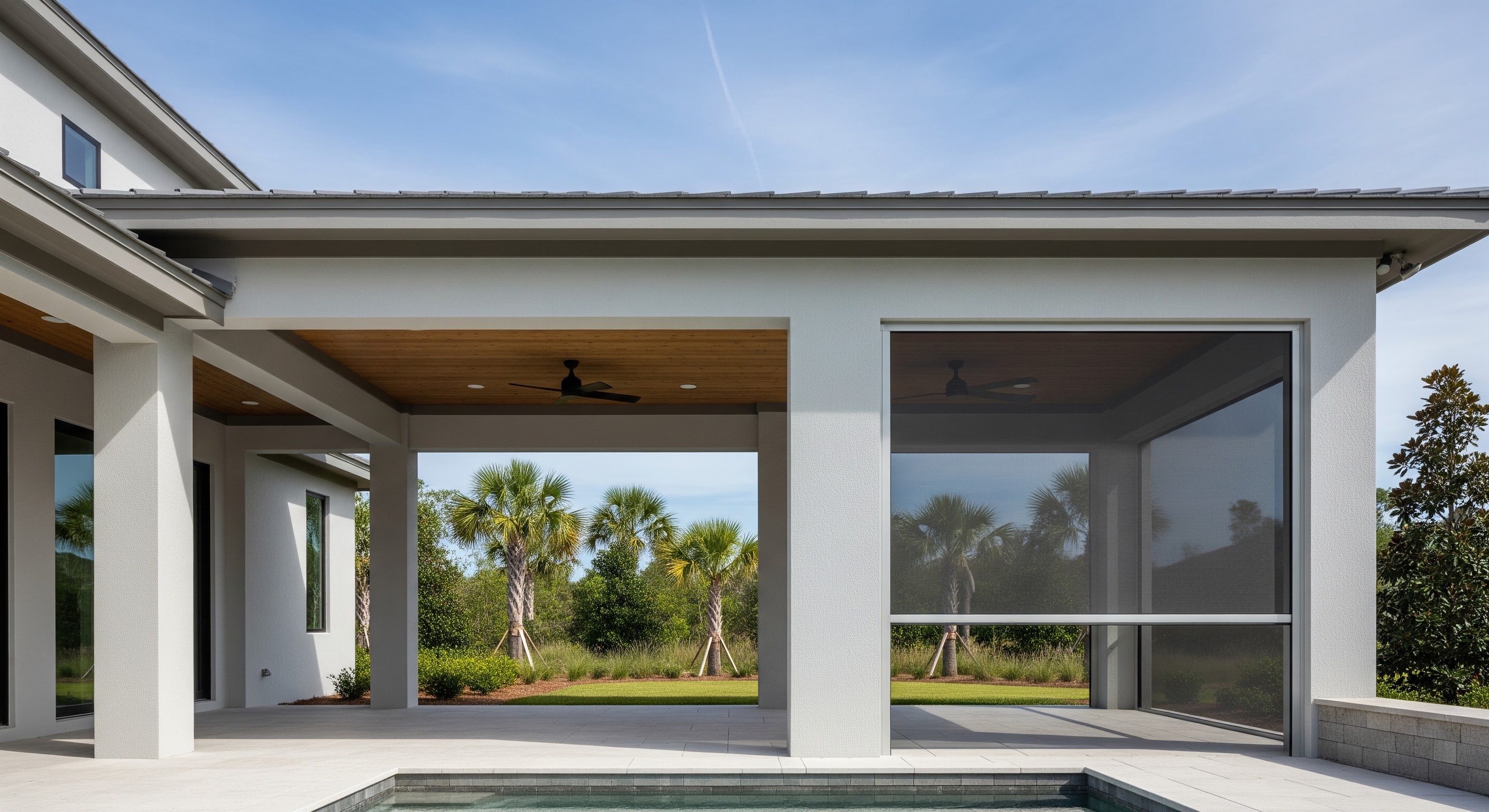
A fixed cover or pergola solves the overhead problem: direct sun and rain falling vertically. Per the U.S. Department of Energy, exterior shading that blocks solar radiation before it reaches a space is among the most effective methods for reducing cooling load, meaning a roof over a patio does real, measurable work against heat gain, not just visual shade. What a cover alone doesn't solve is the vertical opening at the sides. Wind-driven rain during a passing front, as discussed in an earlier post in this series, still reaches an open-sided patio regardless of how good the roof overhead is. Insects and direct low-angle sun, common at sunrise and sunset, also pass through an open side that a roof was never designed to address.
What a screen alone does and doesn't solve
A retractable screen solves the opposite problem: it addresses the vertical opening, blocking insects, wind-driven rain, and glare from the side, without doing anything about what falls from directly overhead. Screens like Titan's One-Track and MaxForce systems are built for spans up to 25 feet with L, U, or wraparound configurations, covering large openings efficiently, but a screen closed across an opening with no roof above it still leaves that opening exposed to direct sun and rain from above. A screen is a vertical solution, not a roof replacement, and treating it as one leaves the overhead problem completely unaddressed.
Where they're genuinely complementary versus redundant
The honest answer to whether you need both comes down to which opening, horizontal or vertical, your specific patio still has exposed. A patio with a solid roof and open sides has addressed the overhead problem but not the vertical one, adding a screen closes the remaining gap rather than duplicating anything the roof already does. A patio that already has both a roof and a screened perimeter has addressed both openings, and adding a second screen system or a second roof layer would genuinely be redundant. The two products aren't in competition with each other; they're each answering a question the other one doesn't ask.
A roof and a screen aren't competing for the same job. One handles what falls from above, the other handles what comes in sideways. Redundancy only happens when you've already solved both and add a third layer on top.
One boundary worth stating clearly: this post describes the general division of labor between a roof structure and a screen system, based on the U.S. Department of Energy's shading research and manufacturer span specifications. It is not a claim about every specific product combination or a substitute for evaluating an individual patio's actual layout, which determines which of the two openings, if either, still needs addressing.
Sources
U.S. Department of Energy. Exterior Shading and Cooling Load Reduction. energy.gov
Titan/Fenetex product specification, span and configuration capacity for One-Track and MaxForce systems.
