Fixed Cover, Pergola, or Screened Structure: What Each One Actually Handles in Wind and Rain
Fixed Cover, Pergola, or Screened Structure: What Each One Actually Handles in Wind and Rain
The first post in this series looked at the gap between choosing a patio structure for summer shade and what that structure actually has to survive across a full Northeast Florida year. This post gets specific: fixed covers, pergolas, and screened structures are often talked about as if they're interchangeable options for the same job. They aren't. Each one answers a different question about wind, rain, and light. And knowing which question each one answers is most of the decision.
This is the second post in Built for Both Seasons, following the first post on the summer-shade mistake.
Fixed cover — what it is, what it handles
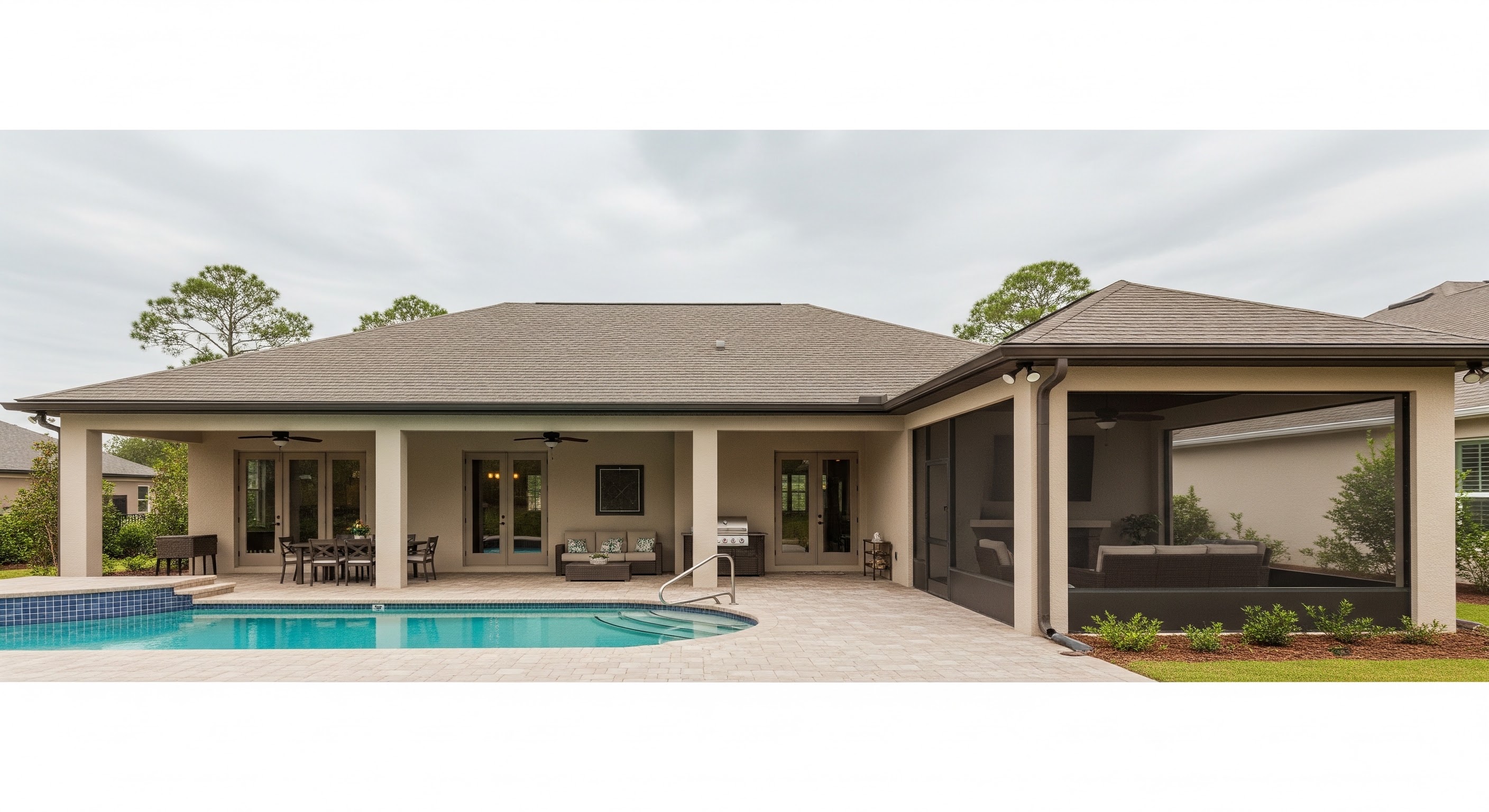
A fixed patio cover is a solid, permanent roof structure, typically aluminum, attached to the home. Its job is straightforward: block sun and rain from directly above, all the time, with no moving parts. That simplicity is also its limit. A fixed cover can't open up for more light on an overcast day, and depending on the design, it may leave the sides of the patio completely open. Rain falling straight down is fully blocked; rain driven sideways by wind, the kind common during Northeast Florida's cold-front passages, can still reach much of the space underneath.
Pergola — what it is, what it handles
A pergola ranges from a simple open lattice structure to a fully motorized system with adjustable louvers that rotate open or closed. The adjustable versions are the more relevant comparison here: closed, the louvers block sun and shed rain much like a fixed roof; open, they let light and air through on a mild day, which a fixed cover simply can't do. Some motorized pergola systems include a rain sensor that closes the louvers automatically when precipitation starts. What a pergola still doesn't solve on its own, open-louvered or closed, is the open sides — wind-driven rain at an angle, or a gusty afternoon, still reaches the space unless the pergola is paired with a screen or wall at the perimeter.
Screened structure — what it is, what it handles
A screened structure adds a physical barrier, fixed screen panels, or a motorized retractable screen — at the open sides of a patio, lanai, or pergola. This is the piece that actually addresses wind-driven rain and gusty conditions, rather than just what falls from directly overhead. A screen won't insulate against cold the way a wall would, and it isn't a substitute for a roof if there isn't one already in place. Its job is specifically the vertical opening, not the horizontal one. Paired with either a fixed cover or a pergola overhead, a screened perimeter is what closes the gap both of the other two structure types leave at the sides.
A roof stops what falls from above. A screen stops what comes in sideways. Most patios only have one of the two — which is usually the one that got chosen for a summer afternoon, not a windy front.
Where they overlap and where they don't
All three structure types are typically built from powder-coated aluminum in this region, chosen specifically because it resists the rusting and material breakdown that coastal humidity and salt air cause in untreated metal over time. That's a shared baseline, not a differentiator between them. Where they diverge is in what they cover: a fixed cover handles the horizontal opening only, a pergola handles the horizontal opening with the added option of adjusting it, and a screened structure handles the vertical opening that neither of the other two addresses on its own. The honest answer to "which one should I choose" usually isn't a single winner. It's whichever combination actually matches which of the two openings, horizontal or vertical, is the bigger problem for that specific patio.
One boundary worth stating directly: this comparison describes what each structure type mechanically does, based on how these systems are generally built and described in the industry. It isn't a claim that every fixed cover, pergola, or screen on the market performs identically — construction quality, installation, and specific product features vary. A later post in this series looks specifically at the aluminum construction and coastal-durability question in more depth.
Sources
This post describes structural mechanisms as they are generally built and marketed in the outdoor living industry, rather than citing a specific external data source. No government, climate, or statute claim appears in this post.
