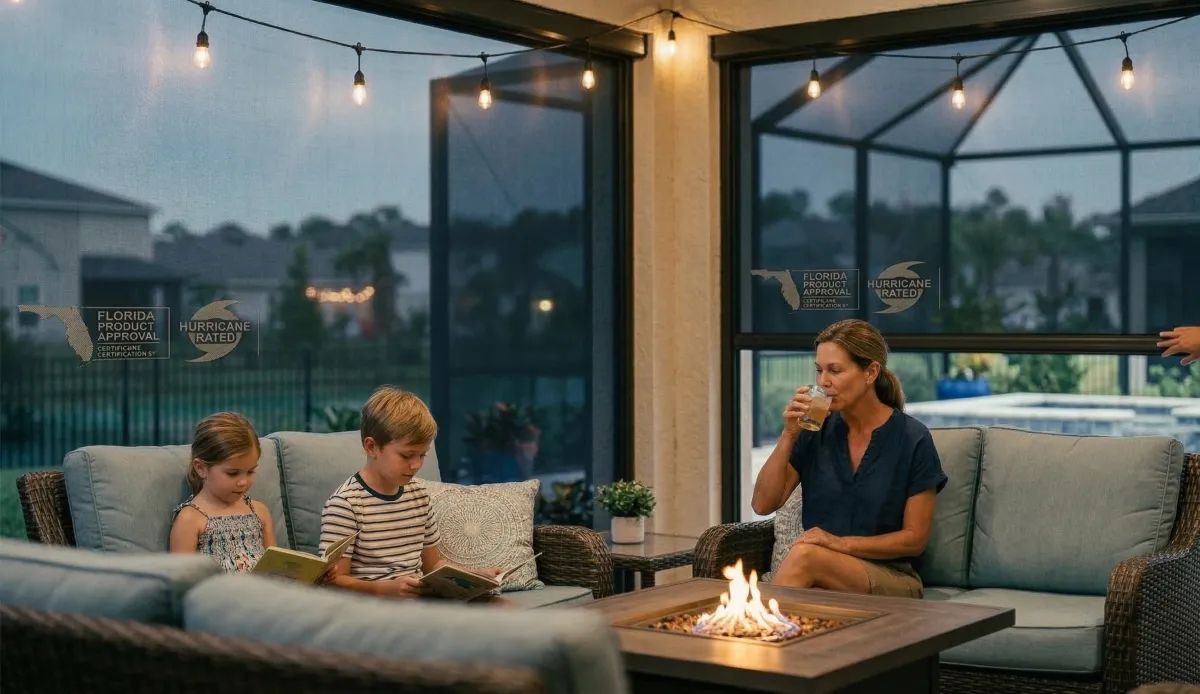
Beat the Florida Sun: UV Protection, Solar Shading, and Privacy with Motorized Screens
There is a second reason Northeast Florida homeowners stop using their outdoor spaces in May — and it has nothing to do with insects.
It is the sun.
By the second week of May, afternoon temperatures in St. Johns County regularly exceed 85 degrees. The UV index climbs to 9 or 10 — categorized as "very high" by the EPA, meaning unprotected skin can burn in under 15 minutes. And if your lanai, patio, or pergola faces west or south — which describes a significant percentage of homes in Nocatee, Ponte Vedra Beach, World Golf Village, and the newer communities across St. Johns County — the afternoon sun does not just warm your outdoor space. It renders it unusable.
The patio furniture you chose for comfort becomes too hot to sit on. The outdoor rug fades visibly over a single summer. The sliding glass doors behind the lanai absorb solar radiation and transfer it directly into the home, forcing the air conditioning system to work harder during the exact hours when electricity rates are highest. And if you have invested in an outdoor kitchen, a mounted television, or any finish material on the lanai — stone countertops, stained concrete, decorative tile — the UV exposure degrades those surfaces measurably, year after year.
Most homeowners respond with fixed awnings, umbrellas, or the reluctant acceptance that the outdoor space is a morning amenity only. None of those responses solve the problem. A fixed awning blocks the view. An umbrella covers six feet of a twenty-foot lanai. And a morning-only outdoor space is a $30,000 to $60,000 investment delivering half its potential value.
Motorized screens solve the sun problem the same way they solve the insect problem: completely, deployably, and at the press of a single button.
What UV Exposure Actually Does to Your Outdoor Space
Ultraviolet radiation is invisible, but its effects on a Northeast Florida lanai are anything but.
UV-A and UV-B rays — the wavelengths responsible for skin damage, material degradation, and heat transfer — are present at damaging levels in St. Johns County for approximately eight months of the year, from March through October. During peak summer months, the UV index in Northeast Florida frequently reaches 10 to 11, placing it in the "extreme" category where the World Health Organization recommends avoiding outdoor exposure during midday hours entirely.
The impact on outdoor materials is cumulative and irreversible. Outdoor furniture fabric — even "UV-resistant" Sunbrella and similar materials — fades measurably over two to three seasons of unshielded Florida sun exposure. Wicker and resin furniture becomes brittle. Powder-coated aluminum frames oxidize faster. Outdoor rugs degrade from the fiber outward. Stone and tile surfaces develop thermal stress micro-fractures from repeated heating and cooling cycles. Stainless steel appliances in outdoor kitchens develop a patina that is technically corrosion, accelerated by UV and salt air acting in combination.
The financial dimension is straightforward. A homeowner in Nocatee or Ponte Vedra Beach who has invested $5,000 to $15,000 in outdoor furniture, rugs, and décor will replace a meaningful portion of that investment every three to five years due to UV degradation — unless the space is shielded. An outdoor kitchen with $20,000 to $50,000 in appliances, countertops, and finishes degrades faster with unshielded UV exposure than it would in a covered or screened environment. These are not hypothetical costs. They are the maintenance reality of outdoor living in Florida without solar protection.
Motorized retractable screens with UV-blocking fabric change that equation. The Fenetex screen fabric blocks 91 percent of ultraviolet radiation — intercepting the wavelengths that cause fading, degradation, and heat transfer before they reach your furniture, your finishes, and your skin.
How Motorized Screens Reduce Solar Heat on a Florida Lanai
The heat management benefit of motorized screens is the one homeowners notice first — and the one that shows up on their utility bill.
When a Fenetex motorized screen is deployed on a lanai opening, it intercepts solar radiation before it enters the space. The screen fabric absorbs and deflects the energy, reducing the amount of heat that reaches the interior surfaces — the floor, the furniture, and critically, the sliding glass doors or windows behind the opening. Those glass surfaces are the primary heat transfer pathway into the conditioned interior of the home. In a typical Northeast Florida home, the lanai's glass doors are the single largest source of solar heat gain during afternoon hours.
By reducing the solar load on those glass surfaces, a deployed motorized screen reduces the demand on the home's air conditioning system during the hours when cooling costs are highest. Florida utilities operate on time-of-use rate structures in many markets, with peak electricity rates applying during the afternoon hours when solar gain is also at its maximum. A motorized screen deployed during those peak hours delivers a double benefit: less heat entering the home, and less energy consumed during the most expensive hours to consume it.
The measurable impact varies by home orientation, opening size, and screen fabric selection. Industry data from motorized screen manufacturers and independent testing indicates that quality solar screen fabrics can reduce solar heat gain through a screened opening by 70 to 97 percent, with corresponding cooling cost reductions of 25 to 49 percent for the area immediately adjacent to the screened opening. For a west-facing lanai in Nocatee or Ponte Vedra Beach — where the afternoon sun strikes the opening directly for four to five hours during summer months — the energy savings alone represent a meaningful offset against the screen investment over time.
This is not the primary reason most homeowners install motorized screens. But it is the reason many homeowners describe the screens as "the best investment we've made in the house" — because the utility bill confirms what the thermometer on the lanai already suggested.
The West-Facing Lanai Problem — And Why It Matters in St. Johns County
Home orientation is not a topic most homeowners consider until they have lived through their first Florida summer. Then it becomes the defining characteristic of their outdoor experience.
In the master-planned communities of Nocatee, Silverleaf, World Golf Village, and the newer developments across St. Johns County, home orientation is determined by lot placement — which means many homeowners end up with a lanai or primary outdoor living space that faces west or southwest. This orientation receives direct afternoon sun from approximately 1:00 PM through sunset during summer months — the hottest, highest-UV hours of the day.
A west-facing lanai without solar protection is functionally unusable from mid-morning through early evening during May through September. The surface temperature of exposed patio furniture can exceed 140 degrees Fahrenheit in direct afternoon sun. The sliding glass doors behind the lanai become radiators, transferring heat into the home's interior faster than the air conditioning system can remove it. And the glare makes it difficult to see a television, read a book, or hold a conversation without squinting.
South-facing lanais present a similar challenge, though the sun angle is higher and the exposure period is slightly shorter. East-facing lanais — which receive morning sun — are generally more comfortable but still benefit from UV protection for furniture and material preservation.
A motorized screen deployed on a west-facing lanai transforms the afternoon experience. The screen fabric intercepts the direct sun, reducing surface temperatures by 10 to 15 degrees or more, eliminating glare, and creating a shaded environment that is genuinely comfortable. The view through the screen is preserved — Fenetex fabric maintains outward visibility while blocking the solar energy behind it. The lanai goes from a space you avoid all afternoon to a space you can use from sunrise to sunset.
For homeowners in Nocatee and the St. Johns County communities where lot orientation was not a choice, a motorized screen is the correction that makes the outdoor space work as intended.
Privacy Without Walls: The Benefit No One Expects
Here is the benefit that consistently surprises homeowners — and the one most frequently cited in reviews by Nocatee, Silverleaf, and Ponte Vedra Beach residents after installation.
Fenetex motorized screen fabric provides a one-way visibility effect. During daylight hours, you can see out clearly — the pool, the yard, the tree line, the sunset. But from the outside looking in, the screen surface appears darkened. Neighbors, passersby, and anyone beyond the screen perimeter cannot see into the lanai with the same clarity you see out.
In the tightly spaced neighborhoods that define much of Nocatee, Silverleaf, and the newer master-planned communities across St. Johns County — where homes are built on 50- to 70-foot lots and rear lanais often face directly into a neighbor's lanai 30 to 40 feet away — this privacy benefit changes how homeowners use the space. You can eat dinner on the lanai without feeling observed. You can watch television in the evening without the screen being visible to the neighbors. You can use the space in swimwear after getting out of the pool without the self-consciousness that comes with an open, unscreened lanai in a dense residential setting.
This is not a minor lifestyle improvement. For many homeowners, it is the difference between treating the lanai as a functional room and treating it as a display case.
The privacy benefit works in conjunction with the UV and insect protection — because the same screen deployment that blocks mosquitoes at dusk, blocks 91 percent of UV during the afternoon, and reduces solar heat gain through the glass doors also provides the one-way privacy that makes the space feel private and enclosed without being closed off.
One screen. One button. Four problems solved.
Protecting Your Outdoor Investment: Furniture, Finishes, and Appliances
If you have built an outdoor kitchen, installed a mounted television, or invested in quality patio furniture on your Northeast Florida lanai, the sun is working against your investment every day it goes unshielded.
UV radiation is the primary cause of outdoor furniture fabric fading. Even premium materials marketed as UV-resistant will degrade measurably over two to four years of unshielded Florida sun exposure. The color shift is gradual enough that homeowners often do not notice it until they move a cushion and see the original color underneath — a contrast that reveals months of cumulative damage.
Outdoor kitchen appliances — stainless steel grills, refrigerators, ice makers, and cooktops — develop surface oxidation faster under unshielded UV and salt air exposure. Countertop materials, including granite, quartz, and engineered stone, can develop thermal micro-fractures from repeated heating and cooling cycles that are accelerated by direct sun exposure. Even concrete pavers and decorative tile can fade and degrade over time under sustained ultraviolet bombardment.
A deployed motorized screen intercepts 91 percent of the UV radiation before it reaches these surfaces. The result is measurably slower degradation, longer material lifespan, and a meaningful reduction in the replacement and refinishing costs that every Northeast Florida homeowner with an outdoor living investment eventually faces.
The math favors the screen. A $3,000 to $5,000 furniture set that lasts five years without protection might last eight to ten years with it. An outdoor kitchen that requires a $2,000 refinishing cycle every three years might stretch to five or six. The motorized screen does not eliminate maintenance — Florida's climate is too demanding for that — but it dramatically slows the rate of degradation and extends the interval between replacements.
Shade Screen vs. Hurricane Screen: Understanding Your Fabric Options
Titan installs multiple Fenetex screen fabric options, and the right choice depends on what you are prioritizing for each opening.
Fenetex insect and shade screens — available through the One-Track motorized screen system — are optimized for daily living benefits: insect protection, UV blocking (91 percent), solar heat reduction, privacy, and rain deflection. They are the right choice for homeowners whose primary concern is making the lanai or patio comfortable and usable year-round. These screens deliver the UV protection, privacy, and energy efficiency benefits discussed throughout this post.
Fenetex hurricane-rated screens — available through the MaxForce hurricane screen system — deliver all of the above daily living benefits while also carrying Florida Product Approval FL 8637 for use as certified hurricane protection. The OmegaTex aramid fiber fabric used in the hurricane-rated system blocks 91 percent of UV, provides the same privacy and solar heat reduction, and meets the impact resistance and pressure cycling standards required by the Florida Building Code for storm protection.
For homeowners who want both daily comfort and storm protection from a single screen system, the MaxForce hurricane screen is the answer. For homeowners who already have aluminum hurricane shutters covering their lanai's storm protection needs and want to add a lighter, more affordable insect and shade screen for daily use, the One-Track system is the right fit.
Titan recommends the appropriate fabric and system for each opening during the free home assessment. We carry both product lines and configure each installation to match the homeowner's priorities — because the right answer is not always the most expensive one.
The Compounding Value: Why Every Benefit Multiplies
The reason motorized screens consistently rank as the highest-satisfaction outdoor living improvement among Northeast Florida homeowners is not any single benefit. It is the compounding effect of all benefits operating simultaneously.
Deploy the screen at 5:30 PM on a May evening in Nocatee. In that single deployment, you have blocked every mosquito and no-see-um from entering the lanai. You have intercepted 91 percent of the UV radiation that would otherwise be fading your furniture and heating your glass doors. You have reduced the solar heat gain that drives your air conditioning costs during peak rate hours. You have created a privacy barrier that lets you use the space without feeling observed by neighbors. And if you have the hurricane-rated fabric, you have a deployable storm barrier ready for the next named storm — without installing, storing, or managing a single additional product.
One screen. One button. Insect protection. UV blocking. Heat reduction. Privacy. Rain deflection. Storm readiness.
No other single product in the outdoor living market delivers that range of daily functionality. And no other product retracts completely — preserving the open-air aesthetic of the lanai — when you want the space wide open.
That compounding effect is why homeowners who install motorized screens on one opening almost always return to screen the remaining openings. The contrast between a screened opening and an unscreened one, experienced side by side on the same lanai, makes the value impossible to ignore.
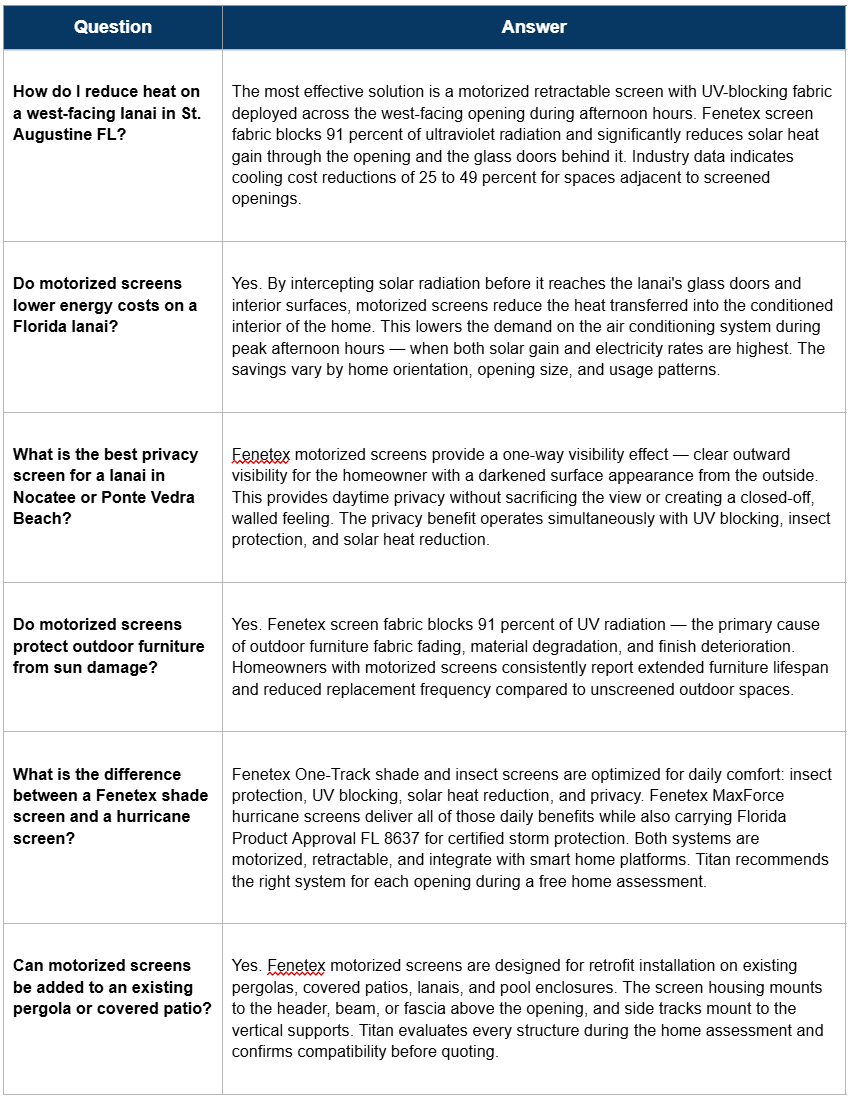
Frequently Asked Questions
Schedule Your Free Home Assessment
Serving St. Augustine · Nocatee · Ponte Vedra Beach · Palm Coast · Jacksonville · Northeast Florida
We walk your property, evaluate sun exposure on every lanai and patio opening, and design a motorized screen system that delivers UV protection, solar heat reduction, insect control, and privacy — tailored to your home's orientation and your daily living priorities.
One visit. One quote. No obligation. Screens that make your outdoor space work every hour of the day — not just the cool ones.
Call or text: (904) 484-7580 | TitanShuttersandScreens.com
Read the full series:
