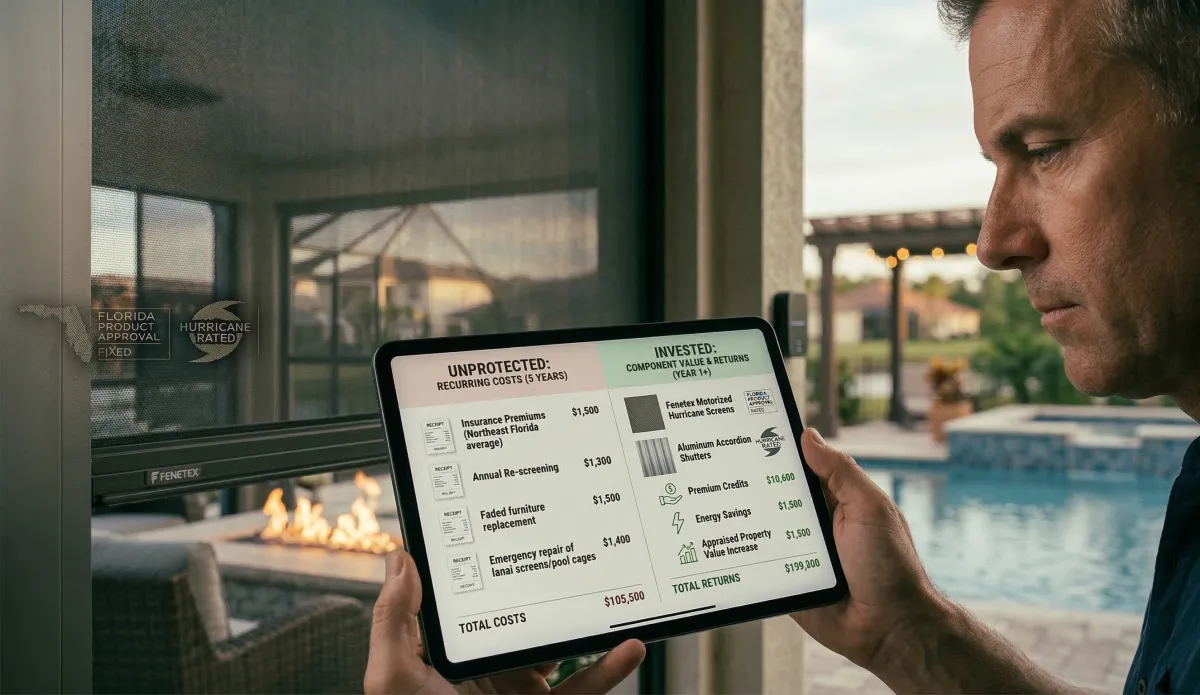
What's the Real ROI of Motorized Screens and Hurricane Shutters? Home Value, Insurance, and the True Cost of Doing Nothing
Every homeowner evaluating storm protection and outdoor living improvements eventually arrives at the same question: what does this cost?
It is the right question. But it is incomplete.
The complete question is: what does this cost — and what does not having it cost? Because in the Northeast Florida market, doing nothing is not free. It carries its own recurring price tag — one that most homeowners have never calculated because the costs arrive in small, separate increments rather than a single invoice.
This post presents the full financial picture. Not just the investment in motorized screens and aluminum hurricane shutters. The return those products generate — through insurance savings, eliminated recurring costs, extended material lifespan, energy reduction, and increased property value. And the cost of inaction — the money a homeowner in St. Augustine, Nocatee, or Ponte Vedra Beach pays, year after year, by choosing to wait.
The math favors acting. Here is why.
Return Stream 1: Insurance Premium Reduction Under Florida Statute 627.0629
This is the most immediate, most quantifiable, and most underutilized financial return available to Northeast Florida homeowners.
Florida Statute 627.0629 requires every insurance carrier in the state to offer premium discounts for verified wind mitigation features. Aluminum hurricane shutters — roll-down, accordion, Bahama, and colonial — qualify. Hurricane-rated Fenetex MaxForce motorized screens, which carry Florida Product Approval FL 8637, qualify. The qualification is documented through a wind mitigation inspection — a licensed inspector completes the standard OIR-B1-1802 form, evaluates every exterior opening on the home, and submits the report to your insurance carrier.
The carrier is then required by law to apply the corresponding insurance discount.
The discount applies to the windstorm portion of your homeowner's insurance premium — which in St. Johns County typically represents 30 to 50 percent of the total premium. The discount on that windstorm portion commonly ranges from 10 to 40 percent, depending on the scope of protection documented on the OIR-B1-1802 form. A home with verified opening protection on all exterior openings — shutters on windows and doors, hurricane-rated screens on the lanai and patio — qualifies for the maximum opening protection credit.
What this looks like in real numbers for a St. Johns County homeowner:
Consider a home in Nocatee or Ponte Vedra Beach carrying an annual homeowner's insurance premium of $5,000 to $8,000 — which is within the normal range for St. Johns County properties valued at $400,000 to $700,000. The windstorm portion of that premium is approximately $2,000 to $4,000. A 20 to 30 percent discount on the windstorm portion translates to an annual savings of $400 to $1,200.
Over five years: $2,000 to $6,000 in cumulative savings. Over ten years: $4,000 to $12,000. Over the typical 15-to-20-year ownership period of a St. Johns County home: $6,000 to $24,000.
The wind mitigation inspection itself costs approximately $75 to $150 — an investment that typically pays for itself within the first year of premium reduction. The inspection report is valid for five years before renewal is required.
This return stream begins the year of installation and compounds every year the protection is in place. It requires no additional action from the homeowner beyond the initial inspection.
Return Stream 2: Eliminated Rescreening and Storm Damage Costs
This is the return stream that homeowners with traditional fixed screen enclosures understand viscerally — because they have already paid it.
A standard fixed screen enclosure in Northeast Florida carries zero hurricane rating. Before a major storm, most contractors advise cutting the mesh to save the aluminum frame from the structural stress of mesh acting as a sail in high winds. After the storm, the enclosure is rescreened. That cycle costs $2,000 to $8,000 per event, depending on the size of the enclosure and the extent of frame damage.
Over a 20-year period in a hurricane-active market like Northeast Florida, a homeowner with a fixed screen enclosure can reasonably expect two to four significant storm events that require rescreening. That represents $4,000 to $32,000 in cumulative rescreening costs — for a structure that provides no certified storm protection.
A hurricane-rated Fenetex motorized screen retracts before a storm and deploys after. The fabric is protected inside a sealed housing. There is no rescreening cycle. There is no structural stress on a non-rated frame. The recurring cost that every fixed screen enclosure owner accepts as normal is eliminated entirely.
For homeowners who do not currently have a screen enclosure and are evaluating whether to build one or install motorized screens, this comparison is especially instructive. The fixed enclosure may carry a lower upfront cost — but it also carries a lifetime of recurring rescreening expenses, UV-degraded mesh replacement every five to eight years, and zero hurricane protection. The motorized screen carries a higher upfront cost but eliminates every one of those recurring expenses.
Return Stream 3: Extended Furniture, Appliance, and Material Lifespan
UV radiation is the primary driver of outdoor material degradation in Florida. Every outdoor surface that is exposed to unshielded sun — furniture fabric, wicker, resin, powder-coated metal, stone countertops, stainless steel appliances, decorative tile, outdoor rugs — degrades measurably faster than the same surface in a shielded environment.
Fenetex screen fabric blocks 91 percent of ultraviolet radiation. For a homeowner with a $5,000 to $15,000 investment in outdoor furniture, rugs, and décor, the UV protection extends the usable lifespan of those materials by an estimated 40 to 60 percent — meaning furniture that would require replacement in three to four years under unshielded Florida sun exposure may last five to seven years with screen protection.
For outdoor kitchens — where the appliance and countertop investment typically ranges from $15,000 to $50,000 — the UV and weather protection provided by deployed motorized screens reduces the rate of oxidation on stainless steel surfaces, the thermal stress on stone and engineered countertops, and the degradation of seals, gaskets, and electrical connections that leads to service calls and premature replacement.
The savings here are cumulative and indirect — they do not arrive as a line item on a bill. They arrive as furniture you do not replace this year, appliances that do not require a service call, and countertops that hold their finish for an additional two to three years before refinishing.
Over a decade, a conservative estimate of avoided replacement and maintenance costs for a typical Nocatee or Ponte Vedra Beach outdoor living space with $20,000 to $50,000 in total investment: $3,000 to $10,000.
Return Stream 4: Energy Savings from Solar Heat Reduction
Deployed motorized screens reduce solar heat gain through lanai glass doors and adjacent windows by 70 to 97 percent, depending on the screen fabric density and the orientation of the opening. For west- and south-facing lanais — which receive the most intense afternoon sun during Florida's eight-month warm season — this translates to a measurable reduction in air conditioning demand during peak-rate hours.
Industry data from motorized screen manufacturers and independent testing indicates cooling cost reductions of 25 to 49 percent for spaces immediately adjacent to screened openings. For a St. Johns County homeowner spending $200 to $400 per month on electricity during summer months, even a 10 to 15 percent reduction in total cooling costs represents $240 to $720 in annual savings.
Over a decade: $2,400 to $7,200.
These savings are most significant for homes with large, west-facing lanai openings — a common configuration in Nocatee, Silverleaf, World Golf Village, and the newer master-planned communities across St. Johns County where lot orientation is determined by the development plan rather than the homeowner's preference.
Return Stream 5: Increased Property Value and Resale Positioning
The value contribution of functional outdoor living improvements in the St. Johns County real estate market is real — though it is the most difficult return stream to quantify precisely.
What is clear: homes with move-in-ready, screened outdoor living spaces sell faster and command higher prices than comparable homes with unscreened or seasonal-only outdoor spaces. Real estate professionals in Nocatee and Ponte Vedra Beach consistently report that functional outdoor living — including motorized screens, outdoor kitchens, and pergola systems — is among the most commented-on features during showings and the most frequently cited reason buyers select one property over a comparable alternative.
The wind mitigation inspection report — the OIR-B1-1802 — is increasingly included in competitive listing packages in the St. Johns County market. It documents the home's storm protection features, signals lower insurance costs to the buyer, and differentiates the property from comparable listings that lack verified protection.
A motorized screen system that is already installed, fully configured with smart home integration, and accompanied by a current wind mitigation report represents a move-in-ready upgrade that the buyer does not have to schedule, wait for, or pay for after closing. That turnkey readiness carries real value in a market where buyers are willing to pay a premium for homes that are finished, protected, and livable on day one.
The Cost of Doing Nothing: A 10-Year Calculation
Here is the calculation most homeowners never make — because the costs of inaction arrive in small, separate increments rather than a single number.
For a St. Johns County homeowner who does not install hurricane shutters and motorized screens over a 10-year period:
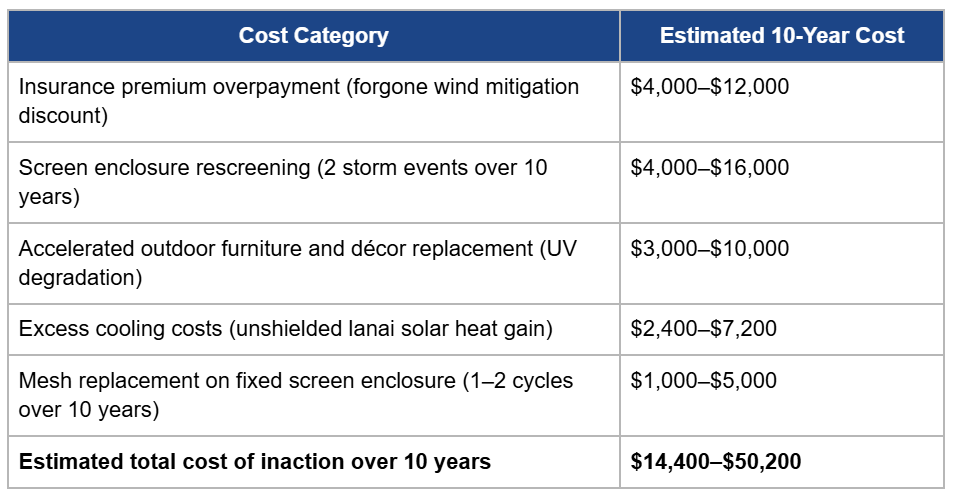
These are conservative ranges based on documented costs in the Northeast Florida market. The actual cost for any individual homeowner depends on their specific insurance premium, the size of their screen enclosure, the value of their outdoor furnishings, their home's orientation, and the number of storm events that require rescreening during the period.
The point is not the precision of any single line item. The point is the aggregate. The homeowner who chooses to wait is not saving the cost of the shutters and screens. They are paying a different set of costs — recurring, compounding, and largely invisible until you add them up.
The Investment vs. the Return: How the Math Works
The combined investment in a complete storm protection and outdoor living system — aluminum hurricane shutters on windows and doors, Fenetex motorized screens on the lanai and patio, smart home integration, and a wind mitigation inspection — varies by home size, number of openings, and product selection. Titan provides exact quotes based on on-site measurements, not ranges.
What the return calculation demonstrates is that the five return streams — insurance savings, eliminated rescreening, extended material lifespan, energy reduction, and property value positioning — compound over time to offset a meaningful percentage of the original investment. In many cases, the 10-year cumulative return equals or exceeds the installation cost.
The shutters protect the home. The screens create the room. The insurance discount starts paying back immediately. The eliminated rescreening costs prevent the largest single recurring expense. The UV protection extends the life of every outdoor material. The energy savings reduce the monthly utility bill. And the property value premium positions the home competitively when it is time to sell.
No other home improvement delivers this many simultaneous return streams. And no other home improvement delivers daily functional value — a lanai you use every evening, a patio that works in every condition, an outdoor kitchen that is protected and accessible twelve months a year — on top of the financial return.
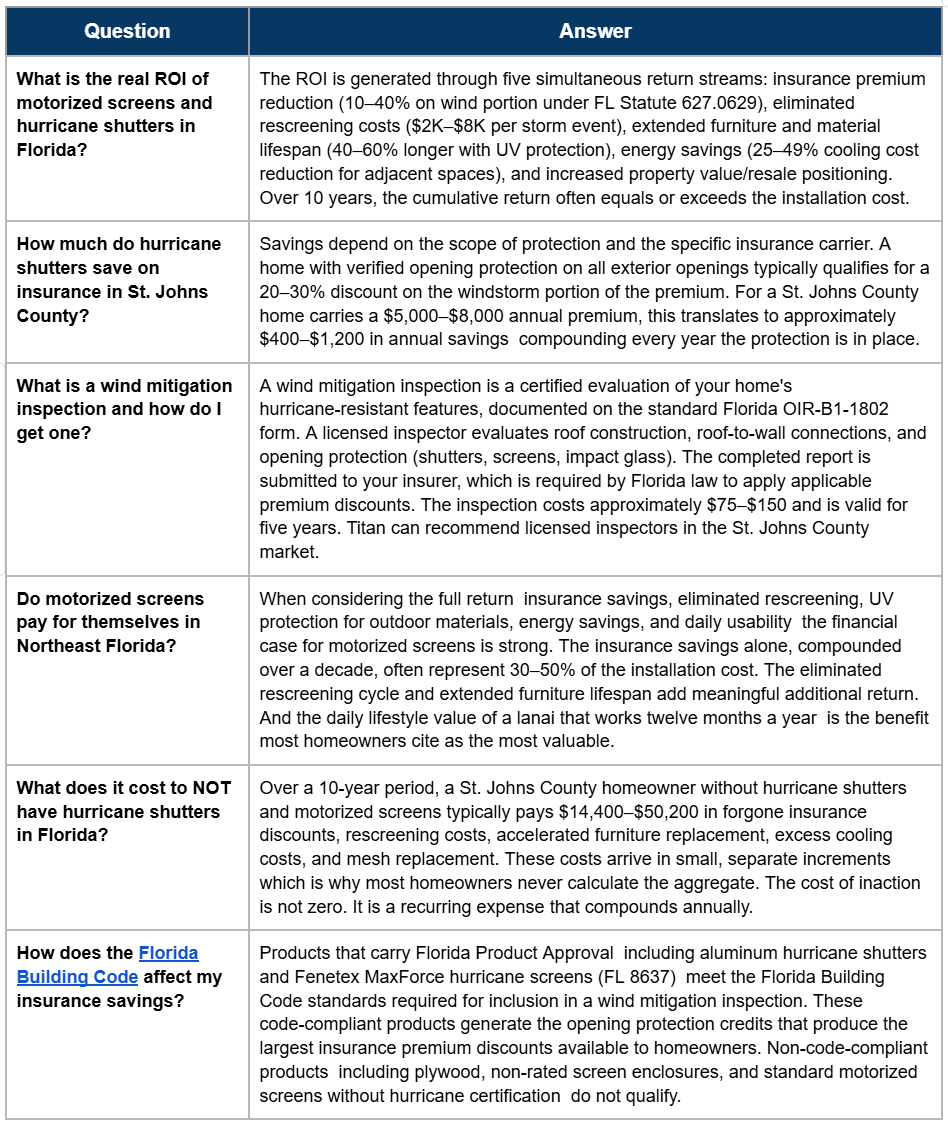
Frequently Asked Questions
Schedule Your Free Home Assessment
Serving St. Augustine · Nocatee · Ponte Vedra Beach · Palm Coast · Jacksonville · Northeast Florida
The investment pays for itself. The insurance savings start immediately. The rescreening costs disappear. The furniture lasts longer. The energy bill drops. And the lanai works every day, every month, every season.
We walk your property, measure every opening, and provide a detailed quote — alongside a clear picture of the return streams your specific home qualifies for. No cost. No obligation. Just the information you need to make a financially informed decision.
Call or text: (904) 484-7580 | TitanShuttersandScreens.com
Read the full series:
