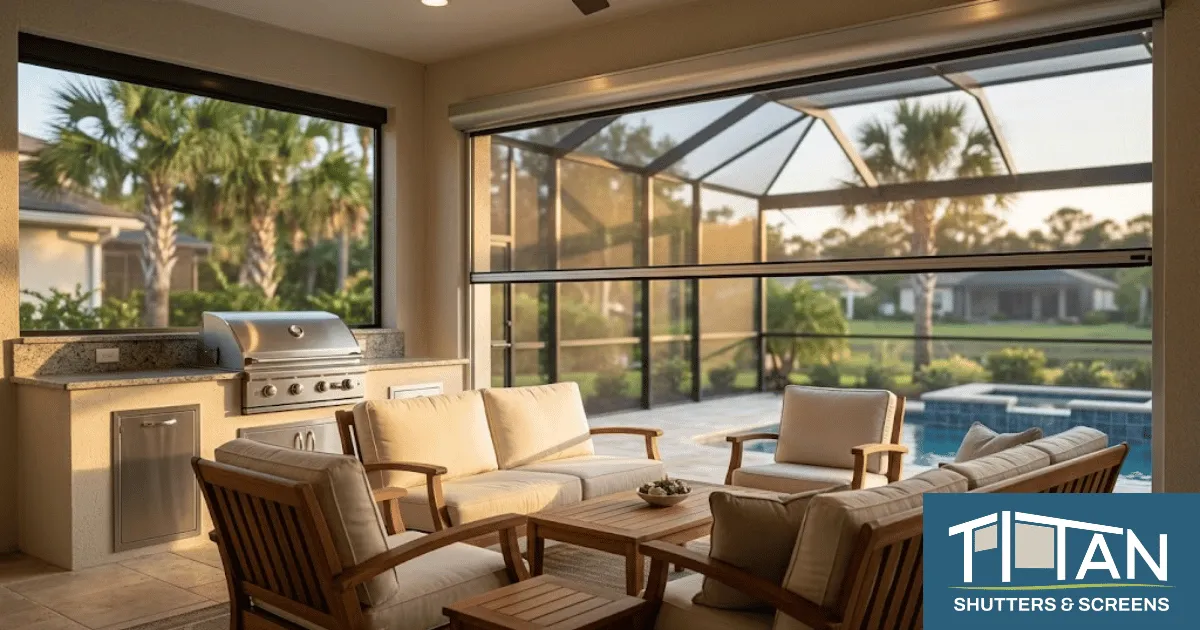
Patio & Lanai Hurricane Protection in Northeast Florida
Smart Tips for Patio & Lanai Hurricane Protection — What Northeast Florida Homeowners Get Wrong
It is late May along the First Coast.
The afternoons have grown heavier. The azaleas have finished. The Atlantic has begun to shift in the way Northeast Florida residents have learned to recognize — that slow, charged stillness that arrives before hurricane season. Homeowners across St. Augustine, Nocatee, and Ponte Vedra Beach walk their lanais in the early evening, coffee in hand, looking at outdoor kitchens that cost more than some cars and pool cages they have stopped noticing until they remember what happens when the wind arrives.
The quiet thought every Northeast Florida homeowner has in late May is the same: "Are we ready this year?"
Most are not. Not because they have not thought about it, but because most homeowners think about hurricane preparation the way the news stations talk about it — shutters on the windows, water in the pantry, batteries in the drawer. That picture is incomplete. The most expensive part of a Northeast Florida home is rarely behind the windows. It is what the homeowner walks past every morning on the way to the back door. This is the article most Northeast Florida homeowners do not read until after their first claim. Read it before.
The Short Answer
What is the smartest way to protect a Northeast Florida patio and lanai from hurricanes?
Your lanai and covered patio are the single most expensive hurricane vulnerability on your property — and the most commonly underestimated. Outdoor kitchens, pool cages, lanai furniture, and screen enclosures represent tens of thousands of dollars in exposure that traditional hurricane shutters were never designed to cover. The right protection combines structural aluminum shutters on windows and doors with motorized hurricane screens on large outdoor openings. The Fenetex MaxForce system, Florida Product Approval FL 8637R11, is rated to 185 MPH high-velocity hurricane zone wind loads and qualifies for the 10–30 percent insurance discount under Florida Statute §627.0629. With June 1 less than two weeks away, the time to act is now — not when a storm is named on the news.
The Patio You Are Walking Past Every Morning
Walk through any home in Nocatee, World Golf Village, Silverleaf, Ponte Vedra Beach, or the established neighborhoods of St. Augustine and the picture is the same. An outdoor kitchen built into the lanai with stainless appliances, a vented hood, granite or quartz counters, a 36-inch grill, an under-counter refrigerator. A pool cage that was thirty thousand dollars when the home was built. A pergola, often. Outdoor furniture that runs three to eight thousand dollars per seating set. Televisions mounted under the lanai ceiling. Speakers. Lighting. A built-in icemaker.
The average fully equipped Northeast Florida lanai represents between fifteen thousand and fifty thousand dollars in outdoor investment. For homes in the higher-end communities, the number can exceed seventy-five thousand dollars when the pool cage and pergola are included. This is the part of the home homeowners use every day, the part that turns a house into the lifestyle they bought it for, the part where the family actually lives most months of the year.
And it is the part that traditional hurricane shutters were never designed to cover.
Aluminum shutters protect glass openings. They are engineered for windows and doors. They are tested to the Florida Building Code for wind-borne debris and design pressure. They do their job well. What they do not do — what they were never built to do — is protect a thirty-foot lanai opening, a screened pool cage, an outdoor kitchen, or a pergola roof. Those openings require a different category of protection entirely.
This is the gap that costs Northeast Florida homeowners millions of dollars in cumulative claims every hurricane season. It is also the most preventable category of damage on a residential property.
What Matthew and Milton Taught Northeast Florida About Lanais
Hurricane Matthew came ashore in October 2016 as a Category 1 by the time it reached the First Coast. The news cycle treated it as the storm Northeast Florida dodged. The insurance claims told a different story. Ponte Vedra Beach saw pool cage collapses on streets where homeowners had never lost a single window. Across St. Johns County, lanai screening was torn from frames, outdoor kitchens were stripped of appliances, and pergola roofs were sent into neighboring yards. Eight years later, the structural repairs from Matthew were still showing up in real estate inspections in the communities along A1A.
Hurricane Milton struck Flagler County in October 2024. The reported damage in Flagler alone reached approximately $18.8 million according to county emergency management assessments, with outdoor structures and pool enclosures hit the hardest. Communities like Flagler Beach and Palm Coast saw the same pattern Ponte Vedra had seen in 2016 — homes whose interiors were untouched and whose lanais were destroyed. In Summerhaven and the southern stretch of St. Johns County, homeowners who had invested in shutters watched the wind take everything that was not behind one.
Northeast Florida homeowners do not need a lecture on abstract hurricane risk. They have lived it. Twice in nine years. And the pattern is consistent: the interior of the home holds. The outdoor investment does not.
Most homeowners learn this lesson once. The smart ones learn it from the neighbor's claim, not from their own.
St. Johns County Emergency Management
"Now is an excellent time to go ahead and get those preparations underway." That advice applies in May. By June 1, it may already be too late to act.
Two Lines of Defense for Your Patio
Comprehensive patio and lanai protection in Northeast Florida runs on two complementary technologies. Neither replaces the other. Each is engineered for a category of opening the other cannot cover. Homeowners who understand this protect their property correctly the first time. Homeowners who do not learn the difference after their first claim.
Aluminum hurricane shutters: the foundation
AHT (Advanced Hurricane Technology) aluminum shutters are the structural foundation of any properly protected Northeast Florida home. They cover windows, sliding glass doors, French doors, garage doors, and any other glass opening. They come in four configurations — accordion, roll-down, hurricane panel, and Bahama — and each fits a specific application. Accordions live in permanent housings beside the window and unfold across the opening when needed. Roll-downs deploy vertically from an overhead housing at the touch of a button or a manual crank. Hurricane panels are storm-only protection installed before the storm and removed afterward. Bahama shutters provide year-round shade and storm protection in the historic St. Augustine and Ponte Vedra Beach architectural style.
All four categories qualify for the opening protection credit under Florida Statute §627.0629 when properly installed and documented on the OIR-B1-1802 wind mitigation form. That statute requires insurance carriers to offer a premium reduction of 10 to 30 percent on the wind and hurricane portion of the homeowner's premium for opening protection that meets the Florida Building Code wind mitigation standards. On a typical Northeast Florida home, that discount alone can exceed the cost of the shutters over a 10 to 15 year window.
Lead time for aluminum hurricane shutters in Northeast Florida runs 60 to 90 days from order to installed. May orders placed today may not be installed before June 1. June orders may not be installed before peak season. This is not a sales tactic. It is the calendar of custom manufacturing.
Motorized hurricane screens: the complement that changes daily life
Motorized hurricane screens cover what aluminum shutters cannot — the large outdoor openings on lanais, covered patios, pergola integrations, and pool cage perimeters. The Fenetex MaxForce system, which Titan has installed across Northeast Florida for over a decade, carries Florida Product Approval FL 8637R11, is rated to 185 MPH high-velocity hurricane zone (HVHZ) wind loads, and is tested to the toughest standards in the United States. The fabric is Twitchell's OmegaTex, an aramid-fiber reinforced material that blocks up to 95 percent of damaging UV rays while resisting wind-borne debris at design pressures up to plus or minus 200 PSF.
Unlike shutters, motorized hurricane screens are not single-purpose. The same screen that locks down the lanai before a hurricane operates every evening to provide privacy, bug protection, solar gain reduction, and dust control. It is the rare hurricane product that earns its keep 365 days a year. For homes in Nocatee and Ponte Vedra Beach where outdoor living is the entire reason the home was bought, this matters.
The MaxForce system also qualifies for the same Florida Statute §627.0629 insurance discount when documented as opening protection. It is engineered for spans up to 25 feet, integrates with smart home systems including Alexa and Google Home through the Bond Bridge Pro hub, and is backed by Fenetex's lifetime manufacturer warranty. Installation is performed by certified Fenetex dealers only — Titan Shutters and Screens has held certification for over a decade.
One more thing worth knowing:Florida HB 293, which passed in 2024, removed the authority of homeowner associations to block the installation of hurricane protection products on residential properties. HOAs in Nocatee, Ponte Vedra, World Golf Village, Silverleaf, and across the master-planned communities of St. Johns County can no longer deny a homeowner's request to install hurricane shutters or motorized hurricane screens. They retain limited authority to regulate color and style consistency. They cannot block the protection itself.
The Combination Approach — What Smart Northeast Florida Homes Do
The homes that come through hurricane season with no claims are not the homes with the most expensive single product. They are the homes with the right product on each opening. Aluminum shutters on the windows and doors. Motorized screens on the lanais, covered patios, and pergola openings. Roll-downs on the second-story windows so no homeowner is on a ladder forty-eight hours before landfall. Each opening matched to the technology engineered for it.
This is the approach the building inspectors recommend, the approach the insurance carriers reward with the full §627.0629 discount, and the approach Titan walks every Northeast Florida homeowner through during the pre-season assessment. It is not the most expensive approach. It is the most complete one.
And it is the approach that turns the lanai from the most expensive hurricane vulnerability on the property into one of the most protected outdoor spaces in the neighborhood — a place that survives the storm and is ready to host the family the following weekend.
What to Do Right Now — Your May Action Plan
Hurricane season starts in eleven days. The peak begins in mid-August. The window for ordering protection that will be installed before the storms arrive is closing rapidly. Northeast Florida has watched what happens when homeowners wait. The decision is not complicated. The action is not optional. The time is not later.
Northeast Florida has seen what happens when homeowners wait. The decision is simple. The window is closing.
Frequently Asked Questions
Why is the lanai considered the most expensive hurricane vulnerability?
The contents of a fully equipped Northeast Florida lanai — outdoor kitchen, furniture, pool cage, pergola, electronics — typically represent between $15,000 and $50,000 in property value, and often more in high-end communities. Traditional aluminum hurricane shutters protect glass openings on the home itself but were never engineered to cover large outdoor spaces. The combination of high investment value and inadequate default protection makes the lanai the single highest-exposure category for most Northeast Florida homeowners.
How far in advance do I need to order patio hurricane protection in Northeast Florida?
Plan for 60 to 90 days from order to completed installation. Custom aluminum hurricane shutters require manufacturing time. Motorized hurricane screens are built to the exact dimensions of each opening and can require up to 90 days. Permits and inspections add additional time. Orders placed in late May may not be installed before June 1. Orders placed in late June may not be installed before peak season in mid-August.
Can my HOA in Nocatee or Ponte Vedra prevent me from installing patio hurricane screens?
No. Florida HB 293, which passed in 2024, removed HOA authority to block the installation of hurricane protection products on residential properties. HOAs in Nocatee, Ponte Vedra Beach, World Golf Village, Silverleaf, and across the master-planned communities of St. Johns County can no longer deny a homeowner's request. They retain limited authority over color and style consistency. They cannot block the protection itself.
Do motorized hurricane screens for the lanai qualify for the same insurance discount as shutters?
Yes, when properly installed and documented on the OIR-B1-1802 wind mitigation form. Florida Statute §627.0629 requires insurance carriers to offer the opening protection credit for qualifying systems, including motorized hurricane screens that meet the Florida Building Code wind mitigation standards. The Fenetex MaxForce system, FL Product Approval 8637R11, qualifies. The discount ranges from 10 to 30 percent on the wind and hurricane portion of the homeowner's premium.
What's the difference between a pool cage and a hurricane-rated lanai enclosure?
A standard pool cage uses lightweight aluminum framing and standard pool screen mesh designed to keep out insects and leaves. It carries no hurricane wind rating and is not designed to resist storm-force winds or wind-borne debris. A hurricane-rated lanai enclosure, by contrast, is built with structural framing and engineered hurricane fabric like Twitchell OmegaTex, tested to Florida Product Approval standards and rated to specific wind loads — up to 185 MPH for the Fenetex MaxForce system. The pool cage protects the pool from leaves. The hurricane enclosure protects the lanai investment from the storm.
INSERT THE WIDGET CALENDAR LINK
