Hurricane Screen Installation Timeline | 90-Day NE FL Guide
What 90 Days Looks Like — Inside a MaxForce Hurricane Screen Installation in Northeast Florida
The homeowner calls in mid-June. The question is always some version of the same thing: how long does this take?
It is a reasonable question. It is also the question that costs more homeowners their hurricane season protection than any other single factor. Not because the answer is complicated. Because the answer is honest: from first contact to a fully installed, tested, and operational MaxForce Hurricane Screen system, the timeline runs 60 to 90 days. And most homeowners, hearing that number for the first time, decide to think about it for a few weeks — which turns 60 days into 90, and 90 days into next season.
This article removes the mystery. Every step of the process, from the first phone call to the moment the homeowner presses the button and watches the screen deploy for the first time, is documented here. The timeline is real. The process is meticulous. And the reason it takes 60 to 90 days is the same reason the system carries a lifetime warranty and a 185 MPH wind rating: nothing about a MaxForce installation is off the shelf.
If you are reading this on June 18 and you have not yet ordered, here is the math: a June 18 order reaches installation between mid-August and mid-September. That is deep into hurricane season — but it is still ahead of the historical peak. The window is not closed. But it is narrowing with every week a homeowner spends thinking about it.
The Short Answer
How long does motorized hurricane screen installation take?
From order to installed-and-tested system, the timeline runs 60 to 90 days. Week 1: on-site assessment and precision measurement by a senior Titan installer. Weeks 2 through 10: custom manufacturing at the Fenetex facility — every screen is built to the exact dimensions of your specific openings. Week 11 through 12: local permit, professional installation (typically 1 to 2 days on site), motor configuration, smart home integration, and a full homeowner walk-through. The process is meticulous because motorized hurricane screens are custom-built to your openings — no sizes off a shelf, no shortcuts, no reason to cut corners on a system that needs to perform at 185 MPH.
The Assessment Visit — Week 1
Every MaxForce installation begins with a senior Titan installer walking the property. Not a sales representative. Not a phone consultation. A field-experienced installer who has mounted MaxForce systems on homes across St. Johns, Duval, and Flagler counties for over a decade.
The assessment visit typically runs 60 to 90 minutes and covers every opening the homeowner wants to protect. Each opening is measured to precise tolerances — width, height, depth of the mounting surface, distance from the structural column to the soffit, clearance for the overhead housing, and any obstructions that will affect installation. The installer evaluates the structural integrity of the mounting surfaces. Aluminum pool cage columns, concrete block walls, wood framing — each substrate requires a different fastening approach and the assessment identifies which approach each opening needs.
During the assessment, the installer also discusses the homeowner’s daily-use priorities. Which openings are used most frequently? Where is privacy the primary concern? Where is bug protection the driver? Where is the wind exposure most severe? These conversations shape the configuration — fabric color selection from the six available OmegaTex options, frame color or custom powder coating for HOA compliance, motor placement, and control preferences (handheld remote, phone app, voice integration through Alexa or Google Home via the Bond Bridge Pro hub, or full automated scheduling).
The assessment visit ends with a written proposal that includes the FL Product Approval number (FL 8637R11), the specific configuration for each opening, the total project cost, and the estimated timeline. Every quote Titan delivers includes the same lead-time honesty regardless of season: 60 to 90 days from signed order to completed installation.
Custom Manufacturing — Weeks 2 Through 10
There is a reason the manufacturing window runs 6 to 8 weeks: MaxForce Hurricane Screens are not stocked in standard sizes. Every system is custom-built at the Fenetex manufacturing facility to the exact dimensions recorded during the assessment visit. The overhead housing, the side tracks, the OmegaTex fabric panel, the weight bar, the motor assembly, and every component of the silent spring-track architecture are fabricated to match your specific openings.
The OmegaTex fabric is cut and finished with Keder-edge technology — a sailboat-rigging-derived edge engagement system that eliminates zippers, cables, and exposed hardware. The Keder edge threads into a channel in the side track, creating a clean, continuous seal from the housing to the weight bar. The weight bar itself is the heaviest in the industry pound-for-pound, with reinforced corners and integrated tie-ins engineered to hold the fabric taut under 185 MPH wind loads and ±200 PSF design pressure.
All frame components are powder-coated aluminum — marine-grade finishes infused with UV ray inhibitors for long-term corrosion resistance in Northeast Florida’s salt-air environment. The powder coating is available in multiple standard colors and optional custom colors for communities with specific architectural requirements.
This is the phase homeowners sometimes find frustrating — the waiting. But the waiting is the manufacturing. And the manufacturing is the reason the system carries a lifetime warranty, the reason it holds FL Product Approval 8637R11, and the reason it performs at 185 MPH when a standard off-the-shelf screen system would fail at a fraction of that load. Custom engineering takes time. That time is the investment in durability.
The Permit and HOA Process — Concurrent with Manufacturing
While the system is being manufactured, Titan handles the permit and HOA coordination on the homeowner’s behalf. This is not optional — motorized hurricane screens in Florida require a building permit in most jurisdictions, including St. Johns County, Duval County, and Flagler County. The permit application references the FL Product Approval number, the engineering specifications of the system, and the structural details of the mounting location.
Florida Permit Requirements
Hurricane protection installations in Florida require a building permit and inspection to verify compliance with the Florida Building Code. St. Johns County, Duval County, and Flagler County each maintain their own permitting timelines. Titan files the application, schedules the inspection, and ensures the installation meets code before the system is signed off.
For homeowners in HOA-governed communities — Nocatee, Ponte Vedra Beach, World Golf Village, Silverleaf, Summerhaven, and across St. Johns County — Titan also coordinates the architectural review process. Under Florida HB 293 (2024), the HOA cannot block the installation of hurricane protection products. They retain authority to regulate color and style consistency. Titan submits the color and profile specifications to the HOA during the manufacturing window so that approval is in hand before the installation crew arrives. The goal is zero surprises on installation day — for the homeowner and for the HOA.
Installation Day — Weeks 11 Through 12
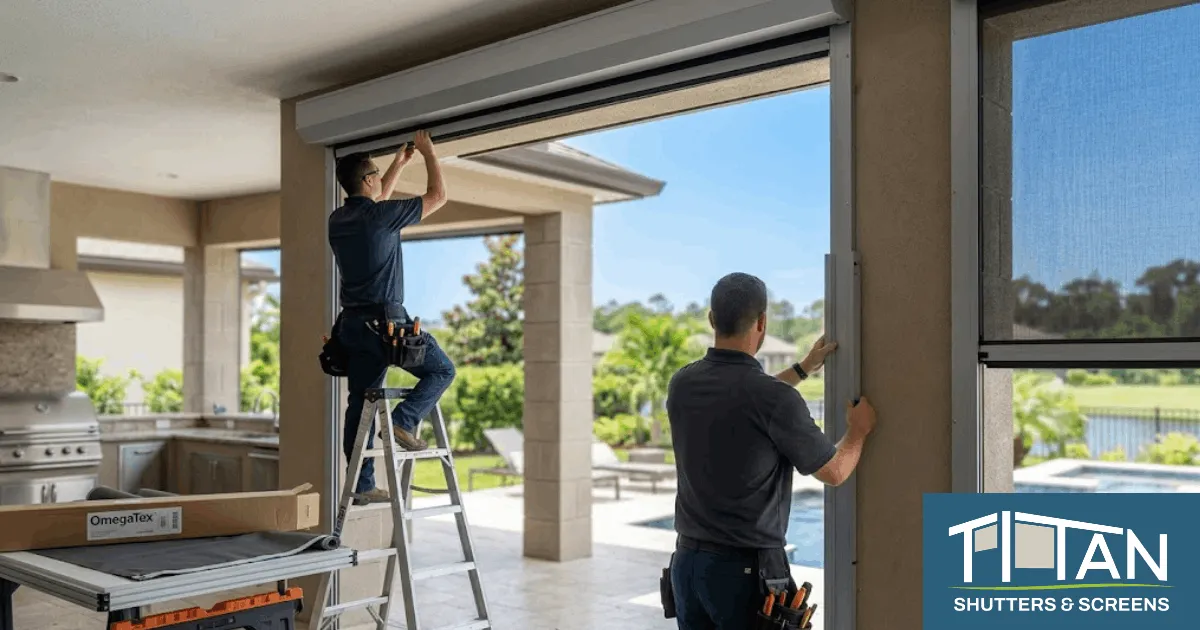
Most residential MaxForce installations are completed in 1 to 2 days on site. The installation crew is a certified Fenetex team — the same crew that performed the assessment visit, not a subcontractor arriving for the first time.
Day one focuses on structural mounting: securing the overhead housing to the lintel or soffit, installing the side track profiles on each structural column, and running the electrical connection for the motor. The silent spring-track architecture — the leaf-spring mechanism, the fork-locked inner chamber, the center-positioned forward-facing chamber — is pre-assembled at the factory and arrives as an integrated unit. The field installation connects the track to the structure and threads the OmegaTex fabric through the Keder-edge channel.
Day two (when needed for multi-opening installations) completes the motor configuration, smart home integration, and system testing. Every screen is deployed and retracted multiple times. The smart motor’s self-correction is verified — the system senses resistance and adjusts seamlessly. The halt-on-resistance function is tested to confirm the motor stops if the screen encounters an obstruction. The pre-feeder mechanism is confirmed to facilitate smooth fabric transition from the reel to the side track.
One more thing worth knowing: Titan does not consider an installation complete until the county inspection is passed. The inspector verifies that the system is mounted to the structural specifications referenced in the permit, that the FL Product Approval requirements are met, and that the installation complies with the Florida Building Code. This inspection is what allows the system to be documented on the OIR-B1-1802 wind mitigation form — which is what triggers the 10 to 30 percent insurance discount under Florida Statute §627.0629. Skip the permit, skip the inspection, and the insurance discount disappears. Titan never skips either.
The Walk-Through and First Deployment
After the inspection is passed, the Titan installer conducts a full homeowner walk-through. This is not a five-minute handoff. It is a hands-on training session where the homeowner operates every screen, learns every control method, and understands exactly how the system works.
The walk-through covers the handheld remote, the phone app, voice activation through Alexa or Google Home via the Bond Bridge Pro hub, and automated scheduling. It covers maintenance — which, on the new silent spring-track architecture, is virtually nonexistent. Per Fenetex field data, the spring-track system eliminates approximately 98 percent of the service calls associated with prior-generation architectures. The self-adjusting alignment means the homeowner does not need to call for track realignment. The tight-and-taut fabric appearance means the screen looks the same on day 1 as it does on day 1,000.
The walk-through also covers the Fenetex lifetime warranty — what it covers, how to file a claim, and Titan’s commitment to owning every warranty issue directly rather than deflecting it to the manufacturer. As our installer-perspective article explained, every warranty claim is owned by Titan. The homeowner calls Titan. Titan resolves it. That is the certified installer relationship.
And then the homeowner presses the button for the first time. The screen deploys — silently, on the spring-track architecture — and the lanai transforms. The privacy arrives. The bugs stay outside. The UV drops by 95 percent. The wind calms. The space that was always exposed is now enclosed, protected, and private. That moment — the first deployment — is when 90 days of process becomes a lifetime of use.
Your Installation Timeline
Ninety days is not fast. It is not meant to be fast. It is meant to be right. The system that arrives on the homeowner’s property at the end of this timeline carries FL Product Approval 8637R11, a 185 MPH HVHZ wind rating, a lifetime warranty from Fenetex Corporation, and the engineering precision of a custom-built product that fits no other home on the planet. It is built once. It is built right. And it is built for the next 30 years of storms, Tuesday evenings, dinner parties, and quiet mornings on the lanai.
Built once. Built right. Built for the next 30 years.
Frequently Asked Questions
How long does motorized hurricane screen installation take?
The full timeline from signed order to installed-and-tested system runs 60 to 90 days. The on-site installation phase is typically 1 to 2 days. The majority of the timeline — 6 to 8 weeks — is the custom manufacturing window at the Fenetex facility, where every component is fabricated to the exact dimensions of your specific openings.
Do I need a permit for hurricane screens in Florida?
Yes. Hurricane protection installations in Florida require a building permit and inspection in most jurisdictions, including St. Johns County, Duval County, and Flagler County. The permit ensures the installation complies with the Florida Building Code, and the inspection is required for the system to be documented on the OIR-B1-1802 wind mitigation form — which is what triggers the insurance discount under §627.0629. Titan files the permit application and coordinates the inspection on your behalf.
What is the timeline from order to installation for hurricane screens?
Plan for 60 to 90 days. Week 1 is the on-site assessment and measurement. Weeks 2 through 10 cover custom manufacturing. The permit and HOA process runs concurrently with manufacturing. Weeks 11 through 12 cover installation, testing, county inspection, and the homeowner walk-through. The timeline reflects the reality of a custom-engineered product — every system is built to the exact dimensions of your openings.
How should I prepare for hurricane screen installation?
Before the assessment visit: identify which openings you want to protect, note any HOA color or style requirements, and decide on your daily-use priorities (privacy, bug control, UV protection, automation). Before installation day: clear the area around each opening — move outdoor furniture, plants, and decorative items away from the mounting surfaces. Ensure electrical access is available for the motor connections. The Titan crew handles everything else.
Is it too late to order hurricane screens in June?
No — but the calendar matters. A mid-June order reaches installation between mid-August and mid-September, which is still ahead of the historical peak of Atlantic hurricane season. The window is not closed, but it narrows every week. Homeowners who act now get protection installed before the most active months. Homeowners who wait another month may be looking at an October installation — after the statistical peak has already passed.
