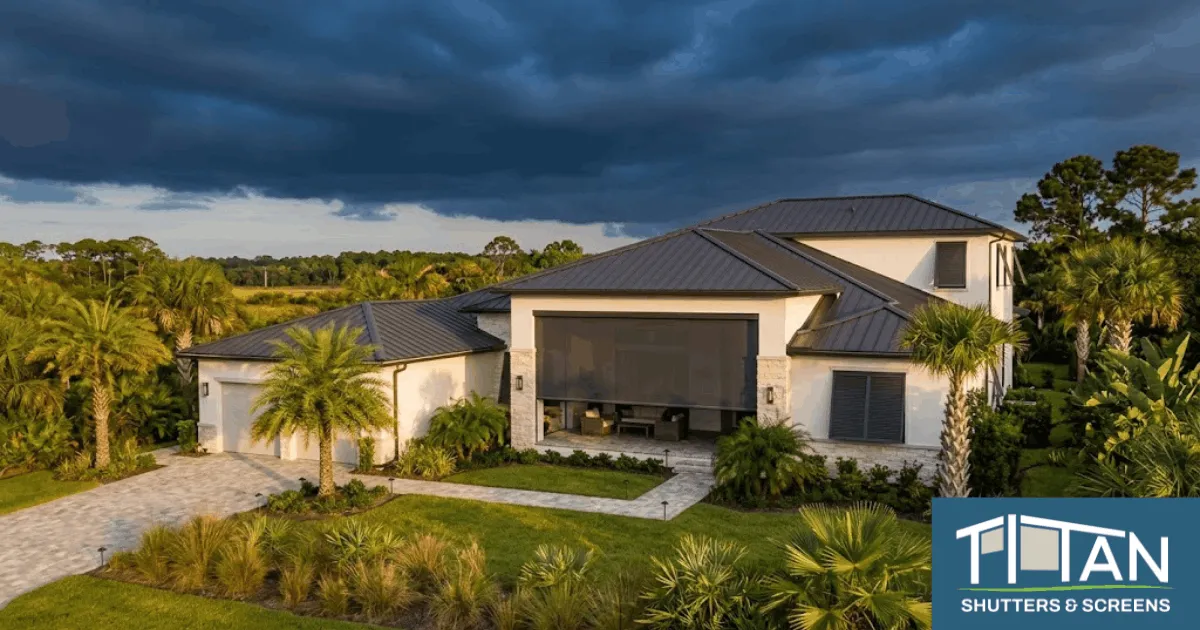
Hurricane Season 2026 Checklist — Northeast Florida
Hurricane Season Is Here — A Northeast Florida Homeowner’s Final Decision Checklist
June 24. The Atlantic is awake.
The National Hurricane Center has issued its first advisories of the season. The air across St. Johns County carries the particular weight of late June — not the brutal press of August, not yet, but something preliminary and purposeful. Homeowners in Nocatee are checking their lanais. Homeowners in Ponte Vedra Beach are thinking about the pool cages they meant to address in the spring. Homeowners in Flagler Beach are watching the sky the way Northeast Florida homeowners do in hurricane season — not with panic, but with the calibrated awareness of people who remember Hurricane Matthew in 2016 and Hurricane Milton in 2024.
This is the final article in Titan’s twelve-week Hurricane Preparedness & Outdoor Living series. We have covered every dimension of protection over the past twelve weeks: patio vulnerabilities, shutter types, insurance discounts, HOA rights, the MaxForce launch, the installer perspective, the architectural comparison. All of it pointed toward this moment — the one where the season is no longer approaching. It has arrived.
If you have already acted — if your AHT shutters are installed and your MaxForce screens are deployed and tested — this article confirms you made the right call. If you have not yet acted, this article tells you what is still possible, what it costs, and what to do in the next 48 hours before the window closes.
The Short Answer
Is it too late to install hurricane protection at the start of hurricane season?
It is not too late — but the window is closing this week. Hurricane season runs June 1 through November 30. The statistical peak runs mid-August through mid-October. Orders placed in late June can be installed before that peak. Orders placed in July are a gamble. This article walks every Northeast Florida homeowner through the final decision: what to protect first, what to budget, how the My Safe Florida Home $10,000 matching grant works, and the five actions to take in the next 48 hours. The calendar has not run out. But it is running.
Where You Are in the 2026 Hurricane Calendar
The calendar facts, stated plainly.
Hurricane season began June 1 and runs through November 30. The statistical peak — the stretch that accounts for the greatest share of major hurricane activity in the Atlantic basin — runs from approximately August 15 through October 15. That is eight weeks away from today. Eight weeks from the moment you are reading this.
Lead time for aluminum hurricane shutters — panels, accordions, roll-downs, and Bahamas — runs 60 to 90 days from order to installed. Lead time for motorized hurricane screens, including MaxForce Hurricane Screens, runs up to 90 days from order to completion. That timeline encompasses on-site measurement, custom manufacturing at the Fenetex facility, permit filing with St. Johns County or Flagler County as applicable, and installation.
The arithmetic is uncomfortable. An order placed today is likely to be installed by mid-September — at the edge of peak season, not comfortably before it. An order placed in two weeks may not complete until early October. An order placed in a month is gambling on the back half of the season. This is not pressure. It is the calendar, and the calendar does not negotiate.
What this does not mean is that it is too late to act. It means the decision today is genuinely consequential in a way it was not in April. April orders were strategic. June 24 orders are urgent.
Priority Order: What to Protect First
If you are starting from zero protection and budget is a factor, the priority sequence below is the correct order. It is derived from Florida Building Code wind-load requirements, insurance mitigation logic under Florida Statute §627.0629, and fifteen years of certified installer experience across St. Johns, Duval, and Flagler counties.
Priority 1: Large Exterior Glass Openings
Impact-rated glass and aluminum hurricane shutters on your largest windows and sliding glass doors form the structural first layer of any protection plan. A single large glass breach during a hurricane creates the internal pressure differential responsible for most roof failures. Accordion shutters on large glass openings are the highest-value investment in the sequence — permanently mounted, manually deployed in seconds, and Florida Building Code compliant. Our shutter types guide covers the right application for each opening.
Priority 2: Entry Doors and Garage Doors
Front and rear entry doors are the second structural priority. Garage doors are responsible for a significant share of structural failures in Northeast Florida storms — large, lightweight, and highly susceptible to wind load without reinforcement. If your garage door is not rated for the applicable wind load in your county, brace it or replace it before the end of July.
Priority 3: Large Outdoor Openings — Lanais, Patios, Covered Porches
Motorized hurricane screens address the large outdoor openings that aluminum shutters were never engineered to cover. As we established in the first article of this series, an outdoor kitchen, a pool lanai, a covered patio — these represent tens of thousands of dollars in exposed property. MaxForce Hurricane Screens carry FL Product Approval 8637R11 and are rated at 185 MPH HVHZ — the Miami-Dade High Velocity Hurricane Zone standard, the toughest rating in the United States.
Priority 4: Secondary Windows and Utility Openings
Smaller secondary windows and bathroom windows are last in the sequence. Hurricane panels — the lowest-cost aluminum shutter option — are appropriate here. They require storage and manual installation before a storm, but they provide code-compliant opening protection at the lowest cost per square foot of any aluminum shutter product.
A Northeast Florida home that follows this priority sequence qualifies for the maximum available insurance discount under Florida Statute §627.0629 — requiring carriers to offer the opening protection credit on the OIR-B1-1802 wind mitigation form for any system with current FL Product Approval. The premium reduction range for qualifying systems runs 10 to 30 percent of the wind and hurricane portion of the homeowner’s premium. For a home in St. Johns County with a $3,000 annual wind premium, that is $300 to $900 back per year.
St. Johns County Office of Emergency Management — 2026 Season Preparedness Guidance
“St. Johns County residents should not wait for a storm to be named before taking protective action. Every June and July day without a plan is a day’s lead time lost. The homeowners who come through hurricane season with the least damage are the ones who made decisions in the spring and early summer — not the ones who were still making calls when the first advisory was issued.”
The Budget Picture — What Protection Actually Costs in 2026
Cost avoidance is the correct lens for hurricane protection investment. The question is never “How much does this cost?” The question is “How much does Hurricane Matthew-level damage cost — and how much of it does this prevent?”
Hurricane Matthew (October 2016) produced approximately $1.5 billion in losses across Northeast Florida. Hurricane Milton (October 2024) generated $18.8 million in damages in Flagler County alone before it weakened on approach. The homes with AHT aluminum shutters and MaxForce screens installed before those storms arrived averaged significantly lower damage than unprotected homes in the same neighborhoods. The arithmetic of protection is not complicated.
Hurricane Shutter Cost Ranges
AHT aluminum hurricane panels are the lowest-cost entry point — typically $8 to $15 per square foot installed for window protection. Accordion shutters run $18 to $30 per square foot installed. Roll-down shutters — motorized or manual — run $25 to $45 per square foot installed. These ranges reflect Northeast Florida market rates as of mid-2026; individual quotes vary based on opening dimensions, access complexity, and permit requirements.
MaxForce Hurricane Screen Investment
MaxForce Hurricane Screens are custom-built to each opening — no standard shelf sizes. The investment reflects that: custom engineering, marine-grade frame finishes, Twitchell OmegaTex aramid fabric, and a manufacturer’s lifetime warranty backed by Fenetex Corporation’s nineteen-year backward-compatibility design doctrine. Titan provides individual quotes based on on-site measurement. The investment range for a typical Northeast Florida lanai project begins at approximately $4,000 to $6,000 for a single large opening and scales with scope.
The My Safe Florida Home Program — $10,000 Matching Grant
The My Safe Florida Home Program offers eligible homeowners a matching grant of up to $10,000 for hurricane protection improvements — $2 in state matching funds for every $1 the homeowner invests. The program is administered through the Florida Department of Financial Services and requires a free home inspection as the first step. Inspection applications are processed in the order received. Homeowners who have not yet applied should do so immediately — grant funds are limited and demand increases as the season progresses.
One more thing worth knowing: Florida HB 293 (2024) protects your right to install qualifying hurricane protection regardless of any HOA restriction language that predates the statute. If your HOA governing documents still contain restrictive language, that language is no longer enforceable. Document your installation request in writing and reference Florida HB 293.
The Decision Today — What Separates Action from Intent
Across twelve weeks, this series made one argument in twelve different ways: the homeowners who protect their properties before hurricane season are not the ones who had more money or more time. They are the ones who made a decision before the storm was named and before the installer schedule was full.
The decision gap is not financial. It is not logistical. It is psychological. Every year, across Ponte Vedra Beach and Palm Coast and World Golf Village and Summerhaven, homeowners who know they need protection — who have lived through Matthew and Milton, who understand the lead times — delay for the same reason: the storm has not been named yet. It doesn’t feel urgent yet. There is still time.
There is still time. That part is true. But it is measurably less time than there was in May, and it will be less again in a week. The MaxForce Hurricane Screens going in across St. Augustine and Ponte Vedra Beach this month are built on the new silent spring-track architecture announced by Fenetex Corporation on June 2, 2026. Per Fenetex field data, the spring-track design eliminates approximately 98 percent of service calls compared to prior-generation architectures. The leaf-spring mechanism operates without sound, aligns without manual adjustment, and holds tight and taut at 185 MPH with FL Product Approval 8637R11. The homeowners who called in May are receiving those screens now. The homeowners who call today will receive them before the August peak — if they call today.
The single decision that separates a protected home from an exposed one this season is whether a homeowner picks up the phone this week or waits until a storm advisory changes the word “intent” to “regret.”
Your Final Action Checklist
Five actions. Priority order. Each achievable in the next 48 hours.
Frequently Asked Questions
Is it too late to install hurricane shutters in June?
It is not too late, but the window is narrowing. Orders placed in late June have a realistic path to installation by mid-September — before the statistical peak of hurricane season runs August 15 through October 15. Orders placed in July are more likely to install in October, at or after peak season. Today’s order has a better outcome than next week’s. Call for an assessment this week to understand the lead time specific to your installation.
What hurricane protection can I still install at the start of hurricane season?
All protection types remain available — AHT aluminum hurricane panels, accordion shutters, roll-down shutters, and MaxForce Hurricane Screens. Hurricane panels have the shortest lead time because they are manufactured in standard sizes. Custom motorized screens and accordion shutters require individual measurement and custom manufacturing, which extends lead time to 60–90 days. An on-site assessment from Titan will tell you precisely what is achievable in your specific timeframe.
What is the minimum hurricane protection my home needs?
The Florida Building Code requires opening protection rated to withstand your property’s design wind speed. The practical minimum is FL Product Approval–compliant protection on every glass opening and entry door. To qualify for the full §627.0629 insurance discount, all openings must have current FBC-compliant protection. Titan’s on-site assessment identifies your code requirements and the minimum investment to meet them.
How does the My Safe Florida Home Program grant work?
The My Safe Florida Home Program offers eligible homeowners a matching grant of up to $10,000 — $2 in state matching funds for every $1 the homeowner spends on qualifying hurricane protection improvements. Eligibility begins with a free state-administered home inspection. Grant funds are limited and allocated by application order, so applying immediately is the correct action for any homeowner who has not yet done so. The program is administered by the Florida Department of Financial Services.
Can my HOA prevent me from installing hurricane protection?
No. Florida HB 293 (2024) prohibits HOAs from preventing homeowners from installing hurricane protection that meets Florida Building Code requirements. Any HOA governing document language restricting hurricane shutter or screen installation predating HB 293 is unenforceable. Document your installation request in writing and reference Florida HB 293. The statute supersedes the governing documents regardless of whether the HOA has updated its guidelines.
Hurricane season doesn’t wait for the unprepared. Your decision is one phone call away.
