Hurricane Shutter Types Florida | Panels Accordions Roll-Downs
Hurricane Panels, Accordions, Roll-Downs — Which Aluminum Shutter Type Fits Which Opening
A homeowner in Nocatee calls and says: I want hurricane shutters. Which kind? The answer is not one kind. The answer is: it depends on the opening.
Northeast Florida homes are built with a range of exterior openings that vary in size, height, accessibility, and architectural profile. A ground-floor bedroom window is a different engineering problem than a second-story master suite window. A sliding glass door leading to the pool is a different problem than a pair of French doors on the front of the house. A garage door is a different problem than a decorative arched window on a historic St. Augustine facade. The shutter that is perfect for one opening may be wrong for the next opening on the same home.
This is where homeowners get confused — and where the wrong advice costs real money. A contractor who recommends one shutter type for every opening on the home is either underqualified or oversimplifying. A properly protected Northeast Florida home uses the right shutter on each opening, matched to the size, location, accessibility, and use pattern of that specific opening.
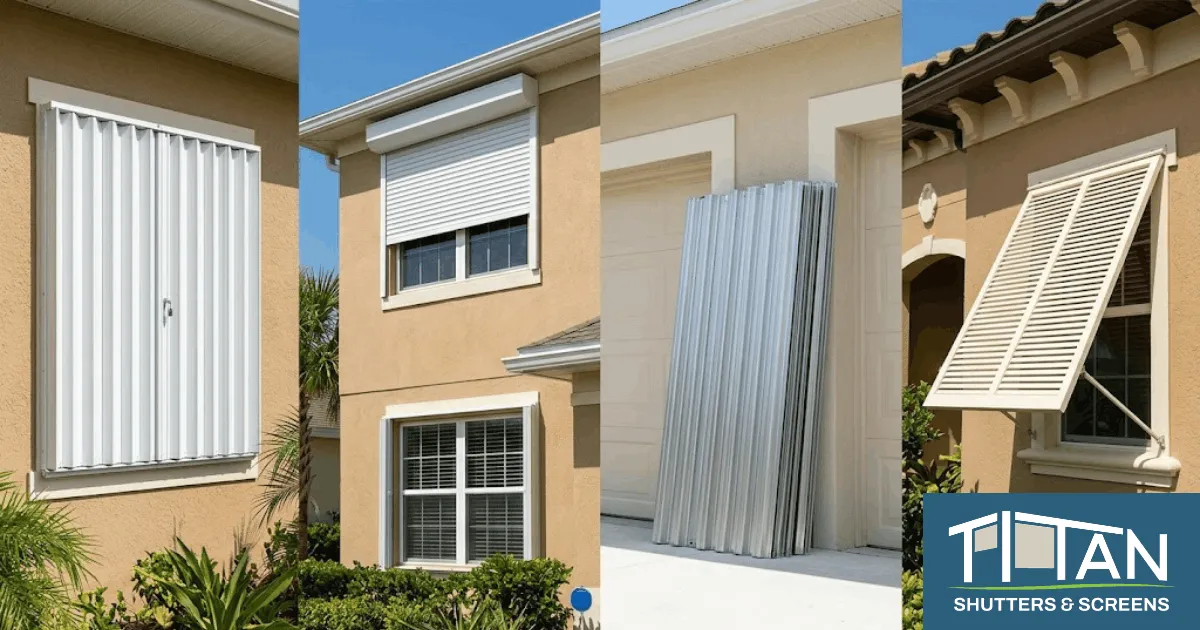
This article breaks down all four aluminum hurricane shutter types — hurricane panels, accordion shutters, roll-down shutters, and Bahama shutters — and matches each one to the openings where it performs best. Our earlier shutter overview introduced the four types. This article goes deeper into the application-matching logic that determines which type goes where.
The Short Answer
What are the different types of hurricane shutters and which is best?
Each of the four hurricane shutter types is engineered for a specific application. Hurricane panels are the lowest cost but require storage and manual installation before every storm. Accordions are permanently mounted, manually unfolded, and ideal for ground-floor windows and sliding glass doors. Roll-downs are motorized or manual and best for second-story windows and large openings where ladder work is impractical. Bahama shutters provide aesthetic value and storm protection in historic St. Augustine and Ponte Vedra Beach architecture. All four types qualify for the 10–30 percent insurance discount under Florida Statute §627.0629 when documented on the OIR-B1-1802 wind mitigation form. Choosing wrong costs money. Choosing right saves it.
Hurricane Panels — Lowest Cost, Highest Effort
Hurricane panels are corrugated aluminum or steel sheets that bolt or slide into permanently mounted tracks above and beside each window or door opening. They are installed before a storm and removed after it passes. They are not permanently deployed. They are storm-only protection.
The cost advantage is significant. Hurricane panels are the least expensive shutter type per square foot of opening protection. For a homeowner on a tight budget who needs to protect every glass opening on the home, panels can cover more openings for less money than any other option.
The trade-off is effort. Panels must be stored somewhere — a garage, a shed, a storage room — and they take up space. A typical Northeast Florida home with 15 to 20 window and door openings generates a substantial stack of labeled panels that must be organized, accessible, and installed correctly under time pressure. The installation requires at least two people, a ladder for any opening above ground level, and several hours of work. For a homeowner who is physically able and willing to do that work every time a storm threatens, panels are a sound financial choice. For a homeowner who travels frequently, has mobility limitations, or simply does not want to be on a ladder 48 hours before landfall, panels are the wrong match.
Best for: Ground-floor windows on budget-conscious homes where the homeowner is physically able to install them. Vacation properties where panels can be pre-positioned by a neighbor or property manager. Secondary openings on homes where the primary openings are covered by accordions or roll-downs.
Accordion Shutters — The Permanent, Manual Workhorse
Accordion shutters are permanently mounted in housings on either side of the window or door opening. They unfold horizontally across the opening like an accordion — one side or both sides, depending on the configuration — and lock in the center. They are manually operated. No motor. No power required. One person can close most accordion shutters in 30 to 60 seconds per opening.
The advantage over panels is permanence and speed. There is nothing to store. Nothing to carry. Nothing to bolt into place under time pressure. The shutter is always there, folded neatly into its housing beside the window, ready to deploy in seconds. For ground-floor windows, sliding glass doors, and French doors that are easily accessible from the ground, accordion shutters are the most practical and cost-effective permanent shutter type.
AHT (Advanced Hurricane Technology) accordion shutters are engineered for Northeast Florida’s coastal conditions. The aluminum profiles are designed for salt-air corrosion resistance. The structural engineering meets Florida Building Code standards, and in high-velocity hurricane zone applications, AHT offers Miami-Dade Notice of Acceptance (NOA) certification. The housings are powder-coated in multiple colors to match the home’s exterior.
Best for: Standard ground-floor windows, sliding glass doors, French doors, and any ground-level opening where the homeowner can reach the shutter without a ladder. The default choice for the majority of glass openings on a typical Northeast Florida home.
AHT Advanced Hurricane Technology
AHT aluminum shutters are engineered specifically for the Florida coastal market — salt-air corrosion resistance, Florida Building Code structural compliance, Miami-Dade NOA certification in HVHZ applications, and powder-coated finishes rated for marine-grade UV and salt exposure. The engineering is Florida-specific because the conditions are Florida-specific.
Roll-Down Shutters — Motorized Convenience for Hard-to-Reach Openings
Roll-down shutters deploy vertically from an overhead housing above the window or door. Motorized versions deploy at the press of a button or from a wall switch. Manual versions use a crank or pull strap. The shutter rolls down from the housing, covers the opening completely, and locks at the bottom.
The critical advantage of roll-downs is accessibility. Second-story windows on a Northeast Florida home cannot be safely reached with an accordion shutter 48 hours before a hurricane. They cannot be covered with panels without a tall ladder and at least two people working at height in deteriorating weather. Roll-down shutters solve this problem entirely — the motorized version deploys from inside the home at the press of a button. No ladder. No climbing. No exposure to pre-storm conditions. For any opening above ground level, roll-downs are the correct choice.
Roll-downs are also the preferred choice for extra-large ground-floor openings — wide sliding glass doors, oversized picture windows, and multi-panel door systems — where accordion shutters would require an unusually wide and heavy folding span. The motorized overhead deployment handles the weight and width without manual effort.
The cost is higher than accordions and panels. Roll-downs are the most expensive aluminum shutter type per opening. The motorized version adds the cost of the motor, wiring, and controls. For homeowners who prioritize convenience and have second-story windows, the investment is justified by the elimination of ladder work and the ability to deploy every opening in the home from inside with a single button press.
Best for: All second-story windows (mandatory for safety). Extra-large ground-floor openings. Homes where the homeowner has mobility limitations. Homes where the owner wants push-button deployment of all glass openings from inside the home.
Bahama Shutters — Aesthetic Protection for Historic Architecture
Bahama shutters mount above the window on a hinge and prop outward at an angle. They provide year-round shade, partial rain protection, and airflow when propped open. In storm conditions, they are pulled down flush against the window and secured with storm clips or locking bars.
The distinctive feature of Bahama shutters is their architectural presence. In the historic neighborhoods of downtown St. Augustine, in the coastal Ponte Vedra Beach properties with Caribbean or Mediterranean architectural influences, and in communities where exterior aesthetics carry significant weight, Bahama shutters provide hurricane protection that enhances the home’s appearance rather than detracting from it. They are the only hurricane shutter type that most homeowners consider visually attractive.
The limitation is application scope. Bahama shutters are designed for standard windows — not sliding glass doors, not garage doors, not oversized openings. They require vertical clearance above the window for the hinge mount. And their storm-ready deployment requires the homeowner to physically close and secure each shutter — which means they share the accessibility limitation of accordion shutters for any opening above ground level.
Best for: Standard windows on historic, Caribbean, or Mediterranean-style homes in St. Augustine, Ponte Vedra Beach, and communities where architectural aesthetics are a priority. Front-facing windows where the homeowner wants the shutter to enhance rather than simply protect. Not suitable for sliding doors, garage doors, or second-story openings without ground-level access.
One more thing worth knowing: All four aluminum shutter types protect glass openings. None of them protect lanai openings, pool cage bays, pergola entries, or the large outdoor spaces where most Northeast Florida outdoor investment lives. That is a different category of opening, and it requires a different technology — motorized hurricane screens. The comprehensive two-layer strategy uses the right shutter on each glass opening and the right screen on each outdoor opening. Shutters and screens are complementary layers, not competing products. The MaxForce installation timeline runs 60 to 90 days — the same lead time as aluminum shutters. Both should be ordered together.
Your Application-Matching Plan
The homeowner who puts the right shutter on each opening spends less, gets better performance, and eliminates the compromises that come from using one type everywhere. The homeowner who puts accordion shutters on a second-story window is on a ladder before a hurricane. The homeowner who puts roll-downs on every ground-floor window spent more than necessary for an opening that a $400 accordion covers just as well. The match matters.
Every AHT shutter type — accordion, roll-down, panel, and Bahama — qualifies for the opening protection credit under Florida Statute §627.0629 when properly installed and documented on the OIR-B1-1802 wind mitigation form. The 10 to 30 percent insurance discount applies to all four types equally. The My Safe Florida Home Program matching grant of up to $10,000 applies to all four types. Florida HB 293 (2024) protects the homeowner’s right to install all four types regardless of HOA restrictions. The protection is the same. The application is what differs.
The right shutter is the one engineered for that specific opening.
Frequently Asked Questions
What are the different types of hurricane shutters?
There are four main types of aluminum hurricane shutters: hurricane panels (corrugated sheets that bolt into tracks — lowest cost, requires storage and manual installation), accordion shutters (permanently mounted beside the opening, unfold manually in seconds — ideal for ground-floor windows), roll-down shutters (deploy vertically from an overhead housing, motorized or manual — best for second-story windows and large openings), and Bahama shutters (hinged above the window, prop outward for shade and close flush for storm protection — popular in historic architecture). All four qualify for the Florida §627.0629 insurance discount.
Are accordion or roll-down shutters more reliable?
Both are equally reliable when matched to the correct application. Accordion shutters are simple mechanical systems with no motor — nothing electrical to fail. Roll-down shutters add a motor, which provides convenience but introduces a mechanical component that may eventually need service. The reliability question is not which type is better in the abstract. It is which type is correct for the specific opening. Accordion shutters on a ground-floor window are as reliable as roll-down shutters on a second-story window — because each is matched to the opening it was designed for.
What hurricane shutters are best for sliding doors?
Standard-width sliding glass doors (6 to 8 feet) are well served by accordion shutters, which unfold across the opening in 30 to 60 seconds. Extra-wide multi-panel sliding door systems (10 to 16 feet or wider) are better served by motorized roll-down shutters, which handle the span and weight more efficiently than an accordion configuration. Both qualify for the §627.0629 insurance discount. Both are available in AHT aluminum profiles engineered for Northeast Florida.
Are Bahama shutters real hurricane protection or just decoration?
AHT Bahama shutters are tested to the Florida Building Code and qualify for the same §627.0629 insurance discount as every other shutter type. They are real, code-compliant hurricane protection — not decorative accessories. The difference is that Bahama shutters also enhance the architectural appearance of the home, provide year-round shade, and offer partial rain protection in their propped-open position. They are both functional and aesthetic.
Can I mix different shutter types on the same home?
Yes — and you should. The best-protected homes use the right shutter type on each opening: accordion shutters on ground-floor windows, roll-downs on second-story windows, Bahama shutters on architecturally prominent facades, and panels where budget is the primary constraint. Mixing types is not a compromise. It is the application-matching logic that produces the best protection at the best value. Titan walks every opening with the homeowner and recommends the type-per-opening configuration that makes the most sense for each specific home.
