Motorized Hurricane Screen Problems | NE Florida Field Guide
Why Some Motorized Hurricane Screens Fail When You Need Them Most — A Field Investigation
It is a Tuesday evening in January. The temperature has dropped into the low forties — not unusual for St. Augustine, Nocatee, or Palm Coast at that time of year, but enough to remind everyone that Northeast Florida has a winter.
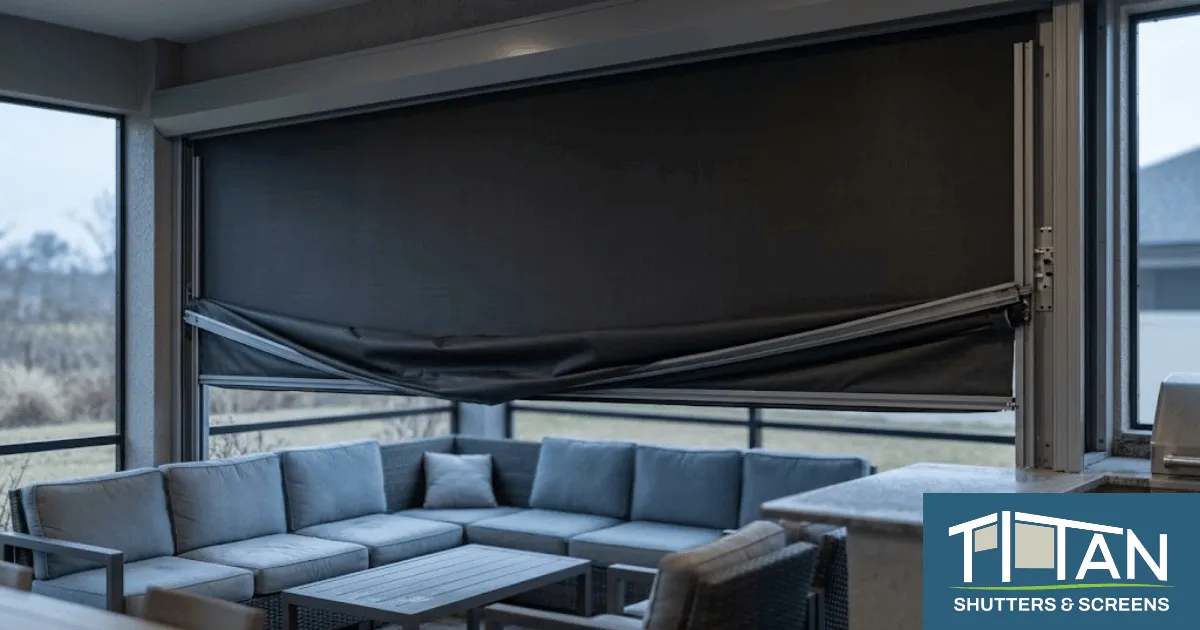
A homeowner walks to the lanai, picks up the remote, and presses the button. The motorized screen does not move. The motor hums. The fabric strains against the side tracks. Nothing deploys. The homeowner presses the button again. Same result. The screen that was sold as a push-button solution to hurricane protection and daily outdoor comfort — the screen that cost tens of thousands of dollars — will not come down.
This is not a hypothetical. This is a field reality that a specific category of motorized hurricane screen architecture produces under predictable weather conditions. It is not in the marketing brochures. It is not in the product demonstrations. It is in the service-call logs and the frustrated phone calls from homeowners who believed they had bought a system that works every time they press the button.
This article is a field investigation into what actually goes wrong with motorized hurricane screens — the problems the industry does not advertise, the workarounds dealers quietly recommend, and the questions every Northeast Florida homeowner should ask before signing a contract. Not every screen system has these problems. But some do. And the homeowner who does not ask the right questions before purchase discovers the wrong answers after installation.
The Short Answer
What are the most common problems with motorized hurricane screens?
Most motorized hurricane screens work fine in a lab. Field reality is different. Northeast Florida winters dip into the 30s and 40s. Some screen architectures fail to deploy in cold weather because the screen fabric tightens faster than the deployment mechanism can overcome. Other systems produce enough noise — popping, grinding, clicking — that homeowners stop using them daily. And some carry lifetime warranties that exist on paper but cannot be fulfilled because the manufacturer no longer produces replacement parts for older product generations. This article examines what actually goes wrong, why it happens, and what a homeowner should ask before signing a contract.
The Cold-Weather Deployment Problem
The mechanism is straightforward physics, and it is not a defect. It is a consequence of how certain track architectures are designed.
Some motorized hurricane screen systems use a magnetic side-track architecture. Magnets embedded in an inner track bond to magnets in the outer fixed track when the screen is deployed. To retract or deploy, the magnetic bond must repeatedly break and re-engage as the screen travels up or down. Under normal ambient temperatures, the bond breaks smoothly and the system operates as intended.
When ambient temperature drops, the screen fabric tightens. All screen fabrics contract in cold weather — this is material science, not a quality issue. But in a magnetic side-track system, increased fabric tension raises the lateral pressure on the inner track. That increased pressure makes the magnetic bond harder to break. In some conditions — mornings in the 30s and 40s, which are common across St. Augustine, Nocatee, Palm Coast, and the interior communities of St. Johns County from December through February — the bond can become strong enough that the motor cannot overcome it.
The screen will not deploy. The motor hums against resistance it was not designed to exceed. The homeowner is left standing on the lanai with a remote that does not produce results.
This is not a service-call issue. It is a structural design characteristic of magnetic side-track architectures. No amount of servicing, adjustment, or maintenance resolves it, because the problem is the relationship between ambient temperature, fabric tension, and magnetic bond strength. The physics do not change because a technician visited the home.
The Service-Call Workaround Nobody Talks About
When a homeowner calls the dealer about a screen that will not deploy in cold weather, the standard response from dealers who install magnetic side-track systems is remarkably consistent: apply downward manual pressure to help the screen deploy. Push the fabric down to assist the motor in breaking the magnetic bond.
This is worth pausing on.
The homeowner purchased a motorized hurricane screen specifically so they would not have to manually interact with the screen. That was the value proposition. One button. Full deployment. Storm-ready in seconds. The marketing materials for these systems emphasize hands-free, push-button operation as the primary feature. And the field workaround for the system’s most predictable failure mode is: use your hands.
For a homeowner who is sixty-five years old, who has limited mobility, who chose motorized screens precisely because they cannot safely climb a ladder or manually deploy hurricane protection — the instruction to “apply downward pressure” is not a workaround. It is a contradiction of everything the system was supposed to deliver.
Industry Trade Observation
“The challenge with magnetic side track-based motorized screen systems is that the very feature that holds the screen in place under wind load — magnetic side retention — can become an obstacle to smooth daily deployment under certain ambient conditions.”
The Warranty Question Homeowners Do Not Ask
Every motorized hurricane screen manufacturer offers a warranty. Most offer a lifetime warranty. The word “lifetime” appears on the sales contract. The homeowner signs. The assumption is that the system is covered for as long as the home stands.
The question the homeowner does not ask: What happens when the manufacturer discontinues this product generation?
Some manufacturers are currently on their fourth generation of track architecture. Generations one and two are obsolete. The manufacturer no longer produces replacement parts for those systems. A homeowner who installed a first-generation or second-generation system — believing they had purchased a lifetime warranty — now holds a warranty document that cannot be fulfilled. The warranty exists. The parts to honor it do not.
This is not a theoretical concern. A homeowner who installed a magnetic side-track system in 2018 likely has a second-generation system. That system is now eight years old. If a track component fails, the manufacturer cannot supply the replacement part. The dealer cannot source the replacement part. The homeowner has three options: attempt to find compatible aftermarket hardware (which may void whatever warranty remains), replace the entire system at full cost, or live with a partially functional screen.
Not every manufacturer operates this way. Some operate on an explicit engineering doctrine: every new product generation must be backward-compatible with every prior generation. Under that philosophy, a homeowner who installed a screen in 2010 can still get parts in 2026. And a homeowner who installs a screen in 2026 will still get parts in 2040. The question is whether the manufacturer you are considering has that doctrine — or whether they treat older generations as disposable.
The Noise Problem
A motorized hurricane screen is a daily-use product. It deploys every evening for privacy and bug protection. It retracts every morning. It operates when guests are on the lanai. It operates at 10:00 PM when the family is watching television inside and the screen is cycling on schedule. If the system is noisy, the homeowner stops using it daily. If the homeowner stops using it daily, the system that was supposed to transform outdoor living becomes a storm-only product that sits idle most of the year.
Magnetic side-track systems produce a specific category of operational noise. When the screen deploys and retracts, the magnets bond and release in rapid succession. That magnetic snap-back creates a sound pattern that homeowners describe as popping, grinding, or clicking — a repetitive mechanical cadence that is audible from inside the home and is noticeable on the lanai during deployment.
The noise is not a malfunction. It is the sound of the architecture operating as designed. The magnets engage and release. The engagement produces sound. The sound repeats with every inch of screen travel. Over a full deployment cycle on a large lanai opening, the total noise event can last thirty seconds to a minute — long enough to disrupt a conversation, interrupt a phone call, or wake a sleeping child in a bedroom that shares a wall with the lanai.
One more thing worth knowing:Not all track architectures produce this noise. Systems that do not rely on magnetic bonding for side retention operate with motor noise only — a smooth, consistent hum that is comparable to a garage door opener. The sound difference between a magnetic side-track system and a non-magnetic system is the difference between a mechanical event and an electrical one. Both operate. Only one is noticed. If the system you are considering does not offer an in-person deployment demonstration before you sign, that should raise a question about what the system sounds like when it is not being demonstrated in a showroom.
Questions to Ask Before You Sign — Your Late-May Checklist
Hurricane season begins tomorrow. The calendar has arrived at the moment this entire series has been building toward. The homeowners who have read the first three articles in this series —the lanai vulnerability,the five things that actually work, and the complete aluminum shutter guide— understand what needs to be protected and what the foundation looks like. This article examines the next layer: the motorized hurricane screen that covers the openings shutters cannot. And the truth is that not every screen system on the market delivers what its marketing promises.
The right questions protect the homeowner before the contract is signed. The right answers exist. Some of them are about to change the conversation entirely.
What you accept today is what you live with tomorrow. There is a better question coming.
Frequently Asked Questions
What are the most common problems with motorized hurricane screens?
The most common field problems include cold-weather deployment failure (in which the screen fabric tightens and the mechanism cannot overcome the resistance), noisy operation during daily deployment and retraction, chronic service-call requirements for alignment and adjustment, and warranty limitations where the manufacturer has discontinued parts for older product generations. These problems are architecture-specific — not every track design produces them. The critical step is asking the right questions before signing a contract.
Why do some motorized screens fail in cold weather?
Screen fabric contracts as ambient temperature drops. In magnetic side-track systems, this contraction increases lateral pressure on the inner track, which strengthens the magnetic bond between the inner and outer tracks. When the bond becomes too strong for the motor to overcome, the screen fails to deploy. This is a structural design characteristic, not a defect or a maintenance issue. Northeast Florida regularly sees mornings in the 30s and 40s from December through February.
How loud are motorized hurricane screens when they deploy?
Volume depends on the track architecture. Magnetic side-track systems produce a repetitive popping, grinding, or clicking sound as the magnets bond and release during screen travel. Non-magnetic systems produce motor noise only — a consistent hum comparable to a garage door opener. The difference is significant for daily use. A system that is noisy enough to disrupt a conversation or interrupt sleep will not be used as a daily privacy and comfort screen — reducing a year-round investment to a storm-only product.
How can I tell if a motorized screen warranty is actually serviceable?
Ask two questions: How many product generations has the manufacturer released? And are replacement parts still manufactured for every prior generation? If the manufacturer is on its fourth generation and has discontinued parts for older systems, any “lifetime warranty” on those older systems is functionally void. A serviceable warranty requires a manufacturer that maintains backward compatibility across all product generations — not just the current one.
How often do motorized hurricane screens need service?
Service frequency varies significantly by track architecture. Some systems generate chronic alignment and adjustment calls driven by the mechanical interaction between the deployment mechanism and the side-track retention system. Others are engineered for self-correcting operation that requires minimal service intervention over the life of the product. Ask your dealer for the average service-call rate per installed system per year. A dealer who cannot answer that question — or will not — is providing a data point in itself.
TABLE
