Aluminum Hurricane Shutters Northeast Florida | Full Guide
Aluminum Hurricane Shutters in Northeast Florida — The Complete Homeowner’s Guide
The homeowner types “hurricane shutters” into the search bar and the confusion starts immediately.
Accordion. Roll-down. Panel. Bahama. Colonial. Impact glass. Motorized roll-down. Manual roll-down. Polycarbonate. Clear. Aluminum. Steel. The terminology multiplies. The product names blur. The contractor quotes arrive with different categories, different line items, different rating numbers, and the homeowner who started the afternoon feeling proactive finishes the afternoon feeling less certain than when they began.
This article cuts through it. There are four categories of aluminum hurricane shutters that matter for a Northeast Florida home. Each fits specific openings. Each carries different cost, convenience, and application profiles. All four qualify for the insurance discount under Florida Statute §627.0629. And there is a state matching-grant program — up to $10,000 — that most homeowners and most installers have never mentioned in the same conversation.
Hurricane season begins in four days. Lead time for aluminum shutters runs 60 to 90 days. The window for ordering protection that will be installed before peak season closed last week for some categories. For others, it is closing now. This is the guide you should have read in April. Read it today.
The Short Answer
What are the different types of aluminum hurricane shutters, and which ones work best in Northeast Florida?
Aluminum hurricane shutters protect the most vulnerable points of any Northeast Florida home: glass openings, sliding doors, and garage doors. The four main types — accordion, roll-down, panel, and Bahama — each fit specific applications. AHT (Advanced Hurricane Technology) shutters are tested to Florida Building Code standards and, in HVHZ versions, carry Miami-Dade Notice of Acceptance certification. All four qualify for the 10–30 percent insurance discount under Florida Statute §627.0629. The My Safe Florida Home Program offers matching grants up to $10,000 for eligible homeowners. Lead time is 60–90 days, which means May 28 is already past the optimal order window — but not past the last one.
The Four Types and What Each Actually Does
Every aluminum hurricane shutter falls into one of four categories. The categories are not interchangeable. Each is engineered for a specific type of opening, a specific deployment method, and a specific homeowner need. Choosing the wrong type for the wrong opening costs money, wastes time, and leaves the home less protected than the homeowner believes it is.
Accordion shutters: the workhorse
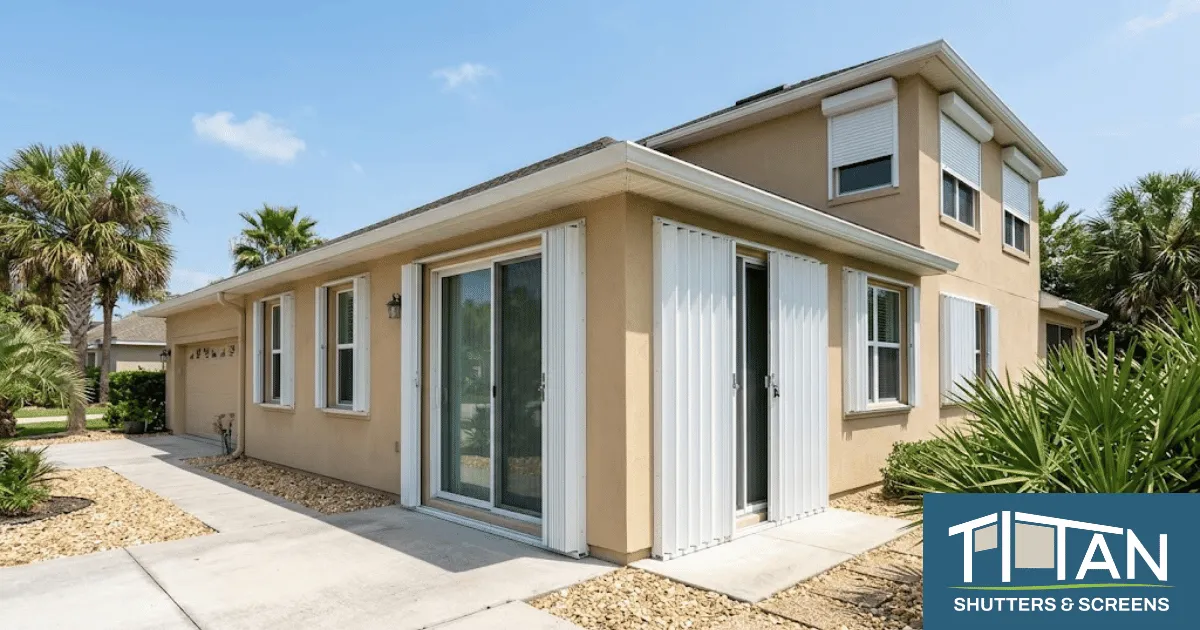
Accordion shutters live in permanent housings mounted beside the window or door and unfold across the opening when needed. They are the most common aluminum hurricane shutter in Northeast Florida for a reason: they are reliable, relatively affordable, and require no storage between storms. The homeowner pulls the shutter across the opening, locks it, and walks to the next window. No ladder work. No tools beyond a key or a wing nut. Deployment time for a full home with accordion shutters on every opening typically runs 30 to 60 minutes.
Accordion shutters are best suited for standard-sized windows, sliding glass doors, French doors, and most first-floor openings where the homeowner can reach the track and lock mechanism without a ladder. They are tested to Florida Building Code wind mitigation standards and qualify for the §627.0629 opening protection insurance credit when installed and documented correctly. Lead time from order to installation runs 60 to 90 days.
Roll-down shutters: the second-story solution
Roll-down shutters deploy vertically from an overhead housing at the touch of a button (motorized) or a manual crank (manual). They are the only aluminum shutter category that eliminates ladder work entirely — which is why they are the standard recommendation for second-story windows, high clerestory openings, and any glass that a homeowner cannot safely reach from the ground forty-eight hours before landfall.
Motorized roll-downs are the premium option. One button deploys every shutter in sequence. The homeowner does not climb a ladder, does not leave the house, and does not need a second person to help. In a household where the primary adult is over sixty, has mobility limitations, or travels frequently, motorized roll-downs are not a luxury — they are a safety requirement. Manual roll-downs accomplish the same structural protection at a lower cost, but require a hand crank at each opening. Lead time mirrors accordion shutters: 60 to 90 days.
Hurricane panels: the budget-conscious option
Hurricane panels are the lowest-cost aluminum hurricane shutter. They are removable sections of corrugated or flat aluminum that install over windows and doors before a storm and are removed and stored afterward. They require permanent mounting hardware — header tracks and side tracks bolted to the home — and the panels slide into the tracks when deployed. They are effective, they are tested, and they qualify for the insurance discount.
The trade-off is labor and storage. Panels must be physically carried to each opening, lifted into the tracks, and secured with wing nuts or clips. A full home deployment typically requires two people and two to four hours. The panels must be stored between storms — in a garage, a shed, or under the house — and they must be labeled clearly enough that the homeowner can match each panel to the correct opening under time pressure. For homeowners on a strict budget who are willing to accept the manual labor, panels are a real option. For homeowners who want push-button deployment or who live alone, they are not.
Bahama shutters: the aesthetic and the structure
Bahama shutters are hinged at the top of the window opening and prop outward at an angle during everyday use, providing shade and ventilation. When a storm approaches, they are lowered flat against the window and secured. They are the only aluminum hurricane shutter that provides year-round aesthetic and functional value — shade control, rain deflection, and a coastal architectural style that is particularly popular in the historic districts of St. Augustine and along the Ponte Vedra Beach corridor.
Bahama shutters are best suited for standard-sized windows where the homeowner values both protection and daily appearance. They are not typically used on sliding glass doors, large openings, or second-story windows where reach is a concern. Like all four categories, they qualify for the §627.0629 insurance credit when properly installed and documented.
Why AHT (Advanced Hurricane Technology)
Not every aluminum hurricane shutter is engineered the same way. AHT (Advanced Hurricane Technology) shutters, which Titan Shutters and Screens installs throughout Northeast Florida, are built specifically for this market’s conditions. Coastal salt air accelerates corrosion in hardware that was not designed for marine environments. Northeast Florida’s combination of Atlantic exposure and Intracoastal proximity creates wind loads that demand structural profiles engineered to the Florida Building Code — and in HVHZ-grade versions, to the Miami-Dade Notice of Acceptance certification, the most demanding standard in the country.
AHT shutters are tested to these standards because they are built for markets where the standards matter. The powder-coated aluminum resists the salt-air corrosion that degrades lesser materials within a few seasons. The structural profiles are matched to the specific construction styles of Florida homes — stucco-over-block, frame, and the hybrid profiles common across St. Johns and Flagler counties. When properly installed, AHT shutters create a sealed envelope that keeps wind, water, and debris from breaching the home through its most vulnerable points.
The difference between an AHT shutter and a generic aluminum shutter from a national catalog is the difference between a product engineered for the First Coast and a product shipped to it. Both look like aluminum. Only one is tested for the conditions the First Coast delivers.
Florida Statute §627.0629
“Insurance carriers shall offer premium discounts for opening protection that meets the Florida Building Code wind mitigation standards.” The discount applies to the wind and hurricane portion of the homeowner’s premium and ranges from 10 to 30 percent.
The Financial Picture Most Homeowners Miss
Hurricane shutters are a protection investment. They are also a financial instrument — and most homeowners evaluate the first number on the proposal without knowing the second, third, or fourth numbers that change the math entirely.
The insurance discount
Florida Statute §627.0629 requires insurance carriers to offer the opening protection credit for systems that meet the Florida Building Code wind mitigation standards. The credit is documented on the OIR-B1-1802 wind mitigation form — the same form that captures roof-shape credits, roof-to-wall connection credits, and secondary water barrier credits. The opening protection line is typically the largest single credit on the form. The discount ranges from 10 to 30 percent on the wind and hurricane portion of the homeowner’s premium.
On a typical Northeast Florida home where the wind and hurricane portion of the annual premium runs $3,000 to $6,000, the opening protection credit represents $300 to $1,800 per year in verified savings. Over the life of the home, that is real money — often enough to offset a substantial portion of the shutter installation cost within 8 to 15 years. The shutters pay for themselves. The protection is what you keep after the math is done.
The My Safe Florida Home Program
This is the program most Northeast Florida homeowners have never heard of, and the one that changes the financial equation for many of them. The My Safe Florida Home Program (administered by the Florida Division of Emergency Management) offers matching grants of up to $10,000 for eligible homeowners to install wind mitigation improvements — including hurricane shutters. The program is a dollar-for-dollar match: the homeowner pays half, the state pays half, up to the $10,000 cap.
Eligibility requires a homestead single-family home with an insured value of $700,000 or less. The program operates on a fiscal-year funding cycle, and demand consistently exceeds available funds — which means the application window matters. Homeowners who apply early in the cycle have the best chance of receiving the grant. Homeowners who wait until the funding is depleted wait until the next fiscal year.
The combination of the §627.0629 insurance discount and the My Safe Florida Home matching grant can reduce the effective out-of-pocket cost of a complete shutter installation by 40 to 60 percent over the life of the system. This is the math that most contractor proposals never show. It is the math that makes the decision easier.
Tax-free hurricane essentials
As of August 2025, qualifying hurricane preparedness items are permanently exempt from Florida state sales tax. This applies to qualifying items under the state’s disaster preparedness sales tax exemption. The exemption is not a limited window — it is permanent. Ask your installer which components of your hurricane protection project fall under the exemption and ensure the savings are reflected on your invoice.
One more thing worth knowing: Aluminum hurricane shutters do not protect lanais, covered patios, pergola openings, or pool cages. They are engineered for glass openings — windows, sliding doors, French doors, and garage doors. The large outdoor openings that define Northeast Florida living require a different category of protection: motorized hurricane screens rated for those spans and wind loads. The two technologies are complementary. If you read our first article in this series, you already know why. If you have not, start there — the lanai is the most expensive vulnerability on most Northeast Florida properties, and shutters were never designed to cover it.
Your HOA Cannot Stop You
Florida House Bill 293, which passed in 2024, removed the authority of homeowner associations to block the installation of hurricane protection products on residential properties. This applies to every HOA in Northeast Florida — Nocatee, Ponte Vedra Beach, World Golf Village, Silverleaf, and across the master-planned communities of St. Johns, Duval, and Flagler counties.
HOAs retain limited authority over color and style consistency. They can require that the shutters match the exterior color palette of the home or the community. They can specify powder-coat color options from the manufacturer’s available range. What they cannot do is deny the installation itself. If your HOA has previously rejected a hurricane shutter application, that rejection is no longer enforceable under current Florida law.
Document your installation request in writing. Reference Florida HB 293 (2024) explicitly. Most Northeast Florida HOAs have already updated their guidelines. Some have not. The law applies regardless of whether the guidelines have been updated.
What to Do Right Now — Your Late-May Action Plan
Aluminum hurricane shutters are the structural foundation of any properly protected Northeast Florida home. They have been for decades. They are tested, rated, and understood. The insurance industry rewards them. The state offers grants to help pay for them. The HOA cannot block them. The only variable left is whether the homeowner orders them before the calendar closes the window.
But shutters are the foundation. They are not the complete picture. They protect every glass opening on the home. They do not protect the lanai, the outdoor kitchen, the pergola, or the pool cage. The next layer of protection — the one that covers the openings shutters cannot — is what completes the plan. That story is coming.
Aluminum shutters are the foundation. They do not replace what comes next.
Frequently Asked Questions
What is the difference between accordion and roll-down hurricane shutters?
Accordion shutters unfold horizontally from permanent housings mounted beside the window or door. The homeowner manually pulls the shutter across the opening and locks it. Roll-down shutters deploy vertically from an overhead housing using a motor (motorized) or a hand crank (manual). The key difference is access: roll-downs can be deployed from inside the home with a button press, making them the standard recommendation for second-story windows and high openings where ladder work is unsafe or impractical. Accordion shutters are typically the more affordable option for first-floor windows and standard openings.
How does the My Safe Florida Home Program work?
The My Safe Florida Home Program provides matching grants of up to $10,000 for eligible homeowners to install wind mitigation improvements, including hurricane shutters. It is a dollar-for-dollar match administered by the Florida Division of Emergency Management. Eligibility requires a homestead single-family home with an insured value of $700,000 or less. The program operates on a fiscal-year funding cycle and demand typically exceeds available funds, so early application is important. Contact the program directly or ask your certified installer about the current application window and process.
Are Bahama shutters real hurricane protection or just decoration?
Bahama shutters are real hurricane protection when they are engineered and tested to Florida Building Code wind mitigation standards. They are not decorative louvers. They are structural aluminum shutters hinged at the top of the window opening that prop outward during everyday use for shade and ventilation, and are lowered and secured flat against the window before a storm. They qualify for the §627.0629 insurance discount. The distinction is between code-rated Bahama shutters and decorative lookalikes sold at home improvement stores that carry no wind rating. If it does not have a Florida Product Approval number, it is not hurricane protection.
How much insurance discount do aluminum hurricane shutters provide in Florida?
Florida Statute §627.0629 requires insurance carriers to offer the opening protection credit on the OIR-B1-1802 wind mitigation form for qualifying systems. The discount ranges from 10 to 30 percent on the wind and hurricane portion of the homeowner’s premium. On a typical Northeast Florida home, this can represent $300 to $1,800 per year in verified savings, depending on the premium and the level of protection documented. Over the life of the home, the insurance savings often offset a substantial portion of the shutter installation cost.
Can my HOA in Nocatee require a specific shutter color?
Yes — but they cannot deny the installation itself. Florida HB 293 (2024) removed HOA authority to block hurricane protection installations. HOAs retain the right to regulate color and style consistency. In practice, this means your HOA in Nocatee, Ponte Vedra Beach, World Golf Village, Silverleaf, or any other master-planned community in St. Johns County can require that the shutters match the home’s exterior color palette using the manufacturer’s available powder-coat options. They cannot tell you that you are not allowed to install them. AHT shutters are available in multiple frame and powder-coat colors to meet community requirements.
