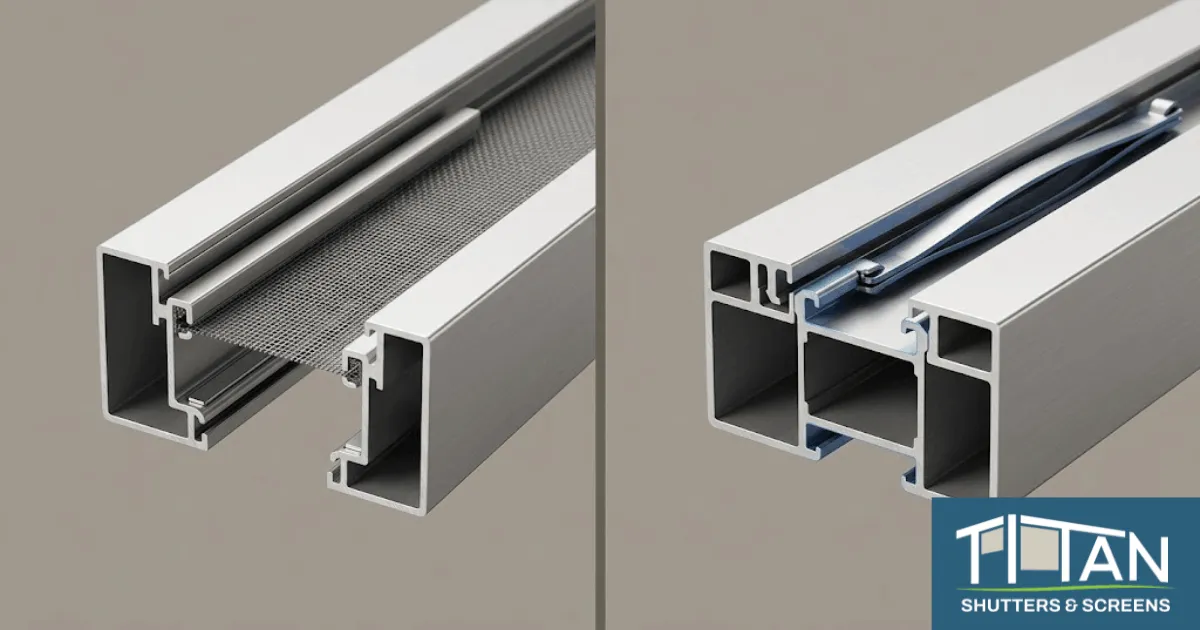
Magnet Track vs Spring Track Hurricane Screens | Comparison
Magnetic Side Track vs. Spring Track Hurricane Screens — The Architectural Comparison Homeowners Deserve
If you are a Northeast Florida homeowner researching motorized hurricane screens, you have already discovered that the category is divided into two architectural camps. The marketing from both sides is confident. The specifications sound similar. The claims overlap. And unless you happen to understand the physics of track engineering, the difference between the two approaches is nearly invisible from a product brochure.
This article exists because the difference is not invisible. It is fundamental. And it determines how the screen performs in the four situations that matter most to a homeowner in St. Augustine, Nocatee, Ponte Vedra Beach, or Palm Coast: cold weather, 185 MPH winds, long-term warranty service, and the sound the system makes every time it deploys.
We are not going to name brands. We are going to describe architectures — how each one works, where each one excels, and where each one has documented limitations. The homeowner who understands the architecture will recognize which system they are looking at in any showroom, on any website, and in any quote they receive.
Two approaches. One comparison. The facts.
The Short Answer
What is the difference between magnetic side-track and spring-track hurricane screens?
Motorized hurricane screen technology has converged on two architectural approaches. Magnetic side-track systems use rare-earth magnets to bond a free-floating inner track to a fixed outer track. Spring-track systems use mechanical leaf-spring physics with a fork-locked inner chamber. Both deploy similarly. Both retract similarly. They behave very differently in cold weather, in 185 MPH winds, in long-term warranty service, and in the sound they make. Magnetic side-track systems are rated to 156 MPH and have not achieved Miami-Dade approval. The MaxForce silent spring-track system carries Florida Product Approval FL 8637R11, a 185 MPH HVHZ wind rating, and Miami-Dade compliance.
How Magnetic Side-Track Systems Work — and Where They Excel
Magnetic side-track systems use rare-earth magnets embedded in the track profile to bond a free-floating inner track to a fixed outer track. The screen fabric is attached to the inner track via a Keder edge — a bead-and-groove retention system borrowed from sailboat rigging. When the screen deploys, the motor drives the fabric downward through the track. The magnetic bond between inner and outer tracks holds the system in alignment, creating a tight, clean fabric appearance.
Where magnetic side-track systems excel is aesthetic. The magnetic bond pulls the inner track snug against the outer track, which produces a custom-fit fabric appearance — no visible slack, no sag, no bow. For homeowners whose primary concern is the visual appearance of the deployed screen, magnetic side-track systems deliver a clean look. The maximum span on some magnetic systems reaches 30 feet, which covers the widest lanai openings.
The wind rating on magnetic side-track systems typically reaches 156 MPH — a Category 5 claim. These systems have not achieved Miami-Dade High Velocity Hurricane Zone (HVHZ) approval, which is the most demanding wind-borne debris standard in the United States. The 156 MPH rating is tested to a different standard than the 185 MPH HVHZ rating carried by Florida Product Approval FL 8637R11.
The magnetic bond that creates the tight appearance also creates documented limitations. Our earlier field investigation examined these in detail, but the summary is worth restating here. In cold weather — when Northeast Florida temperatures dip into the 30s and 40s during winter months — the screen fabric contracts. That contraction increases lateral pressure on the magnetic inner track, strengthening the magnetic bond. When the bond strength exceeds the motor’s deployment force, the screen fails to deploy. The documented field workaround is for a service technician to instruct the homeowner to manually push the screen downward to break the magnetic bond — a workaround, not a fix.
The magnetic snap-back during operation also produces sound — a popping, grinding, or clicking noise as the magnets release and re-engage during deployment and retraction. This is an inherent characteristic of magnetic track physics, not a defect in any particular system. Some homeowners accept it. Others stop using the screen for daily deployment because the sound disrupts the outdoor living experience.
How Spring-Track Systems Work — and Where They Excel
Spring-track systems use the same physical principle as a vehicle’s leaf-spring suspension. A free-floating inner track rides inside an outer track, held in position by mechanical leaf springs rather than magnets. When force is applied — whether from wind, from deployment tension, or from thermal expansion and contraction — the spring absorbs the energy and returns the inner track to its original position. Gently. Smoothly. Silently.
The new MaxForce silent spring-track architecture, announced on June 2, takes this principle and engineers it for hurricane-grade performance with three specific refinements. First, an internal fork-locking system — the inner track contains a fork-like mechanical lock that prevents the inner track from dislodging even when twisted to a 45-degree angle under hurricane wind loads. Second, a forward-facing inner chamber positioned at the center of the track profile — the geometric centroid of wind-load forces, which is the strongest mechanical position to absorb and return energy. Third, a reinforced rear chamber with additional aluminum mass at the location that bears the most predictable structural stress during wind events.
The MaxForce spring-track system carries Florida Product Approval FL 8637R11 and a 185 MPH HVHZ wind rating — the highest in the motorized hurricane screen category. It is Miami-Dade compliant and tested to ASTM E1886, ASTM E1996, ASTM E330, TAS 201, TAS 202, and TAS 203. The OmegaTex fabric is a ballistic-grade aramid-fiber reinforced mesh manufactured by Twitchell. The system is backed by a lifetime manufacturer warranty, and every Fenetex product generation is backward-compatible with every prior generation — a design doctrine established in 2007 when Fenetex introduced OneTrack, the first motorized screen built on spring-track technology.
The new spring-track architecture also delivers the tight, taut fabric appearance that was previously exclusive to magnetic side-track systems — without the magnetic bond, without the cold-weather limitation, and without the operational sound. Per Fenetex field data, the new track eliminates approximately 98 percent of the service calls associated with prior-generation architectures.
Florida Building Code — Opening Protection
Any opening larger than three square feet in a Florida High-Velocity Hurricane Zone must be protected with a tested and certified opening protection system. The HVHZ standard requires testing to Miami-Dade protocols, including large missile impact at 50 feet per second and cyclic pressure testing to design wind loads. Not all motorized hurricane screens meet this standard.
The Cold-Weather Comparison
Northeast Florida is not the tropics. Winter temperatures in St. Johns, Duval, and Flagler counties regularly dip into the 30s and 40s. January mornings in Nocatee and Ponte Vedra Beach can reach the low 30s. Homeowners who use their motorized screens daily — for privacy, bug control, and wind protection— deploy and retract the screens year-round, including during cold-weather months.
In a magnetic side-track system, cold temperatures cause the screen fabric to contract. That contraction increases lateral pressure against the magnetic inner track. The magnetic bond — which holds the inner track against the outer track — becomes stronger as the fabric tightens. When the bond strength exceeds the motor’s deployment force, the screen does not deploy. The motor runs, but the screen does not descend. The documented field response is manual assist — the homeowner or a service technician physically pushes the screen downward to break the magnetic bond and allow the motor to resume deployment.
In a spring-track system, there is no magnetic bond to overcome. Deployment relies on gravity, motor force, and mechanical spring physics — none of which are affected by ambient temperature. Fabric contraction in cold weather simply applies pressure against the spring, which absorbs it and returns to position. The screen deploys consistently in January the same way it deploys in July. No manual assist. No service call. No workaround.
The Long-Term Warranty Comparison
A lifetime warranty is only as meaningful as the parts supply that supports it. This is a distinction most homeowners do not consider at the time of purchase — and discover only when something needs to be replaced years later.
Some magnetic side-track manufacturers have discontinued parts for earlier product generations. A homeowner who installed a first-generation or second-generation magnetic side-track system may find that replacement parts are no longer manufactured. The warranty exists on paper. The parts to fulfill it do not. This is the reality we described in our installer’s perspective article: a warranty that cannot be fulfilled is not a warranty. It is a marketing claim.
The Fenetex engineering doctrine — established by the engineer behind both OneTrack (2007) and the new MaxForce track (2026) — is explicit: never design a product that makes older models obsolete. Every Fenetex product generation is backward-compatible with every prior generation. A OneTrack installation from 2010 still has parts available in 2026. A MaxForce installation from 2026 will still have parts available in 2040. The lifetime warranty is not a document filed in a drawer. It is a design philosophy that determines how the engineering team builds every generation.
One more thing worth knowing: TheMaxForce installation timeline runs 60 to 90 days from order to completion. The aluminum shutter types that protect the glass openings on the same home carry the same lead time. June 21 orders may be installed by late August or September — inside peak hurricane season. The calendar is not a sales tactic. It is the manufacturing reality of custom-built protection.
Your Decision Framework
The comparison table presents the facts. The homeowner draws the conclusion. Both architectures exist because both solve a real problem. Magnetic side-track systems deliver a clean aesthetic and a wide span. Spring-track systems deliver a higher wind rating, silent operation, consistent cold-weather performance, a lower service-call profile, and a backward-compatibility doctrine that makes the lifetime warranty meaningful across decades.
For Northeast Florida homeowners — where the combination of hurricane exposure, winter cold snaps, daily-use expectations, and long-term home investment makes every dimension of this comparison relevant — the architecture choice has consequences that last far longer than the initial purchase decision.
Two architectures. One that is engineered to be serviceable in 2040.
Frequently Asked Questions
What is the difference between magnetic side-track and spring-track hurricane screens?
Magnetic side-track systems use rare-earth magnets to bond a free-floating inner track to a fixed outer track. Spring-track systems use mechanical leaf-spring physics with a fork-locked inner chamber. The key differences are in cold-weather operation (magnets can prevent deployment when fabric contracts in cold temperatures; springs are unaffected), operational sound (magnetic snap-back produces popping and clicking; springs are silent), wind rating (magnetic systems typically reach 156 MPH without Miami-Dade approval; MaxForce spring-track is rated to 185 MPH HVHZ with FL 8637R11), and long-term serviceability (some magnetic generations have been discontinued; all Fenetex spring-track generations remain backward-compatible).
Which hurricane screen system has the lowest service-call rate?
According to Fenetex field data, the new MaxForce silent spring-track architecture eliminates approximately 98 percent of the service calls associated with prior-generation motorized hurricane screen architectures. The self-adjusting alignment of the spring mechanism corrects itself without service intervention, and the absence of a magnetic bond eliminates the cold-weather deployment failures and magnetic alignment drift that drive the majority of service calls in magnetic side-track systems.
Which hurricane screen system has the longest warranty?
Both magnetic side-track and spring-track systems typically carry lifetime warranties. The critical distinction is warranty fulfillment. Some magnetic side-track manufacturers have discontinued parts for earlier generations, making warranty service impossible on those systems. Fenetex maintains backward compatibility across every product generation since 2007, which means parts are available for every system ever installed. A lifetime warranty is only as meaningful as the manufacturer’s commitment to producing parts for every generation.
What hurricane screen wind rating is best for Northeast Florida?
Northeast Florida is not technically classified as a High-Velocity Hurricane Zone, but the region’s hurricane exposure — demonstrated by Hurricane Matthew (2016) and Hurricane Milton (2024) — makes the highest available wind rating the prudent choice. The MaxForce spring-track system at 185 MPH HVHZ with Miami-Dade compliance and FL Product Approval 8637R11 carries the highest wind rating in the motorized hurricane screen category. The 185 MPH rating also qualifies for the maximum opening protection credit under Florida Statute §627.0629.
Can I see both architectures before deciding?
Titan Shutters and Screens can demonstrate the MaxForce silent spring-track system on an installed system in Northeast Florida. We encourage every homeowner to see and hear the system operate before making a decision. We also encourage homeowners to request demonstrations from any other installer they are considering — specifically asking to see the system deploy in real conditions, listening for operational sound, and asking about the cold-weather deployment record in Northeast Florida. The architecture comparison is most convincing when experienced in person.
