The Northeast Florida Hurricane Checklist: Every Opening, Every Risk, One Plan
This is the post that pulls everything together.
Over the past three weeks, we have covered the reality of hurricane preparation timelines, a complete guide to aluminum hurricane shutters, and an honest assessment of motorized screens for hurricane protection. Each of those posts went deep on a single topic. This one goes wide.
This is your pre-season hurricane checklist — built specifically for homeowners in St. Augustine, Nocatee, Ponte Vedra Beach, and the surrounding St. Johns County and Flagler County communities. It covers every step between where you are today and where you need to be by June 1: property assessment, exterior opening inventory, product decisions, HOA approval, insurance optimization, lead time management, and emergency preparedness. It is designed to be saved, printed, and used — not just read.
Hurricane season runs from June 1 through November 30. Today is April 22. That gives you 39 days. Custom hurricane shutters and motorized screen systems carry lead times of 60 to 90 days. If you have not started the process yet, the math is tight. If you start this week, the math works.
Here is how to use the next 39 days.
Step 1: Know Your Evacuation Zone and Storm Surge Risk
Before you invest a single dollar in storm-protection hardware, you need to understand your property's specific risk profile. Not Florida's risk. Not the Gulf Coast's risk. Your neighborhood's risk.
St. Johns County Emergency Management maintains an interactive evacuation zone locator at sjcfl.us. Enter your address, and the system returns your designated evacuation zone — A through E, with A representing the highest storm-surge risk. Ponte Vedra Beach, Vilano Beach, Anastasia Island, Davis Shores, Crescent Beach, and the A1A corridor fall predominantly in Zones A and B. Nocatee, World Golf Village, Silverleaf, and the inland communities west of I-95 are generally Zone C or higher — lower storm surge risk, but not immune to wind damage, flooding from rain, and power outages that affect the entire county during a major storm.
Knowing your zone determines your evacuation decision. It does not determine your decision on protection. Wind-borne debris travels regardless of zone classification. A home in Nocatee is just as vulnerable to a window being breached by airborne roofing material as a home on Anastasia Island. The evacuation zone tells you when to leave. The storm protection plan determines what you come home to.
Write down your zone. Know your evacuation route. The St. Johns County Emergency Management website and the City of St. Augustine both publish zone-specific route maps. Do this today — it takes five minutes, and it eliminates one of the most stressful decisions you will face if a storm approaches.
Step 2: Walk Your Property — Every Opening, Every Vulnerability
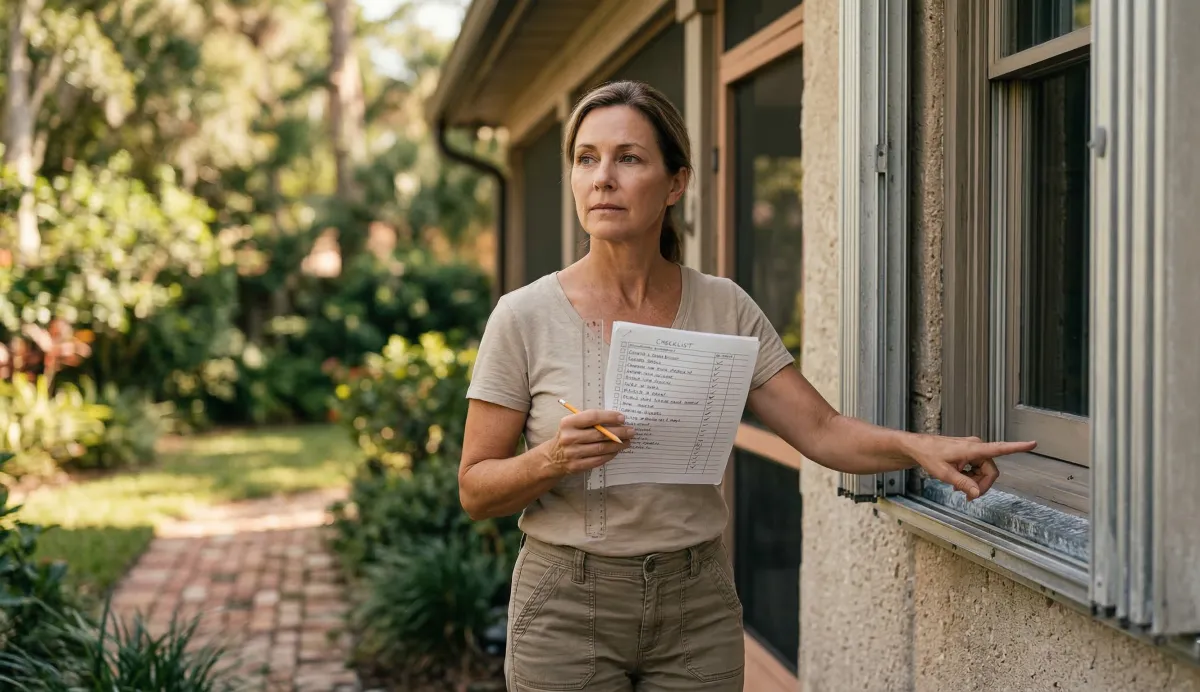
This is the most valuable hour you will spend this April. Walk the entire exterior of your home with fresh eyes and a notepad. You are building an inventory of every exterior opening and assessing the current state of each.
Windows. Count every window on all four sides of the home. Note which are currently unprotected, which have existing shutters or impact glass, and which have shutters that may be damaged, outdated, or no longer code-compliant. Pay particular attention to large picture windows, second-story windows that are difficult to reach for manual shutter deployment, and any window facing east toward the Atlantic — the primary direction of wind-driven debris in most Northeast Florida hurricane scenarios.
Doors. Every exterior door is a potential point of entry. Entry doors, sliding glass doors, garage doors, and French doors all require protection. Sliding glass doors are among the most vulnerable openings on a Northeast Florida home — large surface area, glass construction, and often positioned on the side of the home facing the lanai or pool, which is typically the least sheltered.
The lanai and patio. This is where most Northeast Florida homeowners discover the largest gap in their storm plan. If your lanai is enclosed by a traditional fixed screen enclosure — the standard aluminum-framed cage with non-rated mesh — it carries zero hurricane certification. The mesh acts as a sail in high winds, and the frame absorbs the stress. Most contractors advise cutting the mesh before a major storm and paying $2,000 to $8,000 for rescreening afterward. If this describes your lanai, you have identified the opening where a Fenetex hurricane-rated motorized screen delivers its greatest value.
Pergolas and outdoor kitchens. If you have invested in a StruXure pergola, an outdoor kitchen, or any substantial outdoor living improvement, assess how to protect that investment during a storm. A pergola with louvered panels can close against rain — but it does not protect the furniture, appliances, or surrounding structure from wind-borne debris. Motorized screens paired with a pergola create a deployable barrier that protects the entire space.
The garage. Garage doors represent the single largest opening on most homes. A standard two-car garage door spans 16 feet or more. If this opening is breached, the pressure differential inside the home changes catastrophically. If your garage door is not rated for hurricane wind loads, this is a critical vulnerability — and one that exists regardless of how well the rest of the home is protected.
Write down every opening. Categorize each one: protected, partially protected, or unprotected. That list becomes the foundation of your storm protection plan.
Step 3: Match the Right Product to Every Opening
This is where the first three posts in this series become actionable. Each type of opening has a product that is engineered specifically for it. The mistake most homeowners make is trying to use one product everywhere, or protecting the easy openings and ignoring the difficult ones.
Windows and primary entry doors → Aluminum hurricane shutters. Roll-down shutters for large openings, second-story windows, and any location where push-button deployment is a priority. Accordion shutters for standard windows and doors where reliable, affordable protection is the goal. Bahama shutters for homes that want year-round shade and architectural enhancement alongside storm protection. Colonial shutters for properties — particularly in the St. Augustine historic district and HOA communities — where traditional aesthetics are a requirement.
Lanai, covered patio, and pergola openings → Hurricane-rated motorized screens. Fenetex MaxForce hurricane screens for any large open-air space where a rigid aluminum shutter is impractical or architecturally inappropriate. These screens carry Florida Product Approval FL 8637, deploy at the push of a button or through smart home integration, and retract into a flush-mounted housing when not in use. They protect the space during a storm and deliver daily value — bug protection, 91 percent UV blocking, privacy, and rain management — every other day of the year.
Standard openings where motorized convenience is not needed → One-Track motorized screens. For insect and shade protection for openings that do not require hurricane-rated fabric, the Fenetex One-Track system offers a lighter, more affordable motorized screen option that integrates with smart home platforms and retracts completely when not in use.
The goal is not to buy the most expensive product for every opening. It is to buy the right product for every opening. Titan installs every product listed above, and we recommend the appropriate match for each opening during a free home assessment — because we have no financial incentive to steer you toward one product when another is the better fit.
Step 4: Navigate Your HOA — The Law Is on Your Side
If you live in Nocatee, Ponte Vedra Beach, Coastal Oaks, World Golf Village, Silverleaf, or any master-planned community in St. Johns County governed by an HOA, this step matters.
Florida HB 293, which took effect in 2024, requires homeowners' associations to adopt hurricane protection specifications and prohibits them from denying homeowners the right to install code-compliant hurricane protection products. Your HOA can regulate color and style to maintain aesthetic consistency. Your HOA cannot block the installation of Florida Building Code-approved shutters or motorized screens.
The practical reality is that most HOA architectural review committees process these requests smoothly — especially when the homeowner provides complete product specifications, Florida Product Approval numbers, and color options upfront. This is the documentation Titan prepares for every installation project in an HOA community. We submit it with you or on your behalf, and we have experience with the specific review processes of the major communities across St. Johns County.
Do not let a perceived HOA restriction delay your storm protection plan. The law changed. The documentation is straightforward. And the earlier you submit, the earlier you are approved — which matters when the installation calendar is filling and lead times are measured in months.

Step 5: Schedule Your Wind Mitigation Inspection and Review Your Insurance
This step can save you thousands of dollars — and most homeowners either do not know about it or assume it applies only to newer homes. It applies to every home with qualifying storm protection.
Florida Statute 627.0629 requires insurance carriers to offer premium discounts for verified wind mitigation features. After your hurricane shutters and motorized screens are installed, a licensed wind mitigation inspector evaluates the protection systems on every exterior opening. That inspection generates a report — the OIR-B1-1802 form — which is submitted to your insurance carrier. The carrier is then required by law to apply the corresponding insurance discount.
The savings typically range from 10 to 30 percent on the wind and hurricane portion of your annual premium. In St. Johns County, where insurance costs have escalated sharply over the past three years due to statewide market disruption, rising replacement costs, and reinsurance pricing, that discount represents real money — potentially $800 to $2,000 or more annually, depending on your policy, your coverage level, and the protection systems in place.
The wind mitigation inspection should be scheduled after your shutter and screen installation is complete. Titan can recommend licensed inspectors in the St. Johns County market who are experienced with both aluminum shutter systems and Fenetex motorized screens.
While you are reviewing insurance, also confirm: Do you have flood insurance? Standard homeowner's policies cover wind damage but not flood damage. If your property is in a FEMA-designated flood zone — or even if it is not, since extreme rainfall from hurricanes can flood areas outside designated zones — a separate flood policy through the National Flood Insurance Program or a private carrier is worth evaluating. Flood insurance carries a 30-day waiting period from purchase to activation. Do not wait until June.
Step 6: Manage the Lead Time Calendar
This is the step where preparation meets logistics. Every custom-fabricated storm protection product has a lead time from deposit to completion of installation. These lead times are not flexible — they are driven by fabrication schedules, material supply chains, permitting timelines, and installation crew availability.
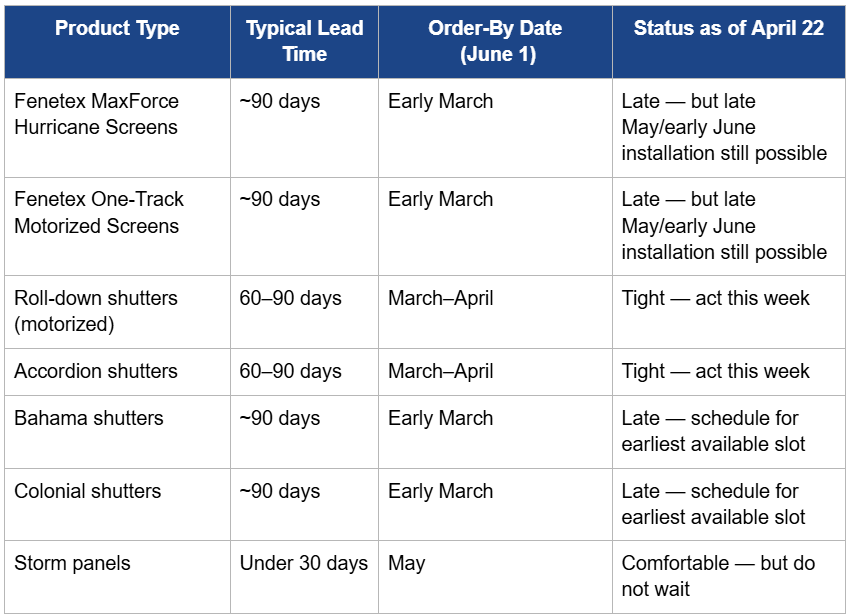
If you are reading this on April 22 and you have not started the process, here is the honest reality: a June 1 completion date for some products may no longer be achievable. But hurricane season runs through November 30. The goal is not exclusively June 1 — it is the earliest possible installation date. Every week you wait pushes that date further into the season.
The most productive action you can take today is to schedule a home assessment. That starts the process — the property walk, the opening inventory, the product recommendations, the quote, and the deposit that puts you in the fabrication queue.
Step 7: Prepare Beyond the Hardware — Your Emergency Readiness Kit
Storm protection hardware protects the home. Emergency preparedness protects the people inside it. This checklist covers both, because Titan is not just in the business of installing shutters and screens — we are homeowners in this community, and we go through the same season you do.
Emergency supplies (assemble now, not in June): Minimum three-day supply of water — one gallon per person per day. Non-perishable food and a manual can opener. Flashlights with fresh batteries and backup batteries. Battery-powered or hand-crank NOAA weather radio. First aid kit. Prescription medications — minimum seven-day supply. Important documents in a waterproof container: insurance policies, identification, medical records, and property deed. Cash — ATMs and card readers require power.
Communication plan: Designate an out-of-state contact as your family check-in point. Ensure all household members know the evacuation zone and route. Register for Alert St. Johns — the St. Johns County Emergency Notification System — to receive official evacuation orders and shelter information directly. Download the FEMA app for real-time alerts.
Home preparation (48 hours before a storm): Charge all devices. Fill vehicles to full fuel — do not wait for the rush. Set the refrigerator and freezer to the coldest settings. Fill bathtubs with water for non-drinking use. Move outdoor furniture, grills, potted plants, and any loose items into the garage or a protected interior space. Deploy shutters and motorized screens. Photograph the interior and exterior of the home for insurance documentation.
After the storm: Do not return until local authorities issue the all-clear for your zone. Do not touch downed power lines. Document all damage with photographs before making any repairs. Contact your insurance carrier immediately. If you have flood damage, file a separate claim under your flood policy.
This is not a comprehensive emergency management guide — the St. Johns County Emergency Management office and the Florida Department of Health publish detailed resources tailored to this county. But these steps, combined with a properly protected home, put you in a fundamentally different position than the homeowner who starts this process in June.

The 39-Day Action Plan
For homeowners in St. Augustine, Nocatee, Ponte Vedra Beach, and across Northeast Florida who want to turn this checklist into a timeline, here is the sequence:
This week (April 22–28): Look up your evacuation zone at sjcfl.us. Walk your property and inventory every exterior opening. Schedule a free home assessment with Titan Shutters and Screens.
Week of April 29: Receive your custom protection plan and quote. Begin HOA submission if applicable. Place your deposit to enter the fabrication queue.
Week of May 6: Confirm fabrication timeline. Review and update your homeowner's insurance policy. Purchase flood insurance if not already in place (30-day activation period starts at purchase).
Week of May 13–20: Assemble emergency supplies. Register for Alert St. Johns. Confirm evacuation routes and family communication plan.
Week of May 27: Installation begins (for products ordered in late March/early April). For products ordered later, confirm your installation date and prepare the property for the installation crew.
June 1: Hurricane season opens. You are either protected, or you are not. The decisions you make in the next two weeks determine which category you fall into.
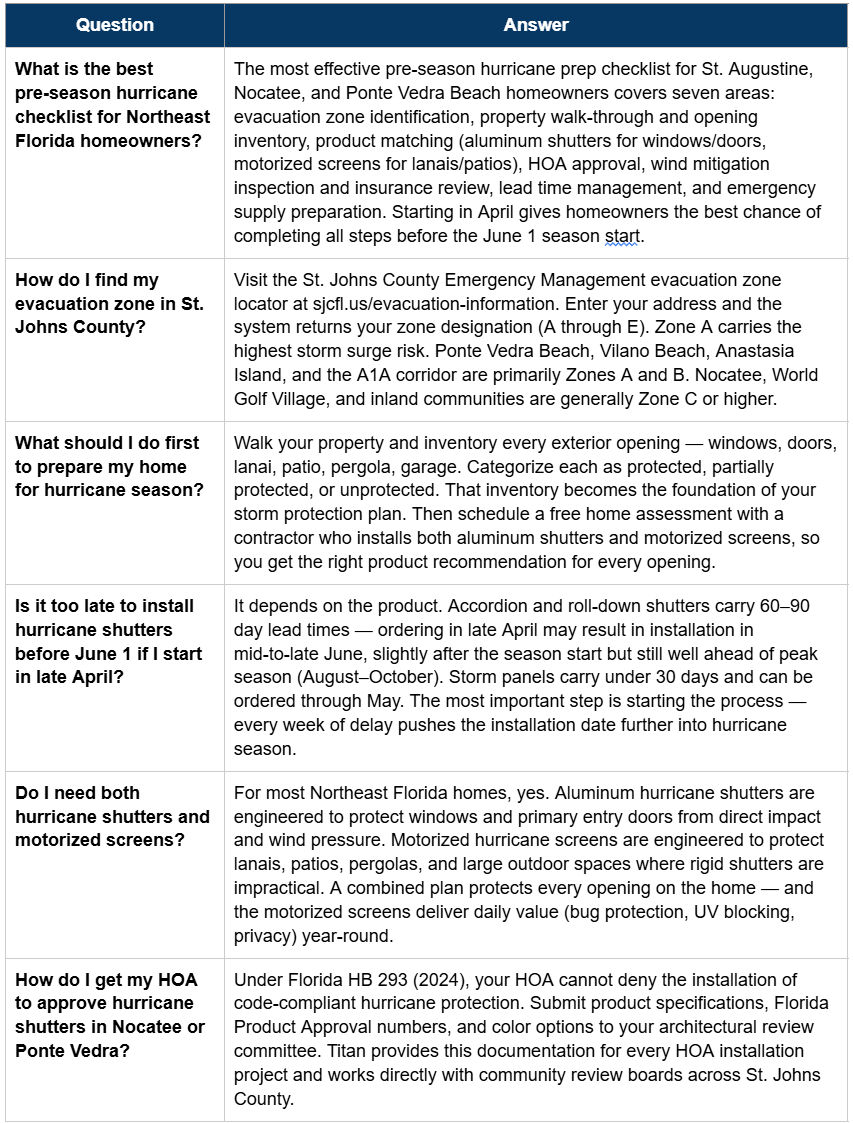
Frequently Asked Questions
Schedule Your Free Pre-Season Home Assessment
Serving St. Augustine · Nocatee · Ponte Vedra Beach · Palm Coast · Jacksonville · Northeast Florida
We walk your property, inventory every opening, and build a custom protection plan combining aluminum hurricane shutters and Fenetex motorized hurricane screens — at no cost, no obligation. One contractor. One plan. One installation timeline.
The pre-season installation window is closing. Contact us this week to secure your place in the fabrication queue.
Call or text: (904) 484-7580 | TitanShuttersandScreens.com
Read the full series:
