How to Protect Your Patio From Hurricane Winds | NE Florida
How to Actually Protect Your Patio From Hurricane Winds — A Northeast Florida Field Guide
Somewhere in Northeast Florida this Memorial Day weekend, a homeowner will tape a large X across a sliding glass door and believe they have done something useful.
Somewhere else, a neighbor will stack sheets of plywood against the garage wall, cut roughly to size from a trip to the hardware store three seasons ago, and believe those sheets will hold a thirty-foot lanai opening together when the wind reaches triple digits. Social media will reinforce both beliefs. YouTube will show a man in a polo shirt screwing half-inch plywood over a standard window and calling it hurricane preparedness. A comment section will agree.
The Florida Building Code stopped agreeing in the 1990s.
This article is the field guide for the homeowner who wants to know what actually works. Not what is popular. Not what is cheap. Not what the internet recommends when the first named storm appears in the Atlantic and the search traffic spikes. The five things that actually protect a Northeast Florida patio from hurricane winds — ranked by wind rating, engineered to code, and available to order right now if you move before the calendar does.
The Short Answer
What are the best ways to protect a patio from hurricane winds?
There are five protective layers a Northeast Florida patio can use against hurricane winds: motorized hurricane screens rated to 185 MPH HVHZ wind loads, wind-load-rated pergola enclosures with integrated screen systems, hurricane-rated pool cage reinforcement, removable wall panels for open-air patios, and structural tie-downs for outdoor kitchens and built-in appliances. Plywood is not on this list. Tape on glass is not on this list. The real options are engineered, tested to Florida Building Code standards, and need to be ordered now — not when a storm is named. Lead times run 60 to 90 days. June 1 is seven days away.
What Does Not Work (And Why People Still Believe It Does)
Before the five things that work, the three things that do not. These persist because they are visible, they are cheap, and they feel like action. They are not protection. They are performance.
Plywood. Half-inch plywood sheeting was once considered an acceptable temporary measure for standard-sized windows. It was never acceptable for large openings. It cannot meet the structural requirements of the Florida Building Code for wind-borne debris impact. It is ineffective above approximately 100 MPH winds, and it is useless on any glass or opening wider than eight feet. A thirty-foot lanai opening cannot be covered by plywood in any configuration that a building inspector would approve. More critically, plywood is not a certified opening protection system under the FBC. It does not qualify for the opening protection insurance credit under Florida Statute §627.0629. It is not engineered. It is not tested. It is a sheet of wood held in place by screws that were never designed to resist design pressures exceeding ±200 PSF.
Tape on glass. Masking tape, duct tape, and painter’s tape applied in an X pattern across glass provides exactly zero structural protection against wind-borne debris. It does not hold the glass together on impact. It does not reduce the velocity of incoming debris. What it does, according to the Federal Alliance for Safe Homes, is create larger, heavier shards of glass when the pane shatters — making the failure more dangerous, not less. The Florida Building Code does not recognize tape as any category of opening protection. It has not since the 1990s. The myth persists because it looks like preparation.
Outdoor furniture covers and tie-downs alone. Covering patio furniture and tying it down protects the furniture from rain and light wind. It does not protect the furniture — or anything around it — from 185 MPH winds. At hurricane-force wind speeds, unsecured outdoor furniture becomes wind-borne debris. A tied-down furniture set with a canvas cover becomes wind-borne debris that is slightly harder to remove from whatever it lands on. Covers and tie-downs are a component of storm preparation. They are not patio hurricane protection.
The Five Things That Actually Work
Real patio hurricane protection is engineered, code-compliant, and tested to the standards that the Florida Building Code requires. These are the five protective layers available to Northeast Florida homeowners, ranked by wind rating and lasting value. Not every home needs all five. Every home needs at least one.
Florida Building Code
“Any opening larger than three square feet in a Florida High-Velocity Hurricane Zone must be protected with a tested and certified opening protection system.” Plywood is not a certified opening protection system.
1. Motorized hurricane screens: the lanai and patio foundation
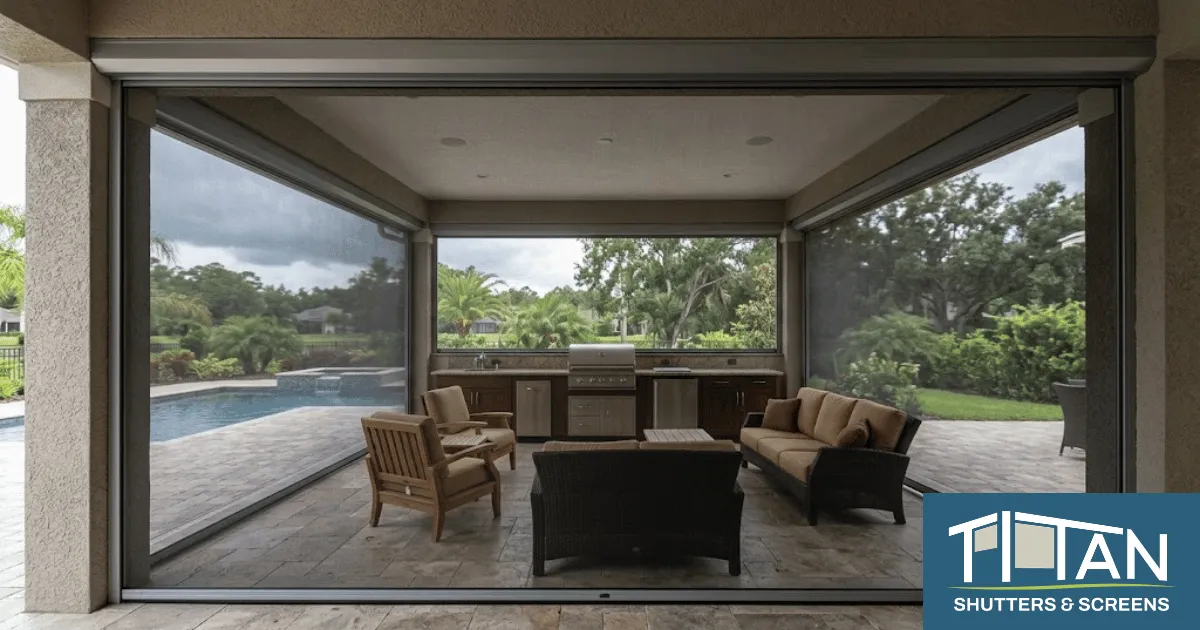
Motorized hurricane screens are the primary protection layer for any lanai, covered patio, or large outdoor opening in Northeast Florida. They are the only product category engineered specifically for the wide-span openings — up to 25 feet — that define how Northeast Florida homes are built. The Fenetex MaxForce Hurricane Screens system carries Florida Product Approval FL 8637R11, is rated to 185 MPH high-velocity hurricane zone wind loads, and has been tested to ASTM E1886, ASTM E1996, ASTM E330, TAS 201, TAS 202, and TAS 203 — the most demanding testing standards in the United States.
The screen fabric is Twitchell OmegaTex, a ballistic-grade aramid-fiber reinforced material that blocks up to 95 percent of damaging UV rays while handling design pressures of ±200 PSF. The system uses Keder-edge technology — borrowed from sailboat rigging — that eliminates zippers, cables, and exposed hardware. The weight bar is the heaviest in the industry pound-for-pound, with reinforced corners and high-strength nylon construction that absorbs impact while maintaining structural integrity.
What separates motorized hurricane screens from every other item on this list is that they are not single-purpose. The same screen that locks down the lanai before a hurricane deploys every evening to provide privacy, bug protection, solar gain reduction, dust control, and rain shielding. It integrates with Alexa, Google Home, and other smart home systems through the Bond Bridge Pro hub. It operates from a handheld remote, a mobile app, or a voice command. It is the rare hurricane product that earns its keep 365 days a year.
MaxForce screens qualify for the opening protection insurance credit under Florida Statute §627.0629 when properly installed and documented on the OIR-B1-1802 wind mitigation form. The discount ranges from 10 to 30 percent on the wind and hurricane portion of the homeowner’s premium. They are backed by Fenetex’s lifetime manufacturer warranty and are installed exclusively by certified dealers — Titan Shutters and Screens has held that certification for over a decade.
2. Wind-load-rated pergola enclosures
Pergolas are one of the most popular outdoor structures across Nocatee, Ponte Vedra Beach, World Golf Village, and the newer communities in St. Johns County. They are also one of the most exposed. A standalone pergola with no integrated screen system offers zero wind protection for whatever sits beneath it. A wind-load-rated pergola enclosure — a permanent pergola structure with Fenetex motorized hurricane screens integrated into the structural columns and header beams — transforms the pergola from a liability into a protected space.
The key engineering requirement is that the pergola structure itself must be rated for the wind loads the screens will transfer to it. Screens that are rated to 185 MPH will transfer those forces into the mounting structure. If the pergola was not engineered for those loads, the screens survive and the pergola does not. Titan’s assessment process evaluates the structural capacity of existing pergolas and recommends reinforcement where necessary before screen installation begins.
3. Hurricane-rated pool cage reinforcement
A standard pool cage uses lightweight aluminum framing and standard pool screen mesh designed to keep out insects and leaves. It carries no hurricane wind rating. It is not designed to resist storm-force winds or wind-borne debris. When Hurricane Matthew tracked the First Coast in 2016, pool cage collapses were among the most common categories of residential damage in St. Johns County and across the Ponte Vedra Beach corridor.
Hurricane-rated pool cage reinforcement involves upgrading the cage’s structural framing and replacing standard mesh with engineered hurricane fabric. Not every existing pool cage qualifies for reinforcement — some are too lightweight or too deteriorated to serve as the structural frame for a hurricane-rated system. The assessment determines whether the existing cage can be upgraded or whether the protection needs to be engineered as a separate screen system installed alongside the cage.
4. Removable wall panels for open-air patios
Some Northeast Florida patios are open-air — no lanai roof, no screen enclosure, no permanent structure. For these spaces, removable wall panels offer storm-only protection that installs before a hurricane and is removed afterward. Panels are engineered to specific wind loads, manufactured to the dimensions of the opening, and stored between storms. They are not a year-round solution. They do not provide daily-use benefits. They are a lower-cost option for homeowners whose primary concern is protecting the patio investment during the storm itself.
5. Structural tie-downs for outdoor kitchens and built-in appliances
An outdoor kitchen that is not structurally tied down is a collection of expensive projectiles. At hurricane-force wind speeds, a standalone grill, a freestanding refrigerator, or an unsecured countertop section can be lifted and thrown into the pool, the home, or the neighbor’s property. Structural tie-downs anchor outdoor kitchen components, built-in appliances, and freestanding furniture to the patio slab or the lanai foundation. They are not a substitute for screens or shutters. They are a complementary layer — the difference between furniture that stays put and furniture that becomes debris.
One more thing worth knowing: The five layers described above are not mutually exclusive. The most protected patios in Northeast Florida combine motorized hurricane screens on the lanai openings, structural tie-downs on the outdoor kitchen, and aluminum hurricane shutters on every glass door and window that faces the outdoor space. The screen protects the opening. The tie-downs protect the contents. The shutters protect the home behind it. That combination is what separates a property that files a claim from a property that does not.
The Northeast Florida Approach
Northeast Florida is not technically classified as a High-Velocity Hurricane Zone under the Florida Building Code. That designation belongs to Miami-Dade and Broward counties. But the distinction is a technicality that the weather does not observe.
Hurricane Milton’s $18.8 million in Flagler County damage in October 2024 came from wind speeds well below the HVHZ threshold. The outdoor structures that failed — pool cages, screen enclosures, unsecured pergolas — failed because they were built to a standard that assumed the HVHZ designation was the line between “needs serious protection” and “probably fine.” The homes that survived with no outdoor damage were the homes that had installed protection rated to HVHZ standards regardless of what the code technically required.
This is the Northeast Florida approach that experienced homeowners and knowledgeable installers have adopted: protect to the highest available standard, not the minimum required standard. Coastal salt air accelerates corrosion on hardware that was not engineered for it. The combination of Atlantic exposure and Intracoastal proximity creates wind patterns that do not respect county-line designations. And the paralleling storms — the ones that track the coastline without making direct landfall — deliver sustained punishment across hundreds of miles that no single wind-zone classification captures.
Miami-Dade-grade protection is not overkill for Northeast Florida. It is the minimum that the last decade of storm history justifies.
The Order of Operations
Protecting a patio from hurricane winds is not a single purchase. It is a sequence — and the sequence matters because the calendar does not wait.
What to Do Right Now — Your Late-May Action Plan
The internet will tell you that plywood and tape are hurricane protection. The Florida Building Code will tell you they are not. The insurance industry will tell you they do not qualify for a discount. And the calendar will tell you that the window for ordering engineered protection that arrives before peak season is closing this week.
The homeowners who protect their patios correctly are not the homeowners with the biggest budgets. They are the homeowners who stopped believing in plywood and started believing in engineering.
Real protection is engineered. Everything else is performance.
Frequently Asked Questions
Is plywood still acceptable hurricane protection under the Florida Building Code?
Plywood is not a certified opening protection system under the Florida Building Code. It cannot meet structural requirements for wind-borne debris impact testing, is ineffective above approximately 100 MPH winds, and is unusable on any opening wider than eight feet. It does not qualify for the opening protection insurance credit under Florida Statute §627.0629. The Florida Building Code requires openings larger than three square feet in a High-Velocity Hurricane Zone to be protected with a tested and certified system. Plywood does not meet that standard.
Can a regular screen enclosure protect my lanai from a hurricane?
No. A standard screen enclosure — including a standard pool cage — uses lightweight aluminum framing and standard mesh designed to keep out insects and leaves. It carries no hurricane wind rating and is not designed to resist storm-force winds or wind-borne debris. Hurricane-rated protection requires engineered fabric like Twitchell OmegaTex, structural framing rated to specific wind loads, and Florida Product Approval certification. The Fenetex MaxForce system, FL Product Approval 8637R11, is rated to 185 MPH HVHZ wind loads.
What wind rating should I look for in a motorized hurricane screen?
Look for a system rated to at least 185 MPH HVHZ — the Miami-Dade High-Velocity Hurricane Zone standard, which is the toughest in the United States. Confirm the system carries a current Florida Product Approval number and has been tested to ASTM E1886, ASTM E1996, and ASTM E330 standards. Any system rated below HVHZ standards may not protect against the wind speeds Northeast Florida has historically experienced. The Fenetex MaxForce system carries FL Product Approval 8637R11 and meets all of these standards.
Do I need a permit to install motorized hurricane screens in St. Johns County?
Yes. St. Johns County, Duval County, and Flagler County each require permits for hurricane protection installation. Your certified installer handles the permit application and coordinates inspections. Florida HB 293 (2024) removed HOA authority to block hurricane protection installations, so your homeowner association cannot deny the installation. They retain limited authority over color and style consistency. The permit process adds time to the overall installation timeline, which is one more reason to begin the process now rather than waiting for a named storm.
How much does real patio hurricane protection cost?
Cost varies based on the number and size of openings, the type of protection selected, the structural condition of existing outdoor structures, and whether permits and engineering are required. Motorized hurricane screens are custom-built to the exact dimensions of each opening. The most accurate way to understand cost is to schedule a free assessment with a certified installer who can evaluate your specific property, identify what needs protection, and provide a proposal with product specifications and FL Product Approval numbers. The insurance discount under Florida Statute §627.0629 — 10 to 30 percent on the wind and hurricane portion of your premium — offsets a meaningful percentage of the investment over the life of the system.
