Aluminum Hurricane Shutters in Northeast Florida: The Complete Homeowner's Guide
If you are a homeowner in St. Augustine, Nocatee, Ponte Vedra Beach, or anywhere across St. Johns County and Flagler County, there is one investment that sits at the foundation of every serious storm protection plan: aluminum hurricane shutters. Not plywood. Not hope. Not the assumption that last season's luck will hold.
Aluminum hurricane shutters are the gold standard in storm protection for Northeast Florida homes — and they have been for decades. They are the only permanently installed exterior protection system that addresses the two forces most likely to destroy a home during a hurricane: sustained wind pressure and impact from wind-borne debris.
This guide is designed to give you everything you need to make a confident, informed decision about which type of aluminum hurricane shutter is right for your home, what the Florida Building Code requires, what they actually cost, and why timing — specifically, ordering before May — is the single most important variable most homeowners underestimate.
Why Aluminum Hurricane Shutters Are the Foundation of Every Storm Plan
The physics of hurricane damage are straightforward, even if the experience of a storm is anything but.
When a hurricane approaches, the greatest structural threat to a home is not the wind itself. It is the moment a single exterior opening is breached. A window shatters from a piece of airborne fence post. A sliding glass door fails under sustained wind pressure. The moment the opening is compromised, the home's internal pressure changes immediately. The roof lifts. Interior walls buckle. Water enters. What was a protected structure becomes a compromised one — and the damage escalates from manageable to catastrophic in minutes.
Aluminum hurricane shutters prevent that breach.
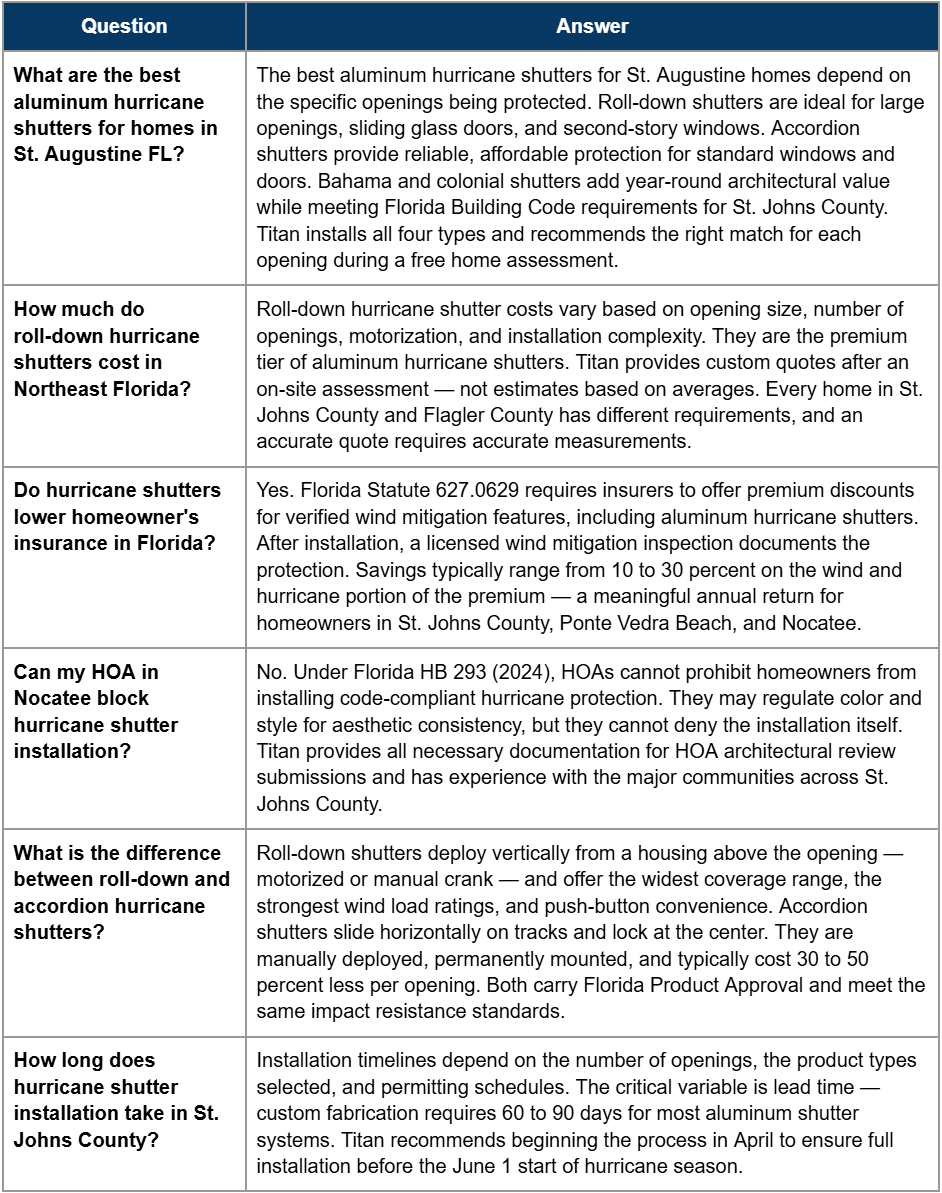
Every aluminum shutter system installed by Titan Shutters and Screens carries a Florida Product Approval number — a verifiable credential confirming that the product has been tested and approved under the Florida Building Code for use in wind-borne debris regions, including St. Johns County, Duval County, and Flagler County. These are not marketing claims. They are engineering certifications that explain why aluminum hurricane shutters remain the most trusted form of storm protection available to Northeast Florida homeowners.
The material itself matters. Aluminum is lightweight enough for practical deployment, strong enough to absorb direct impact from large wind-borne debris at hurricane velocities, and naturally resistant to the corrosion that Florida's salt air and humidity inflict on lesser materials. A properly installed and maintained aluminum shutter system will last decades — protecting a home through multiple hurricane seasons without degradation.
Roll-Down Shutters: The Premium Standard for Large Openings
If there is a single product that defines modern hurricane protection in St. Augustine and Ponte Vedra Beach, it is the roll-down shutter.
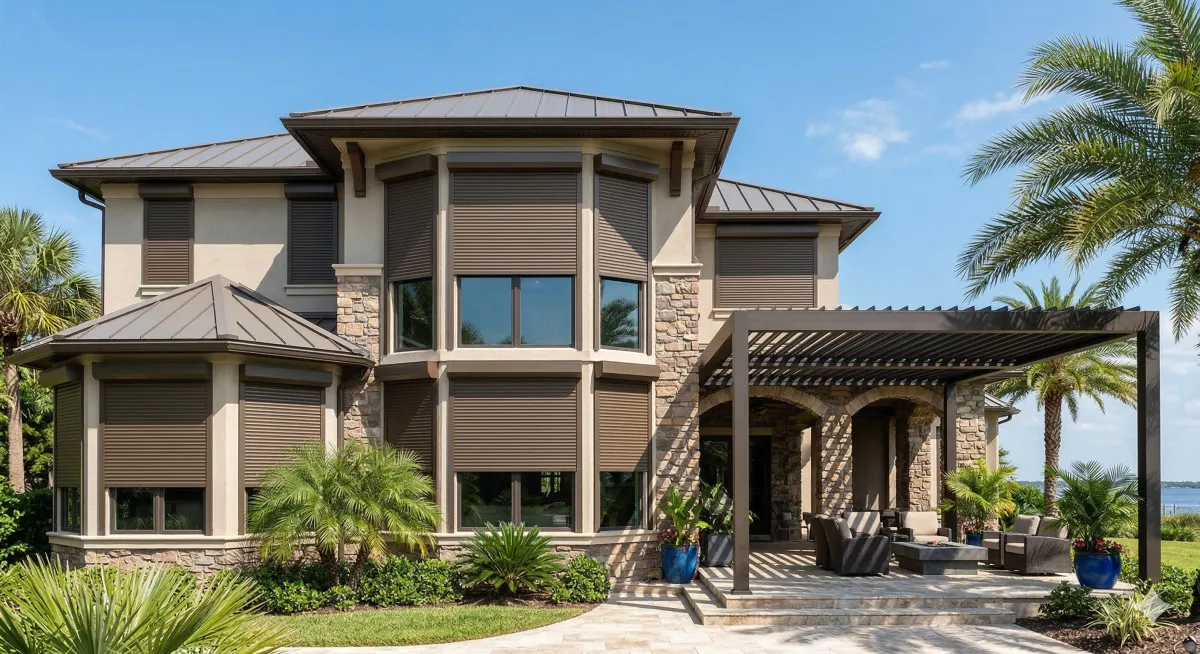
Roll-down aluminum hurricane shutters are permanently mounted above windows, doors, and large openings. They deploy vertically — either by motorized operation or manual crank — rolling down from a compact housing that sits flush against the exterior wall or soffit. When retracted, they are nearly invisible. When deployed, they form a continuous barrier of interlocking aluminum slats that seals the opening against wind pressure, impact, and water intrusion.
For homeowners in St. Johns County, roll-down shutters are the preferred solution for several reasons. They cover the widest range of opening sizes — from standard windows to oversized sliding glass doors, second-story windows, and even large patio openings that would be difficult to protect with any other system. Motorized roll-down shutters deploy at the push of a button, so a homeowner can secure every opening in the house in minutes, not hours. That matters when a storm changes direction unexpectedly and preparation time shrinks from days to a single afternoon.
Roll-down shutters also carry the strongest wind load ratings in the aluminum shutter category. High-quality systems can withstand sustained wind speeds exceeding 145 mph without a storm bar on wider openings, and well over 200 mph on standard window widths. For coastal communities like Ponte Vedra Beach, Vilano Beach, and Anastasia Island — where exposure to direct Atlantic wind is a given during any major storm — that rating is not a luxury. It is a requirement.
The housing for the rolled shutter is powder-coated aluminum and available in a range of colors to match the home's exterior. This is not a minor detail for homeowners in master-planned communities across Nocatee, Coastal Oaks, and World Golf Village, where HOA aesthetic standards are actively enforced.
Titan Shutters and Screens installs roll-down shutters as a certified dealer and factory installer. Every installation includes permitting, engineering review for your specific openings, and a post-installation inspection to confirm full Florida Building Code compliance.
Accordion Shutters: Reliable, Affordable, and Always Ready
Accordion aluminum hurricane shutters are the workhorse of Florida storm protection — and for good reason.
Accordion shutters are permanently mounted on tracks beside windows and doors. They fold flat against the wall when not in use, and slide horizontally across the opening when a storm approaches. Locking them into place takes seconds per opening. No motor. No battery. No electronics. Just a straightforward mechanical system that has been proven across thousands of Florida homes and decades of hurricane seasons.
For homeowners in Northeast Florida who want code-compliant, impact-rated storm protection at a lower price point than roll-down systems, accordion shutters are the most practical choice available. They are particularly well-suited for standard-sized windows, single and double-entry doors, and ground-floor openings where manual deployment is easy and fast.
The cost difference between accordion and roll-down shutters is meaningful. Accordion systems typically cost 30 to 50 percent less per opening than motorized roll-down systems, depending on size and configuration. For a homeowner in St. Augustine or Palm Coast who needs to protect 15 to 20 openings throughout the home, that difference can amount to thousands of dollars — without sacrificing the core engineering that matters: impact resistance and wind load certification under the Florida Building Code.
Accordion shutters carry the same Florida Product Approval credentials as roll-down systems. They are tested to the same impact and pressure cycling standards. The difference is in convenience and aesthetics — not in protection.
Titan installs accordion shutters across St. Johns County, Flagler County, and the greater Jacksonville market. We custom-measure every opening, fabricate to exact specifications, and handle all permitting and inspection requirements.

Bahama Shutters: Storm Protection That Lives on Your Home Year-Round
Bahama shutters occupy a unique position in the aluminum hurricane shutter market — and they are one of the most requested products Titan installs in Nocatee, Ponte Vedra Beach, and the HOA-governed communities across St. Johns County.
A Bahama shutter is a single-piece aluminum panel that mounts above a window on a top hinge. In its normal, everyday position, it props outward at an angle — providing shade, reducing UV exposure, allowing airflow, and adding a distinctive architectural detail to the home's exterior. When a storm approaches, the homeowner lowers the Bahama shutter flat against the window frame and secures it with side arms or thumbscrews. The same panel that enhanced the home's curb appeal five minutes ago is now a hurricane-rated impact barrier.
This dual-purpose design is the reason Bahama shutters are so popular in master-planned communities. They do not look like storm protection. They look like a deliberate architectural choice — because they are. And because they are permanently installed, there is nothing to store, nothing to retrieve from the garage, and nothing to assemble under pressure when a storm watch is issued.
Bahama shutters are Florida Building Code-approved for non-high-velocity hurricane zones, which include all of St. Johns County and Flagler County. They are constructed from 6063-T6 aluminum extrusions — the same aircraft-grade alloy used in roll-down and accordion systems — with welded corner joints that produce a unified frame for maximum strength under wind load.
The one honest limitation: Bahama shutters are best suited for standard windows. They are not the right solution for sliding glass doors, oversized openings, or second-story windows that are difficult to reach for manual deployment. For those openings, roll-down shutters or Maxforce hurricane screens are the better answer.
Colonial Shutters: The Heritage Look with Modern Storm Engineering
Colonial shutters are the traditional two-panel shutter system that flanks a window on either side — one panel on the left, one on the right — hinged to swing closed and lock at the center when storm protection is needed.
In a city like St. Augustine, colonial shutters offer something no other hurricane-protection product can: they look like they belong. They reference a design tradition that predates modern building codes by centuries, while delivering impact resistance and wind load performance that meet all current Florida Building Code requirements for St. Johns County.
Colonial aluminum hurricane shutters are constructed from the same 6063-T6 aluminum extrusions as Bahama shutters, with welded frames, reinforced hinge connections, and powder-coated finishes available in a wide range of colors. They mount permanently to the wall beside each window and swing closed in seconds — no tracks, no motors, no overhead housing.
For homeowners in the St. Augustine historic district, Davis Shores, Anastasia Island, and older neighborhoods where a roll-down housing or accordion track would be visually inappropriate, colonial shutters are the answer. They are also a strong choice for homeowners in communities where the HOA requires a specific architectural aesthetic. Under Florida HB 293, your HOA cannot prevent you from installing code-compliant hurricane protection — but colonial shutters make the approval conversation considerably easier, because they enhance the home's appearance rather than alter it.
The Insurance Savings Most Homeowners Underestimate
Here is where the financial case for aluminum hurricane shutters becomes difficult to ignore.
Florida Statute 627.0629 requires every insurance carrier in the state to offer premium discounts for verified wind mitigation features. Aluminum hurricane shutters — roll-down, accordion, Bahama, and colonial — all qualify. The process works like this: after installation, a licensed wind mitigation inspector evaluates your home and documents the protection systems in place. That report is submitted to your insurance carrier, which is then required by law to apply the appropriate insurance discount.
The savings are not trivial. Homeowners in St. Johns County typically see reductions of 10 to 30 percent on the wind and hurricane portion of their annual premium. In a county where homeowner's insurance costs are among the highest in Florida — driven by coastal exposure, rising replacement costs, and the statewide insurance market upheaval of the past three years — that discount compounds into thousands of dollars over the life of the shutters.
Consider the math on a home in Ponte Vedra Beach or Nocatee carrying an annual premium of $6,000 to $10,000. A 20 percent reduction on the wind portion alone could return $800 to $1,500 per year. Over a decade, that is $8,000 to $15,000 — a meaningful offset against the original installation cost, and in many cases, a full return on investment before the shutter system is halfway through its operational life.
The shutters protect the home. The insurance discount pays for the shutters. And both are working from the day of installation — whether a storm comes that year or not.

HOA Approval in Nocatee, Ponte Vedra, and Master-Planned Communities
The most common hesitation we hear from homeowners in Nocatee, Coastal Oaks, World Golf Village, and the Ponte Vedra Beach corridor is not about cost or product selection. It is about their HOA.
The concern is understandable. Many homeowners have been told — by neighbors, by previous board members, or by outdated covenant language — that their community restricts or prohibits exterior modifications like hurricane shutters. That concern kept thousands of St. Johns County homeowners from moving forward with storm protection for years.
Florida HB 293, which took effect in 2024, definitively changed the legal landscape. Under HB 293, homeowners' associations are required to adopt hurricane protection specifications for all structures within their community. More importantly, HOAs can no longer deny a homeowner the right to install code-compliant hurricane protection products — including aluminum hurricane shutters and motorized retractable screens. They may regulate color, style, and aesthetic consistency. They may not block the installation.
Titan Shutters and Screens has navigated the HOA approval process in virtually every major community across St. Johns County. We provide the documentation your architectural review committee needs — product specifications, Florida Product Approval numbers, color options, and installation drawings — and we work directly with your HOA if needed to expedite the approval. This is not a hurdle. It is a step we handle routinely.
Lead Times, Costs, and the April Installation Window
Custom aluminum hurricane shutters are fabricated to the exact measurements of each opening on your specific home. They are not pulled from a shelf. This means lead times are a real factor — and they are the single most important reason to begin the process in April rather than waiting for the first named storm to appear on a weather map.
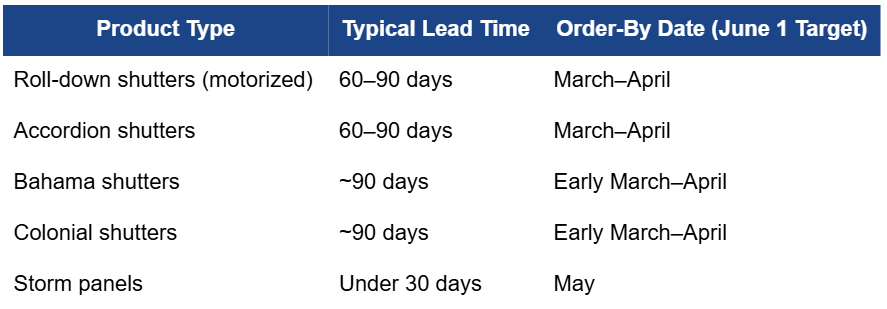
Cost varies by product type, opening size, number of openings, and installation complexity. As a general framework for Northeast Florida homeowners:
Storm panels represent the most affordable entry point — effective, code-compliant, but requiring manual installation and storage between uses.
Accordion shutters occupy the mid-range — permanently installed, easy to deploy, and significantly less expensive than motorized systems.
Roll-down shutters are the premium tier — offering motorized convenience, the strongest wind-load ratings, and the cleanest aesthetic when retracted.
Bahama and colonial shutters fall in the mid-to-upper range, with the added benefit of year-round architectural enhancement.
Every Titan project begins with a free, no-obligation home assessment. We walk your property, measure every opening, discuss your priorities and budget, and present a custom protection plan — not a one-size-fits-all quote. Because we install every type of aluminum hurricane shutter alongside Fenetex motorized screens and Maxforce hurricane screens, we recommend the right product for each opening. Not the most expensive one. The right one.
Frequently Asked Questions
Schedule Your Free Pre-Season Home Assessment
Serving St. Augustine · Nocatee · Ponte Vedra Beach · Palm Coast · Jacksonville · Northeast Florida
We walk through your property, measure every opening, and build a custom aluminum hurricane shutter plan — covering roll-down shutters, accordion shutters, Bahama shutters, colonial shutters, and motorized screens — at no cost, no obligation. Installation slots are filling now for May and June.
Call or text: (904) 484-7580 | TitanShuttersandScreens.com
For the complete storm preparation timeline, read Week 1: Hurricane Season Is Coming — Is Your St. Augustine Home Ready?
For the full Hurricane Prep Checklist, visit our Storm Protection Guide.
