Year-Round Motorized Hurricane Screens | Daily Use NE Florida
365 Days a Year — How Modern Motorized Hurricane Screens Earn Their Keep Outside Hurricane Season
It is a Tuesday evening in June. The temperature has settled into that Northeast Florida sweet spot — warm enough to sit outside, humid enough that the mosquitoes have arrived in force. The family in the Nocatee home has two options. Option one: go inside. Surrender the lanai, the outdoor kitchen, the evening they planned. Option two: spray everyone down with DEET, light three citronella candles, set up the bug zapper that does not actually work, and spend the next ninety minutes swatting instead of relaxing.
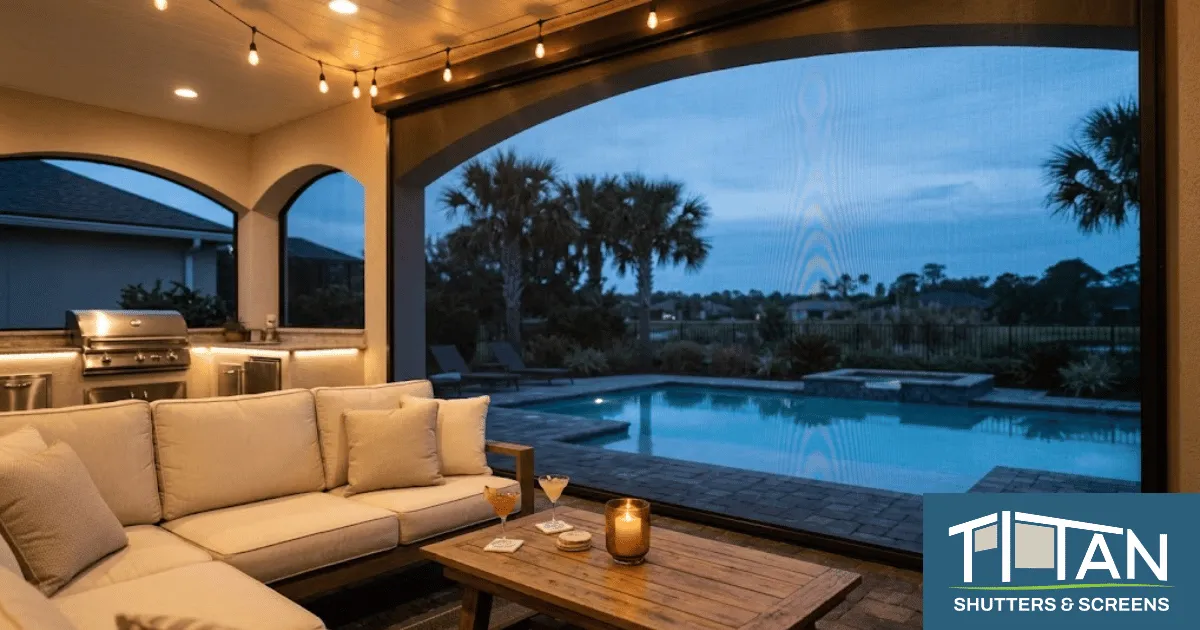
There is a third option. Press a button. The motorized screen deploys in seconds — silently, on the new MaxForce system — and the lanai becomes a bug-free, wind-protected, private outdoor room. The family stays. The candles stay in the drawer. The evening happens the way it was supposed to.
This is the article that most motorized hurricane screen manufacturers do not write. They talk about wind ratings, impact testing, and design pressure. Those specifications matter — they matter enormously when the storm comes. But hurricane season runs June 1 through November 30. That is six months. The screen is installed for twelve. The other six months — and the quiet stretches between storms — are where the system either earns its keep or collects dust.
A hurricane screen that only works during hurricanes is an expensive alarm clock. A hurricane screen that transforms the lanai into a year-round outdoor room is the most valuable product on the property. The difference is whether the system is engineered for daily use — and whether it is quiet enough, convenient enough, and reliable enough that the homeowner actually presses the button every evening.
The Short Answer
Can motorized hurricane screens be used every day — not just during storms?
A motorized hurricane screen is technically a hurricane product. Functionally, the storm protection is the byproduct of a system Northeast Florida homeowners use every day — for privacy, bug control, solar gain reduction, dust filtration, and outdoor-room comfort. The new MaxForce Hurricane Screens with silent spring-track technology are engineered specifically for this dual reality: 185 MPH HVHZ storm protection when the hurricane comes, silent daily-use operation when it does not. The Twitchell OmegaTex fabric blocks up to 95 percent of damaging UV rays, creates a two-way mirror effect for privacy, and stops insects without closing off the view. The system deploys and retracts from a remote, a phone, or a voice command through Bond Bridge Pro.
The Privacy Use Case
Northeast Florida’s master-planned communities are designed for proximity. Nocatee, World Golf Village, Silverleaf, and the newer sections of Ponte Vedra Beach build homes on lots where the neighbor’s lanai is visible from your own. The pool is visible from the sidewalk. The outdoor kitchen is visible from the golf cart path. The space was designed for outdoor living, and the lot layout ensures that outdoor living is a shared experience — whether the homeowner intended it to be or not.
The MaxForce OmegaTex fabric creates a two-way mirror effect. When the screen is deployed, homeowners can see out clearly. Neighbors, passersby, and golf-cart traffic cannot see in. The lanai becomes a private room with an outdoor view — enclosed without feeling enclosed, screened without feeling screened. For families with pools, for homeowners who host, for anyone who uses the lanai after dark when interior lighting makes the space even more visible from outside, the privacy function is the reason the screen deploys most evenings.
The new silent spring-track architecture makes the privacy deployment seamless. No sound. No disruption to the conversation or the movie playing on the mounted television. One button, a smooth silent descent, and the lanai transforms. On systems that produce popping, grinding, and clicking during deployment, the transition is a thirty-second to one-minute noise event that interrupts whatever the lanai was being used for. On the new MaxForce, the transition is not an event at all.
The Bug Control Use Case
Northeast Florida’s insect pressure is not a seasonal inconvenience. It is a defining characteristic of the climate from April through October — and in some years, from March through November. Mosquitoes dominate the evening hours. No-see-ums are active at dawn and dusk. Gnats and midges swarm after rain. The homeowner who invested in an outdoor kitchen, a pergola, comfortable seating, and a mounted television is discovering that the space is functionally unusable during the hours they most want to use it.
The chemical workaround cycle is familiar to every Northeast Florida homeowner: DEET sprays, citronella candles, bug zappers, misting systems, and professional insect treatments. The cost is cumulative and ongoing. The chemicals raise concerns around children and pets. The effectiveness is inconsistent. And the ritual of preparation — spraying, lighting, positioning, treating — is itself a friction that degrades the experience of using the space.
A deployed motorized screen is a physical barrier. The OmegaTex fabric mesh stops mosquitoes, no-see-ums, gnats, and other flying insects from entering the enclosed lanai space while maintaining airflow and visibility. No chemicals. No maintenance. No ongoing cost. One button and the bugs are on the outside. The family is on the inside. Every evening, from April through October, for the life of the system.
Northeast Florida Climate Reality
“Northeast Florida’s subtropical humidity and standing-water landscape produce insect pressure from April through October — the exact months when outdoor living is most desirable. A screen that eliminates the chemical cycle and reclaims the evening hours is not a luxury. It is the completion of the outdoor investment.”
The Solar and UV Use Case
The Twitchell OmegaTex fabric in the MaxForce system blocks up to 95 percent of damaging UV rays. This is the specification that most homeowners read once and forget — until they notice what happens to the lanai furniture, the outdoor kitchen countertops, the area rug, and the decorative cushions after two years of unprotected Florida sun exposure.
UV degradation on a Northeast Florida lanai is not subtle. Sunbrella-grade outdoor fabric fades visibly within 18 to 24 months of direct exposure. Teak furniture grays. Granite and quartz countertops in outdoor kitchens experience surface etching when UV interacts with standing moisture. Mounted televisions overheat and degrade. Decorative items that cost hundreds of dollars individually lose their finish in a single season.
A deployed MaxForce screen reduces the UV load on the lanai’s contents by up to 95 percent. The practical effect is that the furniture, the finishes, the electronics, and the decorative elements last measurably longer. The replacement cycle that most Northeast Florida homeowners accept as normal — new cushions every two years, refinishing the teak every season, replacing the rug annually — slows to a fraction of its unprotected pace. The screen pays for itself in preserved furnishings alone over a ten-year window.
The solar gain reduction also matters for energy cost. A lanai that faces south or west receives direct afternoon sun that heats the adjacent interior rooms through the sliding glass doors. With the screen deployed, solar gain is reduced measurably — the air conditioning system works less to maintain the interior temperature, and the energy cost drops. Homeowners who deploy the screen on sunny afternoons report a noticeable difference in how cool the adjacent rooms feel — and a measurable difference on the electric bill.
The Dust and Particulate Use Case
Northeast Florida homeowners who live near construction zones, agricultural areas, or high-traffic corridors know the dust problem intimately. Pollen season alone covers every lanai surface with a visible layer of yellow-green particulate from February through April. Road dust from nearby arterials settles on outdoor kitchen surfaces. Construction dust from the ongoing build-out in Nocatee, Silverleaf, and the newer phases of World Golf Village coats furniture within days of cleaning.
A deployed motorized screen acts as a particulate barrier. It does not eliminate airborne dust entirely — the fabric is a mesh, not a solid wall — but it significantly reduces the volume of pollen, road dust, and construction particulate that reaches the lanai’s contents. Homeowners in active construction zones report cleaning their lanai surfaces less frequently when the screens are deployed during high-particulate periods. For homeowners with outdoor televisions, sound systems, and kitchen appliances — all of which are sensitive to dust infiltration — the reduction in particulate exposure translates directly to longer equipment life and fewer maintenance issues.
One more thing worth knowing: The reason silent operation matters for daily use is not about comfort alone. It is about frequency. A system that is noisy discourages daily deployment. A homeowner who skips the screen on a Tuesday evening because the noise is not worth it for a quick dinner outside misses the bug protection, the privacy, the UV reduction, and the dust control that evening. Multiply that by three evenings a week, fifty-two weeks a year, and the homeowner has left hundreds of hours of outdoor-room value on the table — not because the system does not work, but because it is too loud to bother with. The new MaxForce silent spring-track architecture was engineered to eliminate that calculation. One button. No noise. No reason not to press it. Every evening.
Your Daily-Use Action Plan
Northeast Florida homeowners buy motorized hurricane screens for the storm. They keep them for everything else. The privacy that turns the lanai into a room. The bug barrier that reclaims the evening. The UV shield that preserves the furniture. The dust filter that keeps the outdoor kitchen clean. The energy savings that show up on the electric bill. These are not secondary benefits. For most homeowners, they are the primary benefits — and hurricane protection is the byproduct of a system they were already using every day.
The new MaxForce silent spring-track architecture was engineered for exactly this reality. Silent operation means the homeowner presses the button without thinking twice. Self-adjusting alignment means no service calls. Tight, taut fabric 365 days a year means the lanai looks as good on a Tuesday afternoon as it does in the marketing photo. The system that Titan chose to build its business around is the system that earns its keep every single day — not just on the six days a year when a storm threatens the coastline.
The lanai you fought for is the lanai you actually live on.
Frequently Asked Questions
Can motorized hurricane screens be used every day?
Yes. Motorized hurricane screens are designed for daily deployment and retraction. The Fenetex MaxForce system delivers year-round daily protection including privacy, insect control, UV reduction, dust filtration, solar gain management, and wind shielding. The new silent spring-track architecture is engineered specifically for frequent daily use — silent operation means no noise disruption, and self-adjusting alignment means no maintenance burden from repeated cycling.
Do motorized hurricane screens block insects?
Yes. The OmegaTex fabric mesh creates a physical barrier that stops mosquitoes, no-see-ums, gnats, and other flying insects from entering the enclosed lanai space. Unlike chemical treatments, sprays, and citronella candles, the screen provides consistent, permanent insect control with no ongoing cost and no chemical exposure. Airflow and visibility are maintained through the mesh.
How do motorized hurricane screens save energy?
The OmegaTex fabric blocks up to 95 percent of damaging UV rays and reduces solar gain through the adjacent sliding glass doors. When deployed during peak afternoon sun hours on south- and west-facing lanais, the screen reduces the heat load entering the home. The air conditioning system runs less to maintain interior temperature, which lowers energy costs. Homeowners report a noticeable difference in interior cooling and electric bill during the summer months.
Do motorized hurricane screens provide privacy?
Yes. The OmegaTex fabric creates a two-way mirror effect when deployed: homeowners can see out through the screen clearly, but neighbors and passersby cannot see in. This is particularly valuable in master-planned communities like Nocatee, Ponte Vedra Beach, World Golf Village, and Silverleaf where lot proximity makes outdoor spaces visible from neighboring properties, sidewalks, and golf cart paths.
Why does silent operation matter for daily use?
A motorized screen that produces noisy operation — popping, grinding, clicking from magnetic snap-back — discourages daily deployment. Homeowners skip the screen on casual evenings because the noise is not worth it for a short dinner outside. Over a year, hundreds of hours of outdoor-room value are lost not because the system does not work, but because it is too disruptive to use casually. The new MaxForce silent spring-track architecture eliminates deployment noise entirely, which means the homeowner presses the button every evening without a second thought. Frequency of use is where the daily-use value is realized.
