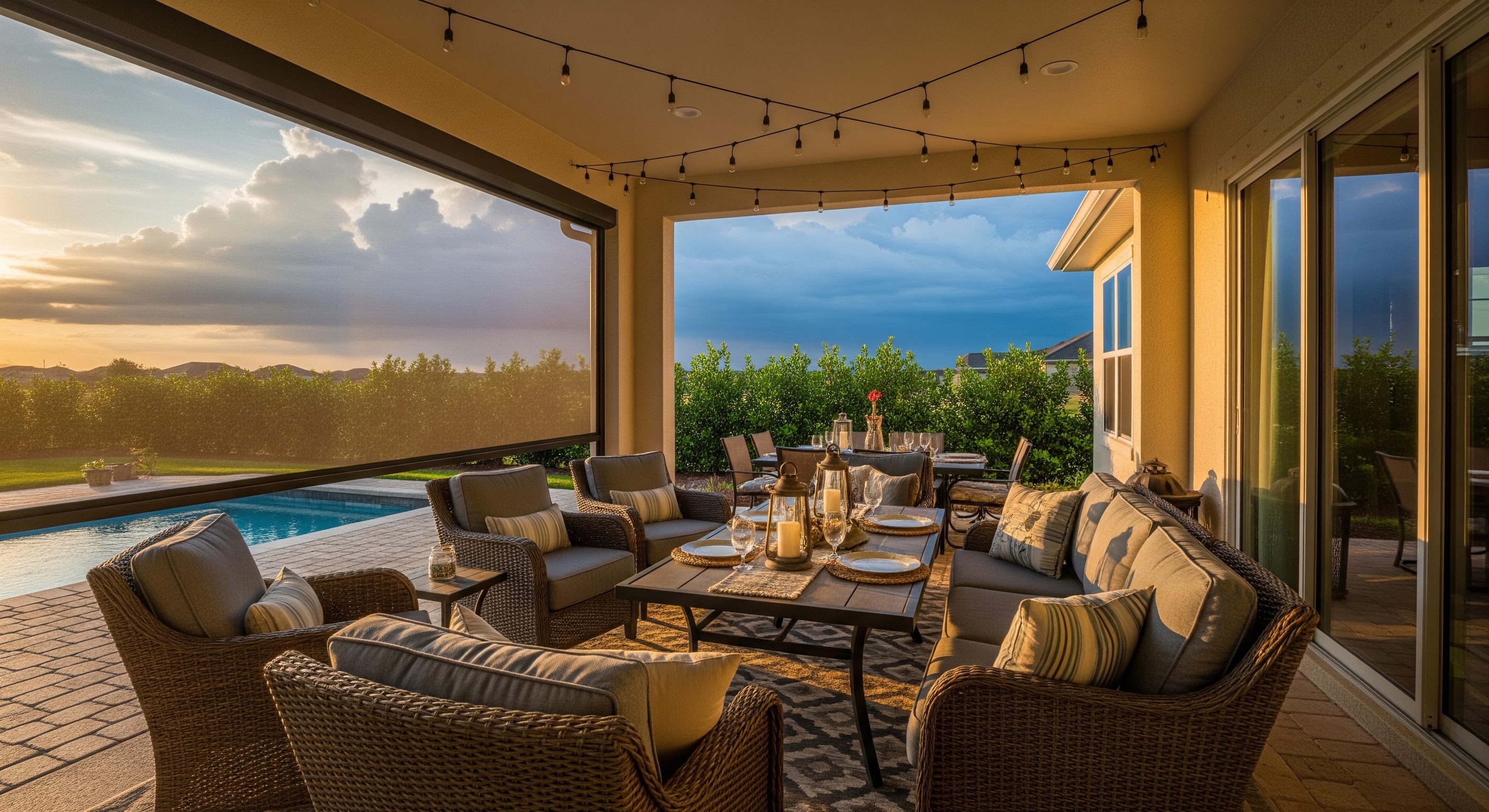
Hosting Labor Day Guests? Here's Which Titan Opening Actually Holds Up If Weather Turns Mid-Party
Hosting Labor Day Guests? Here's Which Titan Opening Actually Holds Up If Weather Turns Mid-Party
Weather turning while people are still standing under it is the exact scenario this post exists to answer. It's the question the first post in this series ended on, and it's a genuinely different question from the ones a typical product-comparison article answers. This isn't about which opening is "best" in the abstract — it's about which of Titan's options can actually respond once a Labor Day gathering is already underway, and which ones needed a decision made days or weeks earlier.
The real variable isn't which product is "best" — it's when the decision gets made
Titan's three outdoor-opening categories — motorized screens, fixed patio covers, and traditional hurricane shutters — have already been compared on mechanics and materials elsewhere on this blog. What hasn't been asked directly is a more practical question for a specific day: if a Labor Day gathering is already underway and the sky changes, which of these can still be acted on, and which one's window for action already closed before the first guest arrived?
Already installed, responds in the moment: One-Track and MaxForce screens
Both One-Track and MaxForce systems are motorized and button-activated — a mechanical and material comparison between the two lines is covered in an earlier post in Titan's Back-to-Back Season series, and isn't repeated here. What matters for this specific scenario is simpler: closing either screen mid-gathering is a button-press, not a project, using the same remote, wall switch, or app used for everyday sun and bug control on an ordinary afternoon. Titan's own marketing describes this as fast, but as noted in that earlier post, no independently timed measurement of an actual deployment exists in this construct's sourcing — so this article states what's verifiable (motorized, button-activated, no crank or multi-step process) without attaching a specific speed claim to it.
Already doing its job, with a known limit: fixed patio covers
A fixed patio cover requires no mid-gathering decision at all — it's a solid, permanent roof that's already in place, already blocking rain falling straight down, before anyone thinks to act. The limit, covered in more depth in an earlier post in Titan's outdoor-living series, is what a fixed roof was never built to solve: wind-driven rain moving in at an angle can still reach guests standing near the open sides, exactly the condition a fast-moving afternoon storm typically brings. For a Labor Day crowd spread across a patio rather than clustered in its center, that's the specific moment the cover's limit becomes visible.
A different category: traditional hurricane shutters aren't a mid-party option
Traditional hurricane shutters sit apart from both of the above, and it's worth naming plainly: they are generally installed by hand, ahead of a storm, as a deliberate pre-event task — not something a homeowner puts up once a gathering is already in progress and the sky starts to change. That's not a criticism of the product; it's simply a different point in the timeline than screens or a cover occupy. A host who hasn't already decided on shutters before Labor Day weekend has, in practice, already made the decision not to use them for this particular event.
What this means for planning a Labor Day gathering
The first post in this series pointed out that most homeowners in this category act on a specific trigger — a named storm, a deadline — rather than on where a date sits on the calendar. This post's finding is the practical consequence of that pattern for one specific day: by the time weather is visibly turning at a Labor Day gathering, the shutter option has already passed, and the only two levers still available are a motorized screen's push-button response and a fixed cover's built-in, but partial, protection. Nothing about that requires a purchase decision made in a panic — it's simply worth knowing, ahead of the holiday, which of your own home's options are still live once the party has started.
The next post in this series takes the practical side of that a step further: a weekend-before check to confirm a screen or shutter actually still functions for this specific gathering, not a seasonal deep-maintenance pass.
Frequently Asked Questions
Can hurricane shutters be put up after a Labor Day party has already started?
Generally, no. Traditional hurricane shutters are installed by hand as a deliberate, pre-storm task, not something typically added once guests are already present and weather has started to turn.
Does a patio cover protect against wind-driven rain during a sudden storm?
It blocks rain falling straight down, since it's a solid, permanent roof. It does not stop wind-driven rain moving in at an angle through the open sides, which is a known limit of a fixed-cover structure rather than a defect.
What can actually be done in real time if a motorized screen is already installed?
A One-Track or MaxForce screen can be closed via remote, wall switch, or app without leaving the gathering. It's a button-activated system rather than a manual, multi-step process, though no independently timed measurement of deployment speed exists in this construct's sourcing.
Sources
Florida Climate Center, Florida State University. Regional Climate Data. Accessed 2026.climatecenter.fsu.edu— thunderstorm-day frequency, foundational figure reused across this construct's Northeast Florida content per series-architecture policy on lateral climate-fact reuse.
The mechanical, material, and structural comparisons referenced above (screen track/fabric differences, patio cover wind-driven-rain limits, shutter installation method) are carried forward from earlier posts in Titan's blog rather than re-derived here — see Section K for the specific companion posts.
