Is Your Pergola Leaking or Is It Condensation? How to Tell in Florida
It can be either, and the difference is where the water comes from: condensation forms when a surface cools to the dew point, and in the southeastern United States the outside air stays above a 75°F dew point through the summer, so a cooled surface can collect water with no hole in it. A published first test is to tape foil flat against the surface and check which side gets wet: moisture on the exposed face of the foil points to condensation, and moisture trapped between the foil and the surface points to water coming through, though the tip was written for indoor walls and floors, not patio covers. The sources give no way to tell a leak from condensation by sight alone, so if you are unsure, photograph the water with the date and the weather and ask the installer to check.
This post is one of a series on the common causes of pergola and patio cover leaks, Water Finds a Way: The Pergola Leak Checklist.
What is condensation, and why does Florida have so much of it?
Condensation is water that forms when air cools to its dew point, or touches a surface that is at or below it, and in the southeastern United States the outside air stays above a 75°F dew point through the summer.
The dew point is the temperature to which air must be cooled to start condensation, and air temperature never falls below it, according to a University of Florida paper on dew-point changes in north Florida. The dew point depends on how much water vapor the air holds, so humid air has a higher dew point.
A Department of Energy publication from the Florida Solar Energy Center describes the same mechanism for homes in the Southeast: when a surface is cooled below the outside dew point, humid outside air touching it condenses. It is about interior surfaces of manufactured homes, so it shows the mechanism and does not measure a patio cover.
None of these sources is about a patio cover. They describe how condensation works and when it starts. They do not say how often it happens under a cover, or what it looks like there.
When can an outdoor surface get cold enough to collect water?
On clear nights with light wind, objects such as grass and leaves become colder than the surrounding air, and a University of Florida study found that dew or frost begins to form once the air is about 1°C above its dew point.
The study measured winter nights at three rural inland stations, Alachua, Citra and Brooksville. It also notes that in summer, when dew points are high, the nighttime fall in dew point may be smaller. It did not measure a patio cover, so applying it to the underside of a cover is an analogy, not a finding.
How can I tell condensation from a leak?
A tip from building advice is to tape foil flat against the surface and check which side gets wet: moisture on the exposed face of the foil points to condensation, and moisture trapped between the foil and the surface points to water coming through.
The tip comes from a reader’s answer on a building-science Q&A site, written about a concrete floor. It is a first clue, not a diagnosis, and no source used here tests it on a patio cover.
What should I do if I cannot tell?
Photograph the water with the date and the weather, note whether it appeared during rain or on a still, humid morning, and ask the installer to check.
If it is a leak, other posts in this series cover where water gets in. Seams and fasteners are one place, covered in can panels, seams or fasteners make an insulated patio cover leak. The house wall is another: why a patio cover leaks where it meets the house.
What the sources do not settle
Five limits apply to everything above.
The Department of Energy publication is about interior surfaces of manufactured homes. It shows the mechanism, not a measurement of a patio cover.
The University of Florida study measured winter nights at three inland stations, and its summer pattern may differ. It did not measure a patio cover.
The foil test comes from a reader’s answer written for indoor surfaces, and no source used here tests it on a patio cover.
No source says how common condensation is under patio covers, or how to tell it from a leak by sight alone.
This article does not describe any installer’s own findings, including Titan’s.
If you cannot tell whether it is a leak or condensation
Photograph the water and note the date and the weather, then contact Titan Shutters and Screens with the photos.
Sources
U.S. Department of Energy and Florida Solar Energy Center. Moisture Problems in Manufactured Housing (Home Energy magazine, March/April 2002). Retrieved November 5, 2026. energy.gov
P. M. Lyrene, University of Florida IFAS. Diurnal Changes in Dewpoint Temperature During the Freeze Season in North Florida. Proc. Fla. State Hort. Soc. 118:279-282. 2005. journals.flvc.org
Green Building Advisor. Condensation on concrete floor (reader Q&A). Retrieved November 5, 2026. greenbuildingadvisor.com
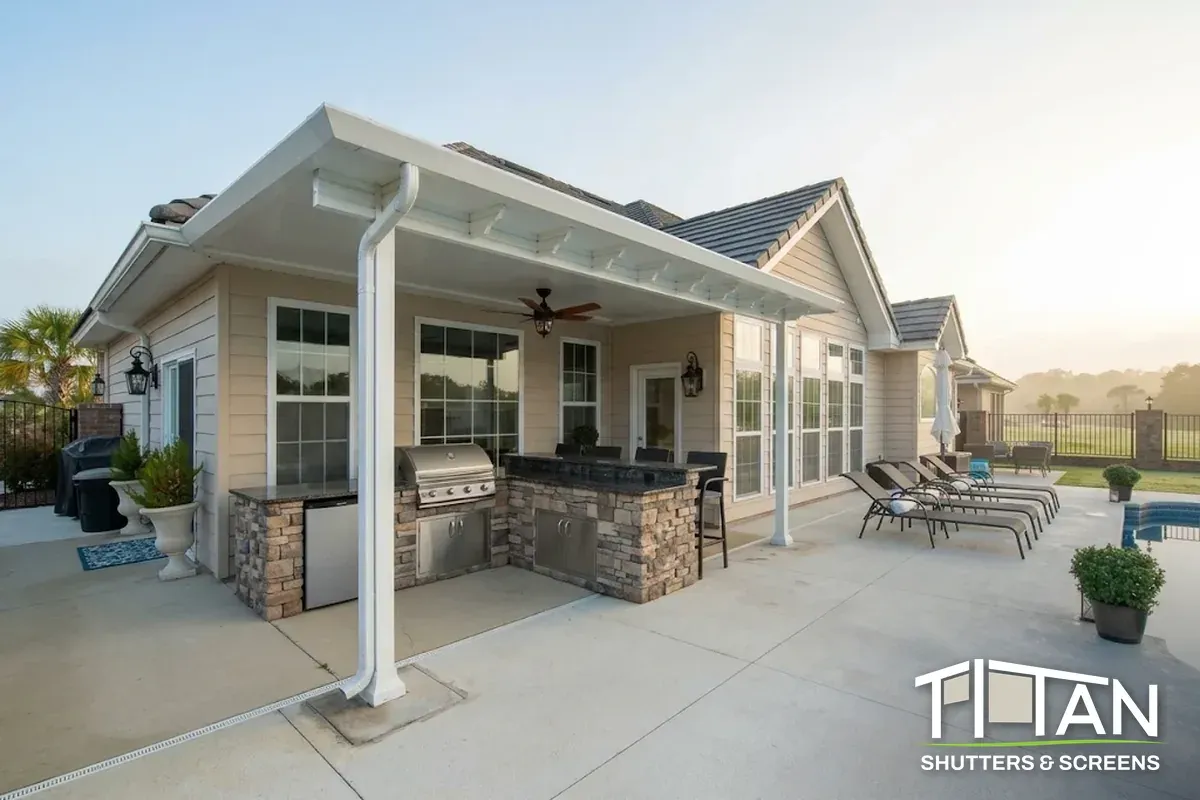
The image on this page is an AI-generated illustration.
