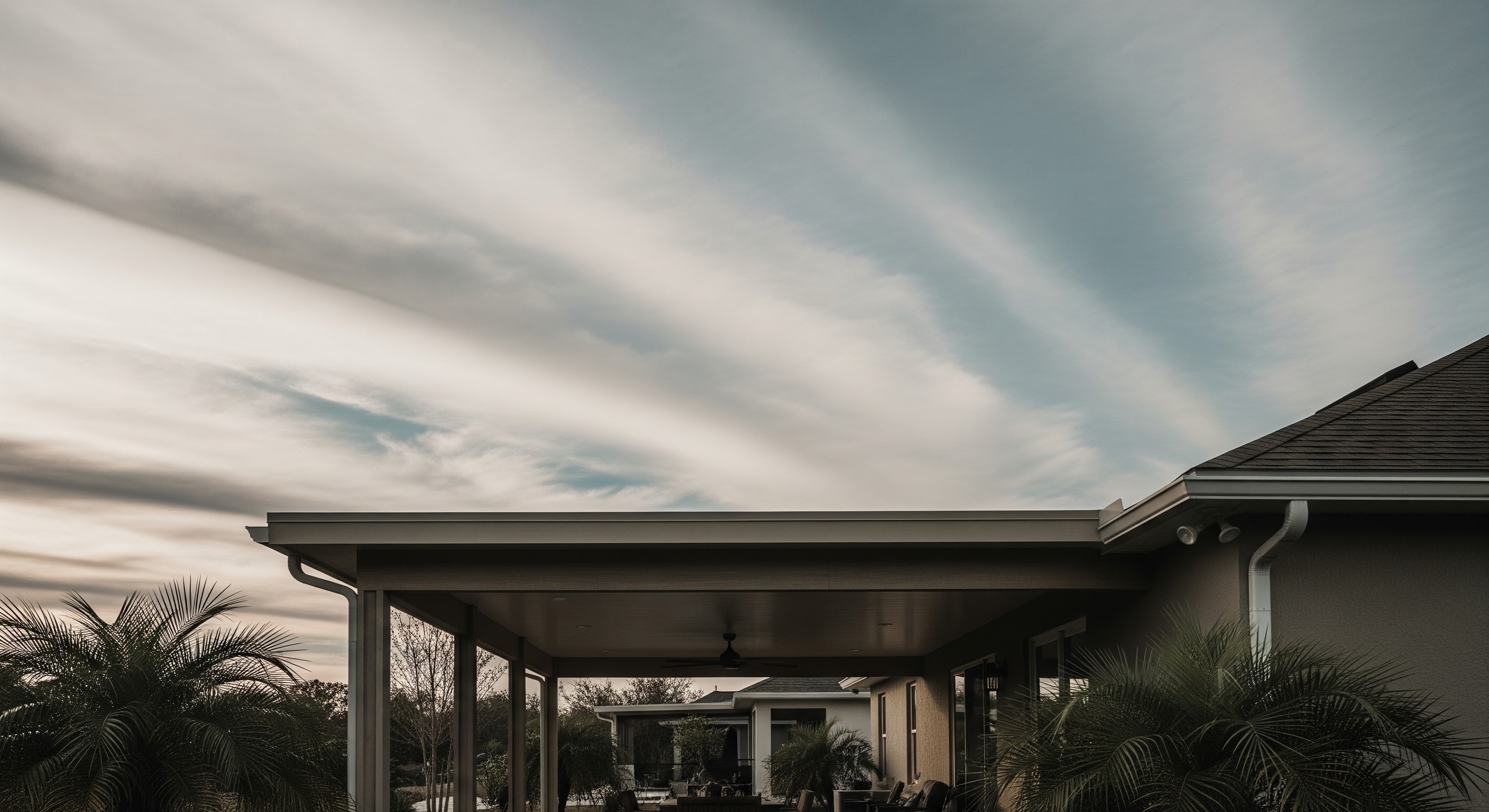
The Patio Cover Mistake: Built for Summer Shade, Not for What Comes Right After It
The Patio Cover Mistake: Built for Summer Shade, Not for What Comes Right After It
Most patio cover decisions in Northeast Florida get made in July, standing in direct sun, thinking about shade. That's a reasonable moment to make the decision. But it also means the structure gets chosen for one season's problem, when the region actually hands that same structure two very different jobs across a full year.
This is the first post in Built for Both Seasons, a series on what a Northeast Florida patio structure actually has to handle, and where most covers fall short of it.
What a patio structure actually faces across a full year
St. Augustine averages more than 100 days a year above 90°F, per NOAA climate data. The summer heat load that drives most shade-buying decisions in the first place. At the same time, the region averages around 52 inches of annual rainfall, most of it falling June through September in fast-moving afternoon thunderstorms, with roughly 117 thunderstorm days a year on average, per the Florida Climate Center. That's the season a patio cover gets bought for: hot, sunny, occasionally interrupted by a fast-moving storm that passes in twenty minutes.
What follows that season is a different kind of weather entirely. Once the year's heat and storm pattern eases, Northeast Florida moves into sustained cold fronts, longer-duration wind and driving rain, arriving at an angle rather than straight down, over hours rather than minutes. A structure that handled the summer's brief afternoon storms without issue faces a genuinely different load in this second season, and it's not a load most buyers were thinking about in July.
The common gap: chosen for shade, not for wind or driving rain
A fixed patio cover's main job, as most homeowners think about it, is blocking sun. That's a real and legitimate need, but "blocks sun" and "handles sustained wind-driven rain" are two different engineering questions, and a structure can answer the first well without ever being evaluated on the second. The gap isn't usually a defect in the product; it's a mismatch between the question a buyer asked and the conditions the structure will actually face across the full calendar.
This matters most at the edges of a structure — open sides, gaps between a fixed roof and the home, or an opening with no wind-rated closure at all. A cover that keeps direct sun off a patio in July may leave those same edges completely exposed to a January cold front's driving rain, simply because that scenario was never part of the original decision.
A structure built for shade and a structure built for a Northeast Florida winter are not automatically the same structure. The calendar just doesn't leave much room to notice the difference until it matters.
What "built for both" actually means
This series looks at what closes that gap. Not by treating "winterizing" as a snow-climate concept that doesn't apply here, but by asking what a structure genuinely needs to handle both halves of this specific region's year: the heat and afternoon storms of summer, and the sustained wind and driving rain of the cooler months right behind it. The next posts in this series get into the specific structure types (fixed covers, pergolas, screened enclosures) and what each one actually handles well.
One boundary worth stating here: the climate data behind this post establishes the region's summer heat and rainfall pattern with real, checkable numbers. It does not establish an equivalent frequency or intensity figure for the winter wind events described above. That's a real gap in the available climate data, not a detail this series is skipping. The argument is about the calendar's structure and the change in threat type, not a claim that winter fronts carry a measured risk profile equal to summer storms.
Sources
NOAA. Climate at a Glance — Northeast Florida. Accessed 2026. ncei.noaa.gov
Florida Climate Center, Florida State University. Regional Climate Data. Accessed 2026. climatecenter.fsu.edu
