You Built the Perfect Outdoor Space. Here's the One Thing That Makes It Actually Work.
You did everything right.
The lanai was part of the original plan — or maybe it was the first major addition after you moved in. Either way, you designed it with intention. The outdoor kitchen came next: a built-in grill, a refrigerator, a countertop that cost more per square foot than the one inside. Then the pergola — a StruXure louvered system, probably, because you wanted something that looked engineered, not assembled. The furniture was chosen carefully. The television was mounted. The lighting was strung. The pool sits just beyond the lanai's edge, and the whole composition looks exactly like the backyard you imagined when you signed the contract on the lot.
And then May arrived. And the mosquitoes arrived with it. And the afternoon sun turned the west-facing side into a furnace. And the afternoon thunderstorm soaked the cushions you forgot to bring inside. And the neighbors 35 feet away can see everything you are doing from their own lanai, which makes the space feel less like a private retreat and more like a stage.
So the outdoor kitchen gets used on weekends — maybe. The pergola is beautiful but exposed. The television has a permanent glare from 2:00 PM onward. And the lanai that was supposed to be the best room in the house becomes the room you walk past on your way to the kitchen.
This is the story of outdoor living in Northeast Florida without motorized screens. And it is the story of tens of thousands of homeowners in St. Augustine, Nocatee, Ponte Vedra Beach, and across St. Johns County who have invested $30,000 to $100,000 or more in outdoor space they use a fraction of its potential.
The investment was right. The space is right. The missing element is a motorized retractable screen system that eliminates every variable keeping you inside.
The Outdoor Space You Built vs. The Outdoor Space You Use
There is a gap — and it is expensive.
Northeast Florida homeowners invest more in outdoor living than nearly any other market in the state. The Athena regional data confirms what any real estate agent in St. Johns County already knows: the lanai is not an amenity. It is square footage. It is appraised. It is expected. And in communities like Nocatee, World Golf Village, Coastal Oaks, and the Ponte Vedra corridor, the outdoor kitchen, the pergola, and the pool are standard features in the upper-tier home market — not upgrades.
The problem is that the investment in the space and the usability of the space are mismatched. A homeowner in Nocatee with a $60,000 outdoor living investment — lanai, kitchen, pergola, furniture, lighting — who uses that space comfortably only from October through April is receiving roughly six months of return on a twelve-month investment. The other six months are compromised by insects, heat, rain, lack of privacy, or some combination of all four.
That is not a design failure. It is an environmental reality. Northeast Florida's climate delivers mosquitoes from May through October, UV indices in the "very high" to "extreme" category from March through October, afternoon thunderstorms nearly every day from June through September, and proximity between homes that creates persistent privacy concerns in every master-planned community built in the last fifteen years.
No amount of outdoor furniture, landscape lighting, or kitchen appliances solves these problems. They are environmental. And they require an environmental solution — a deployable barrier that addresses insects, sun, rain, and privacy simultaneously, and retracts completely when conditions are favorable.
That is the role a motorized screen fills. Not as an addition to the outdoor space. As the element that activates everything you have already built.
What Saturday Night Looks Like With Motorized Screens
Imagine the version of your outdoor space that works.
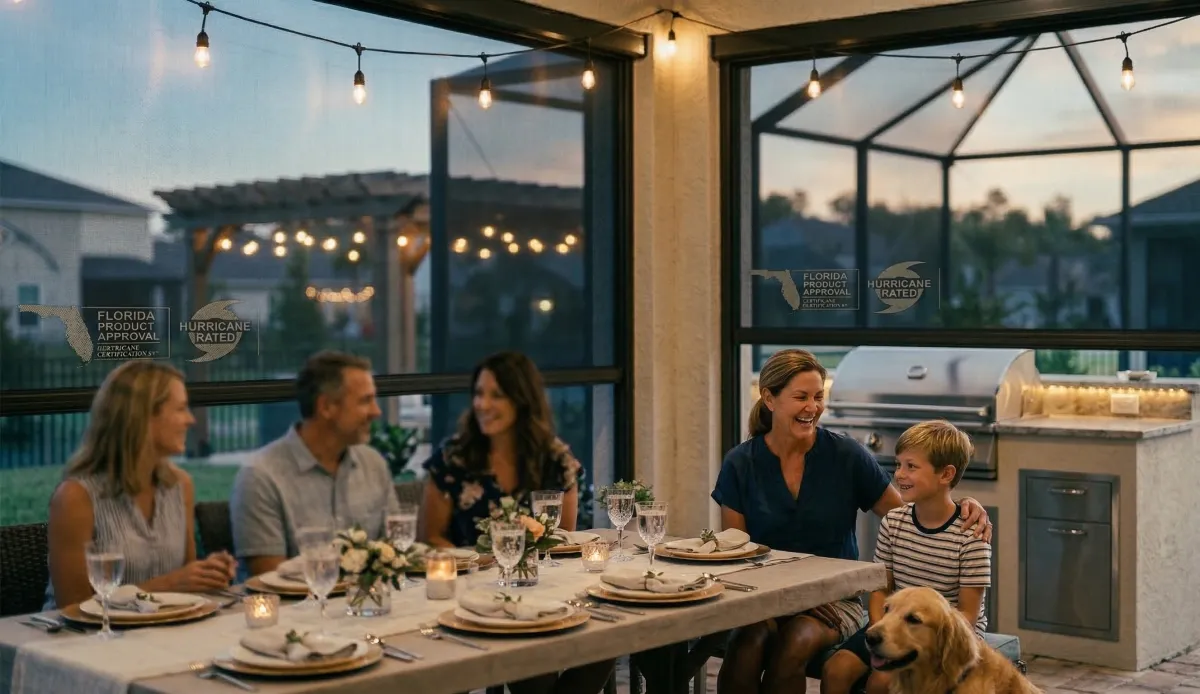
It is Saturday, mid-June. You are having eight people over for dinner on the lanai. At 5:00 PM, you press a button on your phone — or speak a command to Alexa — and the Fenetex motorized screens deploy across the lanai openings. It takes 30 seconds. By the time your first guest arrives at 6:00 PM, the space is sealed.
The mosquitoes that terrorize every unscreened property in the neighborhood cannot enter. The no-see-ums that breed in the retention pond 200 yards away are blocked entirely. Your guests will not spend the evening swatting, spraying, or retreating inside.
The afternoon sun that would have made the west-facing side of the lanai unbearable two hours ago is intercepted by the screen fabric — 91 percent of UV radiation blocked, surface temperatures reduced by 10 to 15 degrees, glare eliminated. The outdoor television is watchable. The countertops are touchable. The space is comfortable.
At 7:15 PM, the daily thunderstorm rolls through. Rain lashes the yard for 20 minutes. Your guests do not move. The deployed screens deflect the wind-driven rain, keeping the lanai dry enough to continue dinner without interruption. The outdoor kitchen is protected. The furniture stays in place. The evening continues.
From the outside, the screen fabric provides one-way privacy. Your neighbors cannot see the gathering with the same clarity you see the yard. The lanai feels enclosed without feeling closed off — private, intimate, and connected to the outdoors without being exposed to it.
At 10:00 PM, the last guest leaves. You press a button. The screens retract into their flush-mounted housings. The lanai returns to its fully open state. Tomorrow morning, you will have coffee out there with the screens up, the breeze moving through, and the space wide open.
That is not a fantasy scenario. That is a Tuesday-to-Saturday reality for homeowners in St. Johns County who have installed motorized screens. The outdoor kitchen gets used on weeknights. The pergola is functional in every season. The lanai is the best room in the house — and it earns that title twelve months a year, not six.
Motorized Screens and Outdoor Kitchens: Protecting the Investment That Needs It Most
Of every element in a Northeast Florida outdoor living space, the outdoor kitchen is the most expensive to build, the most expensive to maintain, and the most vulnerable to the elements.
A mid-range outdoor kitchen in St. Johns County — a built-in gas grill, an under-counter refrigerator, granite or quartz countertops, a sink, and basic cabinetry — represents a $15,000 to $30,000 investment. A higher-end installation with a pizza oven, ice maker, beverage center, built-in smoker, and custom stone or tile work can exceed $50,000. These are permanent fixtures. They do not come inside when the weather turns.
Without a deployed screen barrier, an outdoor kitchen endures: direct UV radiation that fades finishes and degrades seals on stainless steel appliances, wind-driven rain that corrodes gas connections and electrical components, salt air exposure in coastal communities like Ponte Vedra Beach and St. Augustine Beach that accelerates oxidation, insect activity that makes cooking and serving outdoors uncomfortable for half the year, and the accumulation of debris — pollen, leaves, sand — that settles on every surface between uses.
A motorized screen deployed over the kitchen opening while the space is in use blocks insects and UV simultaneously. Deployed between uses — even overnight or during a midday thunderstorm — it deflects rain, reduces debris accumulation, and shields appliances from direct sun exposure. Over time, this protection translates to measurably slower degradation, fewer service calls, and longer intervals between appliance replacement and countertop refinishing.
The homeowners who get the most value from their outdoor kitchens are the ones who use them most frequently. And the homeowners who use them most frequently are the ones who have eliminated the environmental barriers — bugs, sun, rain, wind — that turn cooking outside from a pleasure into a chore.
Motorized Screens and Pergolas: The Pairing That Completes the Space
A StruXure louvered pergola is one of the most popular outdoor living additions in the Northeast Florida market — and for good reason. The motorized louvered roof opens for sunshine and closes for rain, providing adjustable overhead coverage that no fixed structure can match.
But a pergola with a louvered roof and open sides is still exposed on every vertical surface. Insects enter freely. Afternoon sun strikes from the side, below the roofline. Wind-driven rain enters horizontally. And the space has no privacy from any direction.
Motorized screens paired with a pergola close the vertical envelope — creating a fully controllable outdoor room that manages sun from above (through the louvers) and manages insects, UV, rain, and privacy from the sides (through the screens). The combination transforms the pergola from an open-air shade structure into a deployable room that adapts to conditions in real time.
Titan Shutters and Screens installs both StruXure pergolas and Fenetex motorized screens — and we design the integration as a unified system. The screen housings mount to the pergola's beam structure, the side tracks integrate with the vertical posts, and the smart home controls for both the louvers and the screens can be managed from the same app or voice platform. Open the louvers for morning sun. Deploy the screens at dusk for a bug-free evening. Close the louvers for an afternoon storm. Retract the screens the next morning for a wide-open breakfast.
One system. Fully controllable. Every condition covered.
For homeowners who have already invested in a StruXure pergola without screens, a retrofit installation is straightforward. For homeowners considering a new pergola, the integrated pergola-and-screen package delivers a complete outdoor room from day one.
Rain, Wind, and the Afternoon Thunderstorm Problem
Florida's afternoon thunderstorms are one of the most underestimated challenges to outdoor entertaining in Northeast Florida.
From June through September, St. Johns County receives afternoon thunderstorms with near-daily regularity. They arrive between 2:00 and 5:00 PM, last 15 to 45 minutes, and produce wind-driven rain that can soak a lanai, scatter lightweight furniture, and end an outdoor gathering in minutes. The pattern is predictable enough that many homeowners simply stop planning outdoor events during summer months — surrendering the space to the weather rather than managing it.
A deployed motorized screen does not stop all rain. It is a screen, not a wall. But it dramatically reduces the amount of wind-driven rain that reaches the interior of a lanai or pergola. The screen fabric deflects horizontal rain, breaking the wind that drives it, and redirecting water downward along the screen surface rather than allowing it to penetrate the space. For most afternoon thunderstorms — which are intense but brief — the screen provides sufficient protection to continue using the space without relocating furniture, food, or guests.
This rain management capability, combined with a StruXure pergola's louvered roof that closes during rain, creates a space that handles Florida's most common summer weather pattern without intervention. The louvers close. The screens are already deployed for bugs and sun. The storm passes. Nothing moves. Nothing gets soaked. And you did not spend 15 minutes dragging cushions inside.
The Hosting Multiplier: How Screens Change How Often You Entertain
Here is the behavioral shift that homeowners consistently report after motorized screen installation — and it is the one that surprises them most.
They do not just use the outdoor space more comfortably. They use it more often. Significantly more often.
Before screens, outdoor entertaining in Northeast Florida is a seasonal activity — planned around weather windows, limited to certain hours, and always carrying the risk that bugs, rain, or heat will force the gathering inside. The logistics of outdoor hosting — spraying the lanai, setting up citronella candles, monitoring the weather radar, positioning fans — create enough friction that many homeowners default to indoor entertaining for most of the year.
After screens, outdoor entertaining becomes a daily option. Tuesday night dinner on the lanai. Friday evening drinks by the pool with the screens deployed. A Sunday morning breakfast with the screens up and the breeze flowing through. The friction disappears. The logistics reduce to pressing a single button. And the outdoor space — the one that cost $30,000 to $100,000 to build — finally delivers the return it was designed to provide.
The hosting frequency multiplier is real. Homeowners who entertained outdoors once or twice a month before screens report entertaining three to four times a week after screens. Not because they suddenly became more social — but because the barrier to using the space dropped to zero.
Smart Home Integration for Entertaining
Fenetex motorized screens integrate with Alexa, Google Home, and Somfy through the Bond Bridge Pro system — and the entertaining applications go beyond basic deployment.
Scene-based automation. A homeowner can create an "Entertaining" scene that deploys all lanai screens, adjusts the StruXure pergola louvers to a partial-shade angle, dims the outdoor lighting to a warm setting, and activates the outdoor fans — all triggered by a single voice command or a single tap in the app. When the evening ends, an "Open Up" scene retracts the screens, opens the louvers, and returns the space to its fully open configuration.
Guest-proof operation. A wall-mounted switch at the lanai entrance allows guests to deploy or retract individual screens without needing access to the homeowner's phone or smart home platform. This is a small detail that matters during parties — no one needs to find the host to adjust the screens.
Weather-responsive automation. Wind and rain sensors can trigger automatic screen deployment when conditions change, providing protection for unattended spaces. If a storm arrives while the homeowner is inside preparing food or greeting guests, the screens can deploy automatically to protect the outdoor kitchen and furniture.
Titan configures all smart home integrations during the installation. We build the automation scenes, program the sensors, and make sure every control method — app, voice, remote, and wall switch — is working before we leave.
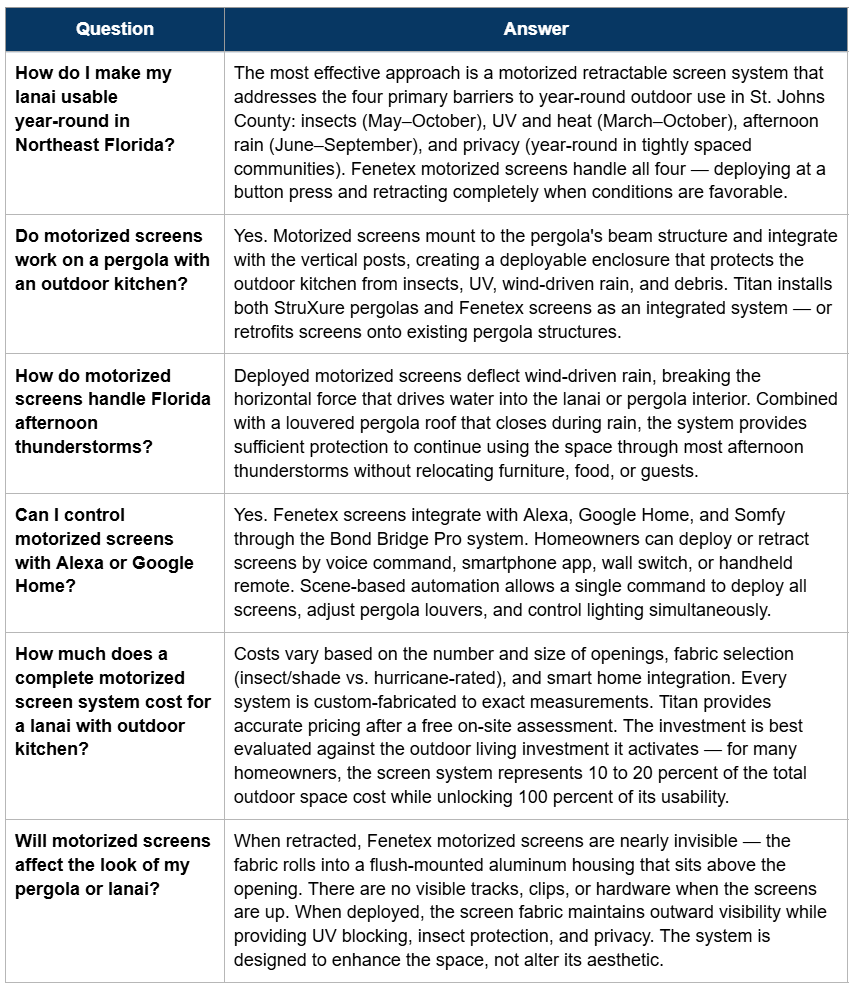
Frequently Asked Questions
Schedule Your Free Home Assessment
Serving St. Augustine · Nocatee · Ponte Vedra Beach · Palm Coast · Jacksonville · Northeast Florida
You already built the outdoor space. We make it work — every day, every season, every time you want to use it.
We walk your property, evaluate every lanai, patio, pergola, and outdoor kitchen opening, and design a motorized screen system that eliminates the bugs, the sun, the rain, and the privacy gap — so your outdoor investment delivers the return it was built to provide.
One visit. One quote. No obligation.
Call or text: (904) 484-7580 | TitanShuttersandScreens.com
Read the full series:
Week 1: Hurricane Season Is Coming — Is Your St. Augustine Home Ready?
Week 2: Aluminum Hurricane Shutters: The Complete Homeowner's Guide
Week 3: Do Motorized Screens Actually Protect Against Hurricanes?
Week 5: Finally Bug-Free: How Motorized Screens Are Reclaiming Nocatee and Ponte Vedra Lanais
Week 6: Beat the Florida Sun: UV Protection, Privacy & Solar Shading
