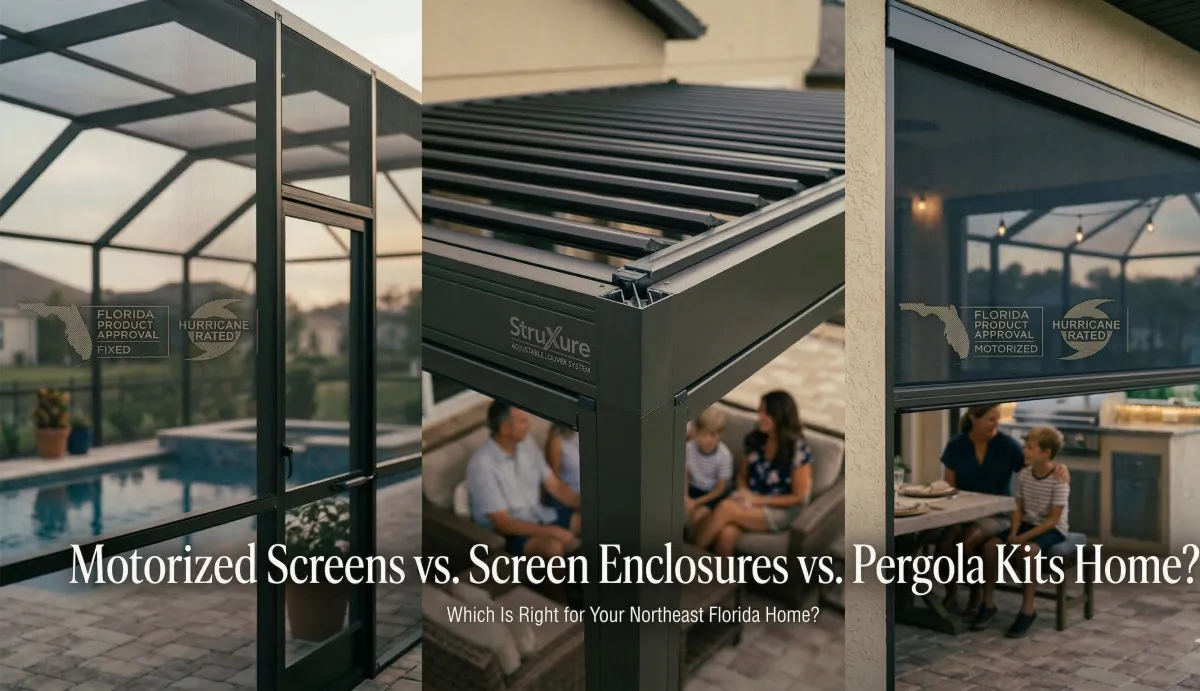
Motorized Screens vs. Screen Enclosures vs. Pergola Kits: Which Is Right for Your Northeast Florida Home?
If you are a homeowner in St. Augustine, Nocatee, Ponte Vedra Beach, or anywhere across St. Johns County researching how to improve your outdoor living space, you have almost certainly found yourself comparing three options: motorized retractable screens, a traditional fixed screen enclosure, or a pergola kit with some form of built-in shade or screening.
All three promise to make your outdoor space more usable. All three carry meaningful cost. And all three have strengths and limitations that most marketing materials gloss over — because every company selling one of these products wants you to believe theirs is the only answer.
This post is different. Titan Shutters and Screens installs motorized retractable screens and StruXure pergolas. We do not build fixed screen enclosures. That means we have no financial interest in recommending a screen enclosure — and we are going to tell you honestly when one might be the right choice anyway. Because the worst outcome for a homeowner is not choosing the wrong product. It is staying frozen in the research phase while another summer burns through the outdoor space you are trying to improve.
Here is the honest, side-by-side comparison.
Fixed Screen Enclosures: The Florida Default
Fixed screen enclosures — the aluminum-framed structures covered in mesh that surround pools and patios across every Florida neighborhood — are the default outdoor improvement in this market. There is a reason for that, and it is worth understanding before dismissing them.
A screen enclosure is a passive solution. It works whether you are home or on vacation, whether you remember to deploy something or forget. For pool owners, this is significant: the enclosure keeps debris out of the water, reduces chemical usage, satisfies Florida's pool safety barrier requirements, and blocks mosquitoes and larger insects without any daily action from the homeowner. You build it once and it works every day.
The typical cost for a fixed screen enclosure in Northeast Florida ranges from $6,000 to $15,000 for a standard patio or pool area, depending on size, roof style, and materials. The aluminum framing with fiberglass or polyester mesh is the most common configuration. Engineering, permitting, and concrete footers are required — a process that takes four to twelve weeks from consultation to completion.
Where screen enclosures fall short:
The mesh is permanent. On a cool February evening when you want the lanai completely open — no screen, no frame, just air — a fixed enclosure does not offer that option. The space is enclosed in February the same way it is enclosed in August. The protection is constant, and so is the confinement.
Standard screen enclosure mesh (18x14) does not block no-see-ums. If you live in Nocatee, Ponte Vedra Beach, or any community near retention ponds, marshland, or the Intracoastal Waterway, the biting midges that torment Northeast Florida homeowners from May through October will pass through standard enclosure mesh without resistance.
Screen enclosures carry zero hurricane rating. The mesh acts as a sail in high winds, and most contractors advise cutting it before a major storm — then paying $2,000 to $8,000 for rescreening afterward. This recurring cost is built into the lifetime ownership of every fixed screen enclosure in Florida's hurricane-prone markets.
The mesh degrades under UV exposure. Standard fiberglass mesh requires panel replacement every five to eight years. Over a 20-year period, a homeowner will rescreen the enclosure two to four times — at $1,000 to $5,000 per cycle — in addition to any storm-related rescreening.
And the enclosure is one configuration, all the time, regardless of conditions. You cannot open one side for a breeze while keeping the other sealed for bugs. You cannot lower the shade on the west side during the afternoon. You cannot adjust privacy, sun blocking, or rain protection independently. The enclosure is what it is.
Motorized Retractable Screens: The Deployable Alternative
Motorized retractable screens take the opposite approach. Instead of a permanent enclosure, they provide a deployable barrier that seals the space when you want protection and disappears completely when you do not.
The concept: mesh panels housed in a compact overhead cassette deploy downward along side-retention tracks at the press of a button — a wall switch, handheld remote, smartphone app, or voice command through Alexa or Google Home. When deployed, the screen seals the opening from header to floor with a weighted bottom bar that holds the fabric taut. When retracted, the screen rolls into a flush-mounted aluminum housing that is nearly invisible from the ground.
Where motorized screens excel:
Flexibility. You control when the screens are up and when they are down. Morning coffee with the lanai wide open and a breeze moving through. Screens down at 5:30 PM when the mosquitoes arrive. Screens up again the next morning. You are not choosing between open-air and protection — you have both, on demand.
Insect protection that actually works against no-see-ums. Fenetex insect screen mesh is engineered with an aperture tight enough to block biting midges, sand gnats, and every other insect common to Northeast Florida. Standard screen enclosure mesh cannot match this.
UV blocking. Fenetex screen fabric blocks 91 percent of ultraviolet radiation — providing meaningful solar heat reduction, furniture protection, and glare elimination that a standard screen enclosure's mesh does not deliver.
Privacy. The one-way visibility effect of deployed Fenetex fabric — clear outward visibility, darkened inward appearance — provides daytime privacy that a transparent screen enclosure mesh cannot.
Hurricane readiness. The Fenetex MaxForce hurricane screen carries Florida Product Approval FL 8637 — certified for use in High Velocity Hurricane Zones. Before a storm, the screen deploys to protect the opening. After the storm, it retracts. No rescreening. No structural repairs. No $2,000-$8,000 recurring cost. And because the screen retracts into a sealed housing, the fabric and motor are protected from the elements between deployments — extending the system's operational lifespan well beyond a permanently exposed screen enclosure mesh.
Smart home integration. Motorized screens integrate with Alexa, Google Home, and Somfy for voice control, app control, and automated deployment based on time of day or weather conditions. A screen enclosure has no technology layer.
Where motorized screens require consideration:
They are not passive. If you forget to deploy the screens, they are not deployed. For pool debris protection — the function where a screen enclosure truly excels as a set-it-and-forget-it solution — a motorized screen requires a conscious action (or an automation routine) to deploy. Homeowners who want 24/7 pool debris protection without daily involvement should carefully consider this difference.
Cost per opening is higher than an equivalent area of a fixed screen enclosure. Motorized screens are precision-engineered, custom-fabricated products — they carry a premium over passive aluminum-and-mesh construction. The total project cost depends on the number and size of openings, but for a comparable covered area, motorized screens typically represent a higher initial investment.
Pergola Kits: The Overhead Solution
Pergolas — particularly motorized louvered systems like StruXure — have become one of the most popular outdoor additions in the Northeast Florida market. And for good reason: a louvered pergola provides adjustable overhead coverage that no fixed roof structure can match. Open the louvers for sunshine. Close them for rain. Tilt them for partial shade. The overhead environment is fully controllable.
But a pergola addresses only the overhead plane. The vertical sides — where insects enter, where the afternoon sun strikes, where rain blows in horizontally, and where the neighbors have a clear sightline — remain open.
This is the critical distinction. A pergola without side screening is a shade structure. A pergola with motorized screens on the sides is a controllable outdoor room.
Many homeowners in St. Johns County discover this distinction after installation. They love the pergola's overhead capability but find the open sides leave them exposed to the same insects, sun glare, and wind-driven rain they were trying to escape. The pergola solved one problem while leaving three others unaddressed.
The integrated approach:
Titan installs both StruXure pergolas and Fenetex motorized screens — and we design the integration as a unified system. The screen housings mount to the pergola's beam structure. The side tracks integrate with the vertical posts. The smart home controls for both the louvers and the screens operate from the same platform.
For homeowners considering a new pergola, the integrated pergola-and-screen package delivers a complete outdoor room from day one — overhead coverage from the louvers, side protection from the screens, and full smart home control of both systems through a single interface.
For homeowners who already have a pergola and are experiencing the open-side limitations, a retrofit screen installation is straightforward and does not require modifying the existing pergola structure.
The Honest Comparison: Side by Side
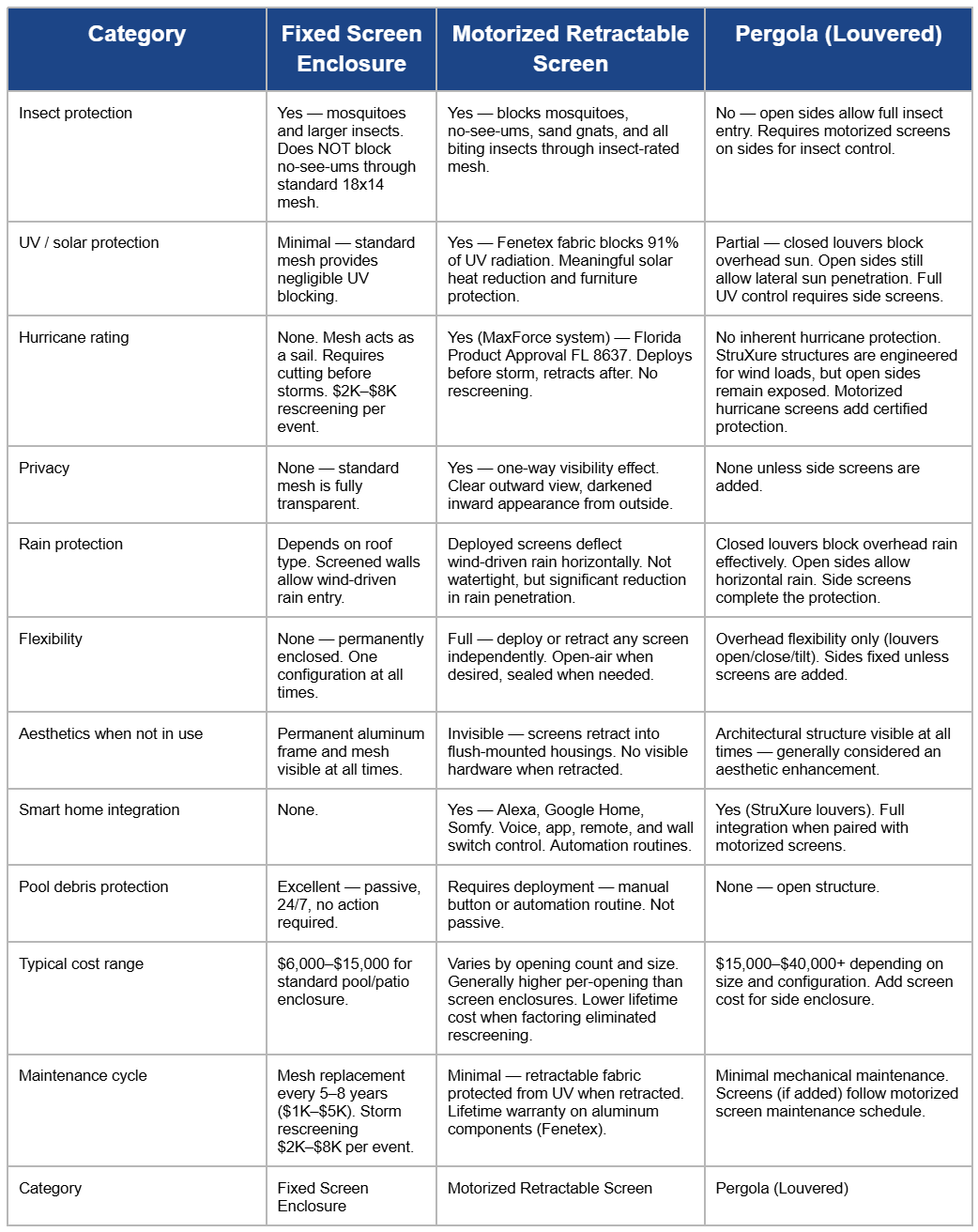
When Each Option Makes Sense: An Honest Recommendation
Choose a fixed screen enclosure if: Your primary goal is passive pool debris protection. You want a set-it-and-forget-it solution that works 24/7 without any daily action. You do not have a significant no-see-um problem. And you are comfortable with the recurring rescreening costs that come with Florida's storm exposure.
Choose motorized retractable screens if: You want flexibility — open-air when conditions are favorable, sealed protection when they are not. You have a no-see-um or sand gnat problem that standard mesh does not solve. You value UV protection, privacy, and solar heat reduction as daily benefits. You want hurricane-rated protection that eliminates the rescreening cycle. And you want smart home integration that lets you control the space from your phone or your voice.
Choose a pergola if you want overhead shade and rain protection on a patio or yard area that does not currently have a roof structure. Understand that a pergola alone does not address insects, side-exposure sun, horizontal rain, or privacy — those require motorized screens on the sides.
Choose a combination if: You want the most complete solution. A StruXure pergola with Fenetex motorized screens on the sides — or motorized screens retrofitted to an existing lanai or covered patio — delivers overhead coverage, side protection, insect control, UV blocking, privacy, rain management, and hurricane readiness in a single, smart-home-controlled system. This is the approach that delivers twelve-month outdoor living in Northeast Florida.
The Question Behind the Question
Most homeowners who find this post are not actually asking "which product is best?" They are asking a more fundamental question: "How do I make my outdoor space work year-round in Florida?"
The answer depends on the space, the budget, and the priorities. But the pattern we see most consistently across St. Johns County — and the one that delivers the highest homeowner satisfaction — is a combination approach. Motorized screens on the lanai and patio openings. Aluminum hurricane shutters on the windows and doors. A StruXure pergola on the open patio where overhead coverage is needed. And a smart home system that ties everything together.
Titan installs every product in that combination. We do not subcontract the pergola to one company, the screens to another, and the shutters to a third. One assessment. One plan. One installation team. One point of accountability.
That is the advantage of working with a contractor who carries the full product range — we recommend the right solution for each opening because we have no incentive to force a single product where it does not belong.
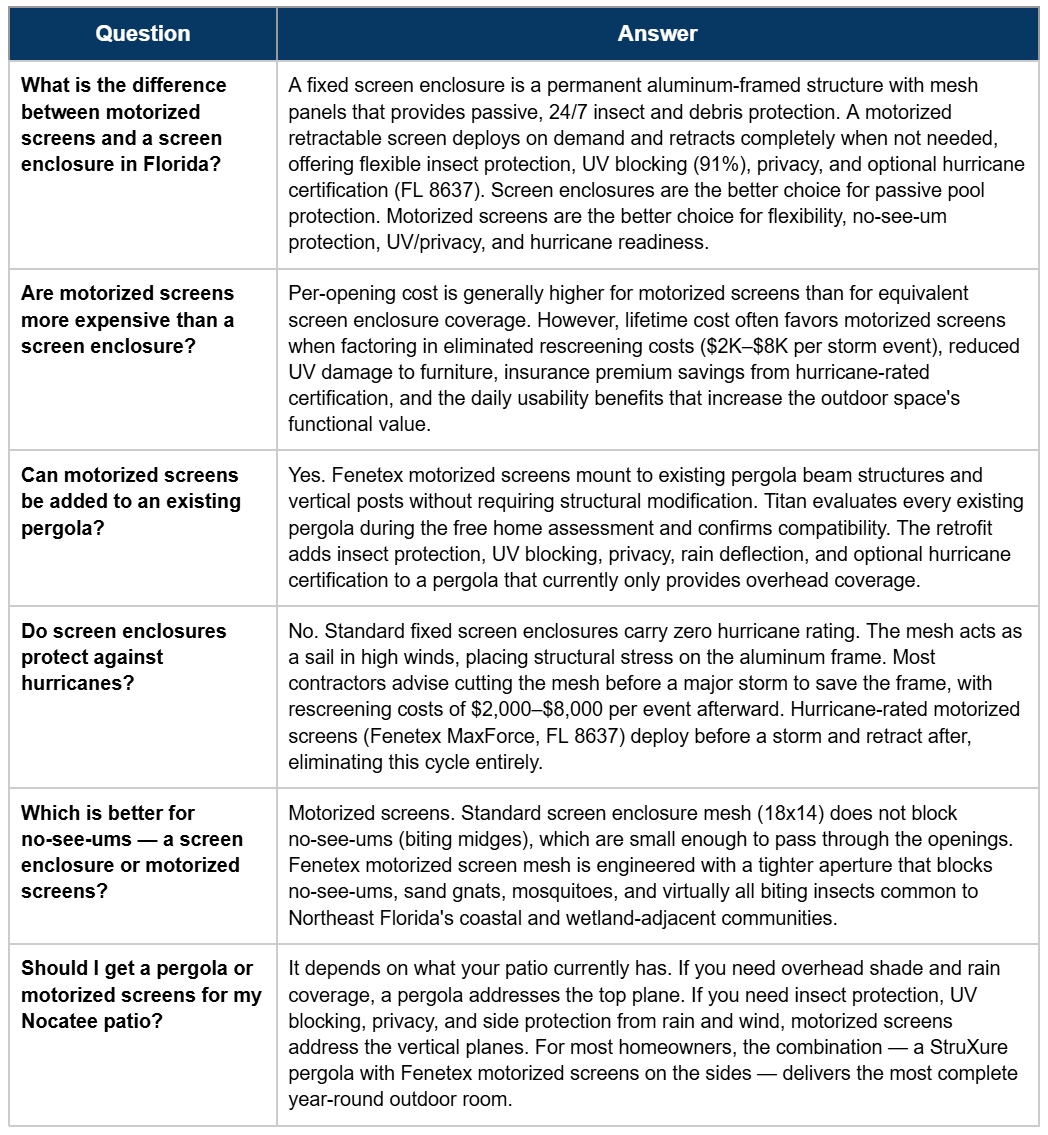
Frequently Asked Questions
Schedule Your Free Home Assessment
Serving St. Augustine · Nocatee · Ponte Vedra Beach · Palm Coast · Jacksonville · Northeast Florida
Not sure which option is right for your home? That is exactly what the home assessment is for. We walk your property, evaluate every outdoor opening, and recommend the right combination of products — motorized screens, hurricane shutters, and pergola systems — based on your space, your priorities, and your budget.
One contractor. Every product. No incentive to sell you something you do not need.
Call or text: (904) 484-7580 | TitanShuttersandScreens.com
Read the full series:
Week 1: Hurricane Season Is Coming — Is Your St. Augustine Home Ready?
Week 2: Aluminum Hurricane Shutters: The Complete Homeowner's Guide
Week 3: Do Motorized Screens Actually Protect Against Hurricanes?
Week 5: Finally Bug-Free: Motorized Screens Reclaiming Nocatee and Ponte Vedra Lanais
Week 6: Beat the Florida Sun: UV Protection, Privacy & Solar Shading
Week 7: The Perfect Outdoor Entertaining Setup: Why Motorized Screens Change Everything
