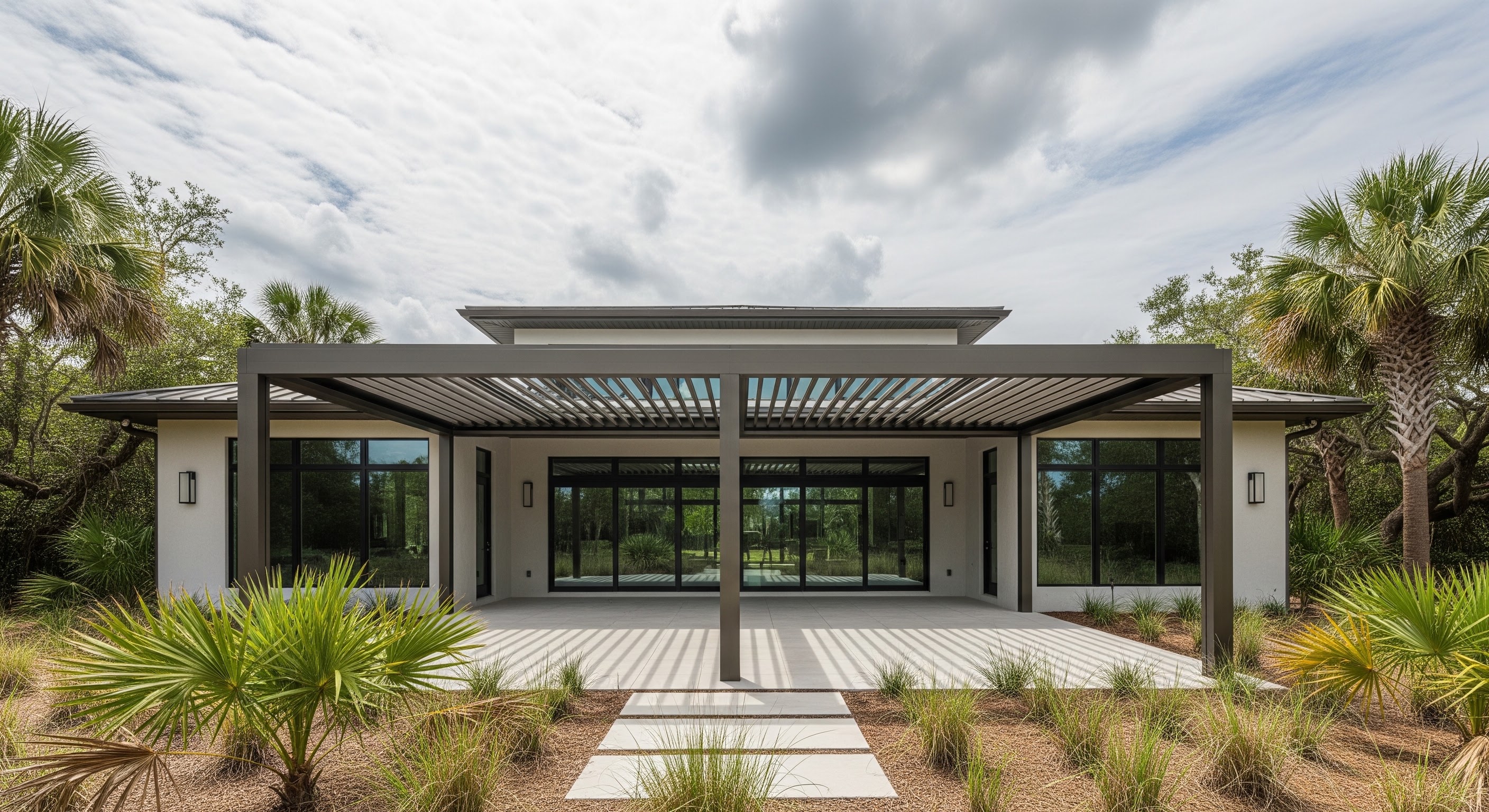
How a Motorized Pergola's Rain Sensor Actually Knows to Close
How a Motorized Pergola's Rain Sensor Actually Knows to Close
A motorized pergola with adjustable louvers can do something a fixed cover never could: sit open on a nice afternoon, then close itself before a homeowner even notices rain has started. That feature gets mentioned a lot in product descriptions without much explanation of how it actually works, or what its real limits are.
This is the fifth post in Built for Both Seasons, following the previous post on aluminum and coastal corrosion.
The sensor mechanism as described by the manufacturer
Motorized pergola systems with rain-close functionality generally rely on a small moisture-detecting sensor mounted where it will make direct contact with falling rain. When moisture reaches the sensor, it completes an electrical trigger that signals the motor controlling the louvers to rotate them into a closed, water-shedding position. This is a description of how these systems are generally built and marketed by manufacturers in this product category. Titan has not independently tested the specific sensor hardware used in every pergola it installs, so this section describes the general mechanism rather than a lab-verified performance claim for any single product.
What triggers it, and what doesn't
Because the sensor responds to physical moisture contact rather than forecasting, it reacts to rain that is already falling, not rain that's about to start. A brief, light drizzle that barely wets the sensor surface may or may not trigger closure depending on the specific sensor's sensitivity threshold, which varies by manufacturer and model. High humidity alone, without actual precipitation, generally will not trigger the sensor, since the mechanism responds to direct moisture contact rather than ambient dampness in the air. This matters practically: the feature is built to catch an unexpected shower while the pergola is open, not to serve as a general weather-anticipation system.
Manual override and everyday control
Automatic rain closure is typically one feature layered on top of full manual control, not a replacement for it. A homeowner can generally open or close the louvers at any time through a remote, wall-mounted switch, or in some systems, a smartphone app, independent of whatever the rain sensor is doing. This means the automation exists to handle the specific case where no one is present to react to a sudden shower, while the everyday use case, adjusting the pergola for shade, sun, or airflow, stays under direct manual control the rest of the time.
A rain sensor reacts to water that's already falling on it. It's a safety net for the moment no one's watching the sky, not a substitute for actually watching the sky.
One boundary worth stating clearly: this post describes how rain-sensing pergola systems are generally built and marketed across the industry, based on manufacturer product descriptions. It is not an independently tested performance claim for a specific product's sensor sensitivity, response time, or reliability, since that would require lab or field testing this post doesn't have data from.
Sources
This post describes motorized pergola rain-sensor functionality as generally built and marketed in the outdoor living industry, based on manufacturer product descriptions rather than independent lab testing.
