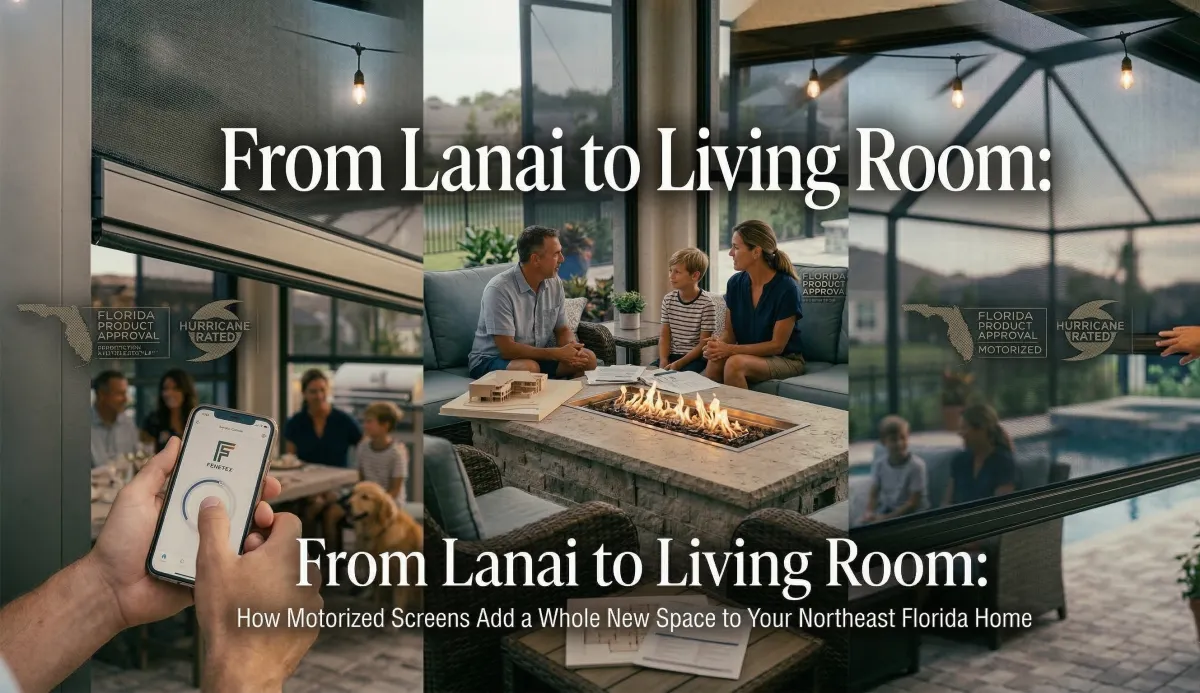
From Lanai to Living Room: How Motorized Screens Add a Whole New Space to Your Northeast Florida Home
Today is June 1. Hurricane season is open.
If you have been following this series since April, your home is prepared — aluminum shutters on the windows, motorized screens on the lanai, a storm plan in place. If you are just joining now, those posts are waiting for you — and the installation calendar still has openings for mid-to-late summer completion.
But this post is not about storms. It is about the room you are sitting in right now — or the room you should be sitting in right now but are not, because you are reading this inside.
Your lanai is not a patio. It is not a bonus. It is not a seasonal amenity. In the St. Johns County real estate market, it is livable square footage — appraised, photographed, and priced into every listing in Nocatee, Ponte Vedra Beach, World Golf Village, and every master-planned community built in the last fifteen years.
The question is whether your lanai functions like livable square footage — usable twelve months a year, in every condition, at every hour — or whether it functions like an expensive patio that works six months and sits empty the other six.
Motorized screens are what close that gap. They are the element that transforms a seasonal outdoor space into a year-round room — a fifth room in a four-bedroom home, a room that connects the kitchen to the pool, the family to the outdoors, and the home's value to the premium that Northeast Florida buyers pay for functional outdoor living.
The Fifth Room: How Northeast Florida Homeowners Are Rethinking the Lanai
There is a behavioral shift happening across St. Johns County, and it is changing how homeowners think about their outdoor space.
The old framework: the lanai is a patio. It is outdoor space. It is where you go when the weather cooperates and where you retreat from when it does not. It has furniture, maybe a grill, maybe a fan mounted to the ceiling. It is nice. It is not a room.
The new framework: the lanai is a room. It has a defined function — dining, entertaining, working, relaxing. It has infrastructure — an outdoor kitchen, a mounted television, integrated lighting, a sound system. It has environmental controls — motorized screens that manage insects, sun, rain, wind, and privacy on demand. And it has the one characteristic that separates a room from a patio: it works regardless of conditions.
This shift is not hypothetical. It is visible in how homes are being designed, built, marketed, and sold across Northeast Florida. New construction in Nocatee, Silverleaf, and the Ponte Vedra corridor increasingly includes motorized screens as a builder-installed feature — not an aftermarket addition. Real estate listings that feature functional, screened outdoor living spaces photograph differently, show differently, and sell differently than listings where the lanai is an open patio with furniture.
The homeowners who have made this shift report the same thing: the lanai went from the most underused space in the house to the most used room in the house. Not because the space changed. Because the screens made the space functional in every condition, and the family stopped thinking of it as "outside" and started thinking of it as home.
What "Year-Round" Actually Means in Northeast Florida
In a state where the climate shifts dramatically across seasons, "year-round" is not a marketing phrase. It is a specific claim that requires a specific solution.
January through March: Northeast Florida's most comfortable outdoor months. Mild temperatures, low humidity, minimal insect activity. An unscreened lanai works during this window — which is precisely why many homeowners assume they do not need screens. But privacy is still a factor in tightly spaced communities. And the morning sun on an east-facing lanai can be intense enough to make coffee uncomfortable without shade.
April: The transition month. Humidity begins to climb. Mosquitoes emerge. This is when the first compromises start — doors close earlier in the evening, the citronella candles appear, and the lanai begins its six-month decline toward abandonment.
May through September: The gauntlet. Mosquitoes, no-see-ums, extreme UV, daily afternoon thunderstorms, and temperatures that make unshaded surfaces untouchable. Without motorized screens, this is the period when the lanai stops functioning as a room and becomes a space you look at through the sliding glass door.
October through December: The recovery. Insect activity declines. Temperatures moderate. The lanai becomes usable again — but homeowners who went without screens all summer have often disengaged from the space psychologically. The furniture is faded. The cushions were left out during a storm. The outdoor kitchen has not been used since April. The reactivation cost — physical and psychological — is real.
With motorized screens, the gauntlet does not exist. The screens deploy in May and the lanai remains a functioning room through September without interruption. The furniture is protected from UV. The space is insect-free at dusk. The afternoon rain is deflected. And the psychological continuity — the habit of using the lanai as a daily room — never breaks.
Year-round does not mean "sometimes in winter." It means Tuesday night in July. Saturday morning in August. Sunday dinner in September. Every day, every month, every condition.
The Financial Case: What a Functional Lanai Adds to a Northeast Florida Home
The value conversation around motorized screens is not abstract. It is grounded in the specific economics of the St. Johns County real estate market.
St. Johns County is among the fastest-growing counties in Florida, with a median household income of approximately $109,000 — one of the highest in the state. Nocatee's median household income exceeds $131,000. The housing market in these communities is driven by high-income buyers relocating from the Northeast, the Midwest, and other Florida markets — buyers who expect functional outdoor living space as a standard feature, not a bonus.
In this market, a lanai that functions as a year-round room is worth more than a lanai that functions as a seasonal patio. That value expresses itself in three ways.
Appraised value. Functional outdoor living improvements — including motorized screens, outdoor kitchens, and pergola systems — contribute to a home's appraised value by increasing the usable square footage and the quality of the improvement. A lanai with motorized screens, integrated lighting, and an outdoor kitchen is appraised differently than a lanai with a ceiling fan and a grill.
Sale price and days on market. Homes with functional, move-in-ready outdoor living spaces sell faster and command higher prices in the St. Johns County market. Real estate professionals in Nocatee and Ponte Vedra consistently report that screened, finished outdoor living spaces are among the most photographed and most commented-on features during showings. The buyer who walks into a lanai with deployed motorized screens — cool, bug-free, private, and connected to an outdoor kitchen — is experiencing the lifestyle, not imagining it.
Insurance premium reduction. For homeowners who install hurricane-rated Fenetex MaxForce screens alongside aluminum shutters, the wind mitigation insurance discount under Florida Statute 627.0629 provides an annual financial return that reduces the net cost of the screen investment every year it is in place. Over a decade, those savings can represent a meaningful percentage of the original installation cost.
The Indoor-Outdoor Transition That Changes How You Live
The most powerful effect of motorized screens is not any single benefit — insects, UV, rain, privacy, hurricane protection. It is the way all of those benefits operating together change the relationship between the inside of your home and the outside.
In a home without screens, the sliding glass door is a boundary. Inside is comfortable. Outside is conditional. You check the weather, check the bug situation, check the sun angle, and then decide whether to open the door. Most of the time, especially from May through September, the door stays closed.
In a home with motorized screens, the sliding glass door becomes a transition — not a boundary. The lanai is comfortable. It is insect-free. It is shaded. It is private. You open the door and walk into a room that happens to be outdoors, with the same expectation of comfort you have walking into the kitchen or the living room.
This sounds like a small shift. It is not. It changes where families eat dinner. It changes where children do homework on a Tuesday afternoon. It changes where you have your morning coffee, where you take a phone call, where you sit after a long day. The lanai stops being a destination you choose and becomes a space you default to — because it is the most pleasant room in the house.
Homeowners in Nocatee, Ponte Vedra Beach, and World Golf Village who have installed motorized screens report a consistent behavioral pattern: the indoor furniture shows less wear. The indoor living room is used less. The television inside is on less. The family has migrated — not to the outdoors, but to the room that used to be outdoors and now functions as a fully integrated part of the home.
June 1: The Dual Reality
Today is the first day of hurricane season. It is also a Sunday — and in Northeast Florida, it is likely warm, humid, and beautiful in the morning. By mid-afternoon, there is a good chance of a thunderstorm. By dusk, the mosquitoes will be out.
This is the dual reality that motorized screens address better than any other product in the outdoor living market. They are storm protection and lifestyle enhancement, deployed from the same housing, operated by the same button, and justified by the same investment.
A homeowner with Fenetex MaxForce hurricane screens on the lanai is protected from the named storm that may or may not come this season. That same homeowner is also eating dinner on the lanai tonight — bug-free, shaded, private, and comfortable — because the screen that was engineered for a Category 5 hurricane is also engineered for a Tuesday in June.
That dual functionality is the reason the Weeks 1–4 hurricane series and the Weeks 5–8 outdoor living series are not separate conversations. They are two expressions of the same investment. The screen you buy for the storm is the screen you use every day. The storm protection pays for itself through insurance discounts. The daily usability pays for itself through the room it creates.
One product. Two purposes. Twelve months of return.
From the Homeowner Who Almost Waited
The homeowner we talk to most often in June is the one who started researching in March, got busy in April, told themselves they would call in May, and is now reading this on June 1 wondering if it is too late.
It is not too late. It is later than ideal — but hurricane season runs through November 30, and the outdoor living benefits begin the day the screens are installed. A homeowner who starts the process today will have screens installed by late August or early September — reclaiming the final quarter of summer and every month after that.
The homeowners who wait until a named storm enters the Gulf call to a different reality: lead times measured from the back of a full production queue, installation crews booked weeks out, and the uncomfortable awareness that they are installing storm protection during storm season rather than before it.
The best time to install was March. The second-best time is today.
What the Next Step Looks Like
If you have read this far and you are thinking about your own lanai — the one that should be a room but is not yet — here is what the next step looks like.
You call or text (904) 484-7580 and schedule a free home assessment. One of our installation specialists comes to your property — typically within a week — and walks every outdoor opening with you. We evaluate the lanai, the patio, the pergola if you have one, the outdoor kitchen, and any other space where screens would add daily value or storm protection.
We measure. We discuss your priorities — insects, sun, privacy, hurricane protection, or all of the above. We recommend the right product for each opening — One-Track motorized screens for daily comfort, MaxForce hurricane screens for daily comfort plus storm certification, or aluminum shutters for windows and doors. We provide a detailed quote — not a range, not an estimate — based on your specific openings and your specific home.
Then you decide. No pressure. No follow-up calls if you say no. Just the information you need to make the decision — and the knowledge that every week you wait is a week your outdoor space is not working to its potential.
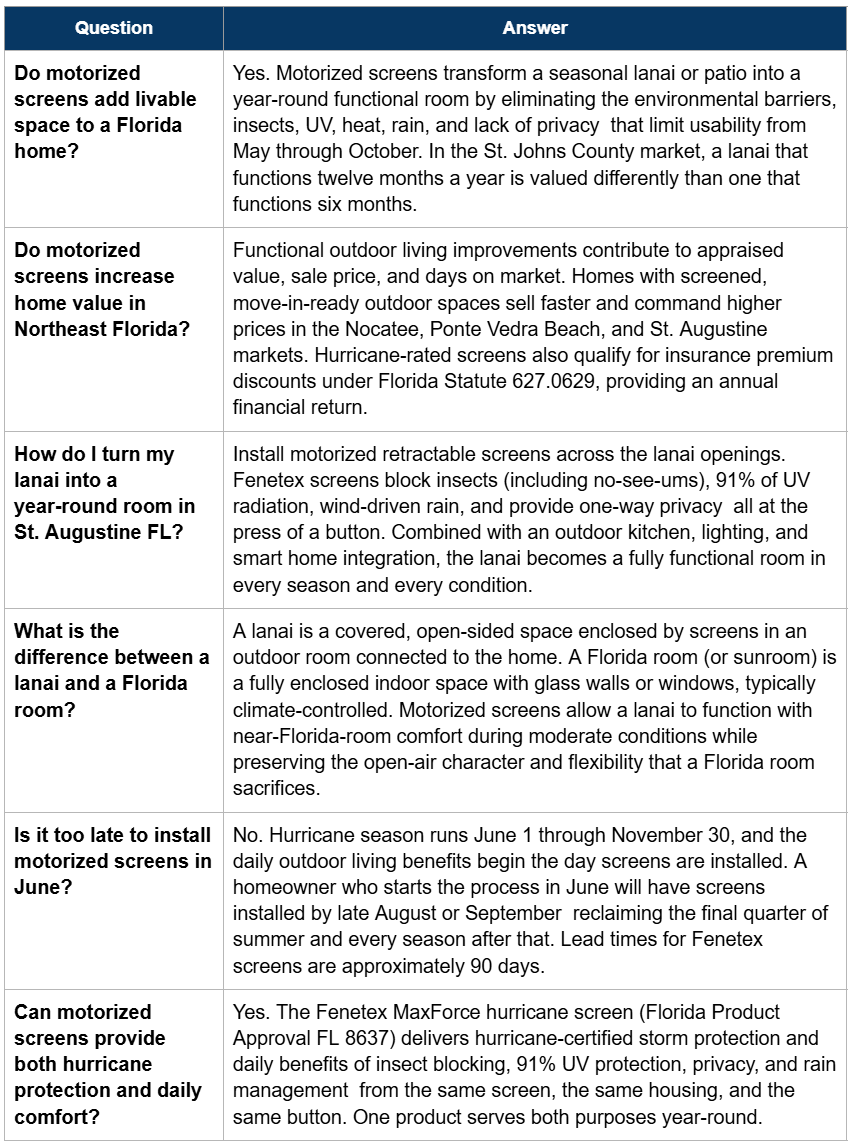
Frequently Asked Questions
Schedule Your Free Home Assessment
Serving St. Augustine · Nocatee · Ponte Vedra Beach · Palm Coast · Jacksonville · Northeast Florida
Your lanai is either a room or a patio. Motorized screens are the difference. We walk your property, evaluate every opening, and design the system that makes your outdoor space work — every day, every month, every condition.
Hurricane season is open. The installation calendar has openings for late summer completion. The best time to start was March. The second-best time is today.
Call or text: (904) 484-7580 | TitanShuttersandScreens.com
Read the full series:
