The Complete Guide to Insect Protection for Your Northeast Florida Pergola
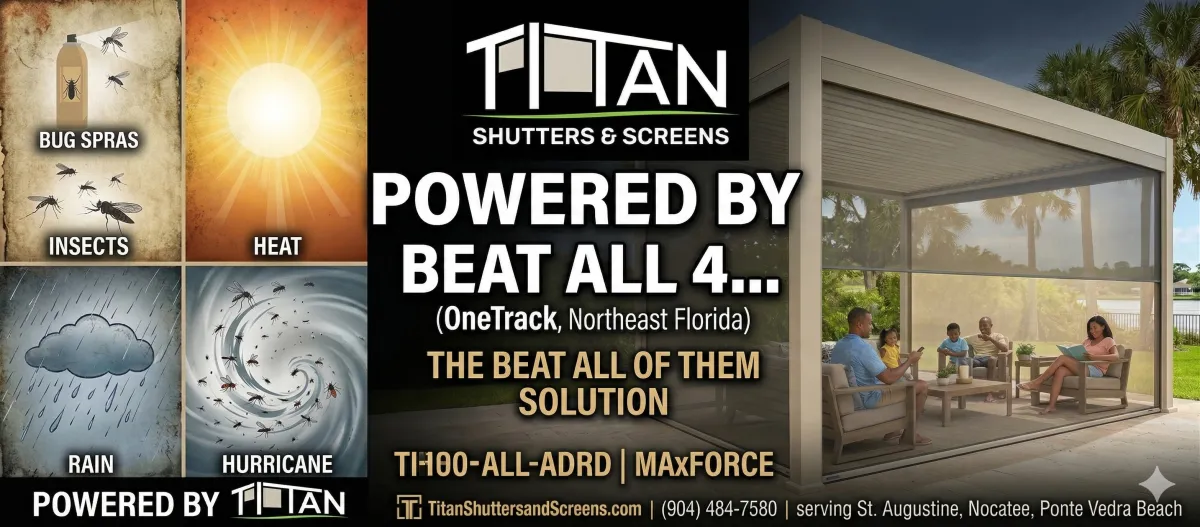
The most effective way to keep insects out of a pergola in Northeast Florida is a motorized retractable screen that physically seals the opening. Bug sprays wear off. Citronella candles cover a two-foot radius. Professional mosquito treatments reduce populations temporarily but do not eliminate them. A motorized screen — specifically the Fenetex OneTrack retractable screen system — changes the environment entirely. When deployed, it creates a sealed barrier that insects cannot penetrate, circumvent, or wait out. When not needed, it retracts completely, leaving the pergola fully open. That is the answer. Everything else is a workaround.
This guide explains why insects are the number-one enemy of outdoor living in Northeast Florida, which specific species drive the most disruption, why traditional solutions fail at a biological level, and how the OneTrack screen system solves the problem permanently — without sacrificing the open-air experience that made you invest in a pergola in the first place.
The Insect Reality in Northeast Florida: What You're Actually Dealing With
Floridians have a habit of describing the insect situation the way they describe the heat — with a shrug and an acceptance that this is simply how things are. But acceptance is not the same as understanding. And understanding the insect landscape in Northeast Florida is the first step toward eliminating it.
The University of Florida Institute of Food and Agricultural Sciences (UF/IFAS) documents more than 12,500 insect species in Florida — a count that makes the state one of the most entomologically active in the continental United States. Of those, four categories directly affect outdoor living for homeowners in St. Augustine, Nocatee, Ponte Vedra Beach, and the surrounding St. Johns County communities:
Mosquitoes. Florida hosts more than 80 mosquito species. The two most relevant to Northeast Florida homeowners are Aedes aegypti and Aedes albopictus — the primary vectors for dengue fever, Zika virus, and chikungunya. The Florida Department of Health actively monitors these species across all 67 counties, and St. Johns County sits in a high-activity corridor between the St. Johns River and the Atlantic coast. Both species are active from dawn through dusk, with a pronounced peak in the hour before and after sunset — exactly when most families want to be outside.
No-see-ums. Biting midges of the genus Culicoides are the most underestimated insect threat in Northeast Florida, primarily because they are invisible to most people until the welts appear. These insects are typically 1 to 3 millimeters in length — small enough to pass through standard window screen mesh, which is rated at 18 x 16 openings per inch. According to the UF/IFAS Entomology Department, no-see-ums are most active at dusk and dawn from April through November in coastal Florida communities. Screens that stop mosquitoes do not stop no-see-ums unless the mesh density is specifically engineered for the purpose.
Stable flies and biting flies. Along Northeast Florida's coastal and intracoastal communities, biting flies — particularly Stomoxys calcitrans — migrate inland from beach and marsh environments during the warm months. Unlike mosquitoes, which can be somewhat deterred by fans, biting flies are persistent in wind and will actively pursue hosts.
Wasps and yellow jackets. A pergola with exposed wood framing is an attractive nesting site for paper wasps and yellow jackets from April through October. An established nest under a pergola beam does not merely inconvenience outdoor use — it creates a safety hazard, particularly for children and anyone with insect sting allergies.
The combined activity window for these four categories spans March through November in Northeast Florida. That is nine months of the year during which an unprotected pergola is functionally compromised for evening and early morning use. Nine months.
Why Everything You've Already Tried Hasn't Fixed It
Most Northeast Florida homeowners who are frustrated with their insect situation have not been passive. They have tried things. They have spent money. They have tested solutions and found them wanting, and in many cases, they have quietly concluded that the problem simply cannot be solved — that insects are an inescapable fact of Florida outdoor living that no product can fully address.
That conclusion is wrong. But understanding why previous solutions failed is essential to understanding why the right solution works.
Bug Spray and Repellents
DEET-based repellents are effective at reducing mosquito landings on treated skin, but they do not eliminate insects from the environment, do not reliably address no-see-ums, and require constant reapplication. The Centers for Disease Control and Prevention (CDC) recommends repellents containing DEET, picaridin, or IR3535 for personal protection — language that implies individual, not space, protection. Repellent applied to one person does not create a bug-free zone for everyone sharing the pergola. It does not protect surfaces, furniture, or food. And it does not address the psychological dimension of the insect problem: the awareness that insects are present, even if they are not currently landing.
Citronella Candles and Torches
Citronella products work by masking the CO2 and lactic acid signals that mosquitoes use to locate hosts. In a controlled indoor environment with limited airflow, this masking effect can reduce mosquito activity. On an open pergola in Northeast Florida — where airflow is constant, and the CO2 plume from a group of people disperses rapidly — the effective radius of a single citronella candle is approximately two feet. A 20-foot pergola with six people sitting at both ends and a candle in the middle is, in practical terms, unprotected at both ends.
Professional Mosquito Treatment
Barrier spray treatments — the most commonly marketed professional solution in St. Johns County — work by applying a synthetic pyrethroid to the foliage and surfaces around a property. The American Mosquito Control Association notes that barrier treatments can reduce adult mosquito populations by 70 to 90 percent immediately following application. That number sounds definitive. What it does not convey is that the treatment degrades within two to four weeks, does not address no-see-ums or biting flies, does not prevent reinfestation from adjacent properties, and must be repeated every three to four weeks throughout the season to maintain effectiveness. The annual cost of a professional barrier treatment program in Northeast Florida typically runs between $600 and $1,500 — a recurring expense that reduces but does not eliminate the problem.
Bug Zappers and Electric Traps
UV-light mosquito traps and electric zappers have a specific and well-documented limitation: they attract and kill a wide range of flying insects indiscriminately, including many beneficial species, but are largely ineffective at targeting Aedes aegypti and Aedes albopictus, which are visually oriented hunters that locate hosts primarily through CO2 and heat rather than UV light. A 2010 study published in the Journal of the American Mosquito Control Association found that less than one percent of insects caught in UV traps were mosquitoes. Bug zappers solve a different problem than the one Northeast Florida homeowners are facing.
The pattern across all of these solutions is identical. They treat the symptom. None of them changes the environment. A motorized screen does the only thing that actually works: it creates a physical barrier that insects cannot enter.
The Physical Barrier Principle: Why Environmental Change Is the Only Real Solution
There is a reason that the most insect-free outdoor spaces in the world — from screened porches in coastal Maine to outdoor dining rooms in Singapore — share one common feature. They are enclosed. Not by chemical treatment, not by electronic deterrence, but by a physical barrier that insects cannot penetrate.
The pergola presents a specific engineering challenge for this principle. Traditional screen enclosures — the aluminum-framed cage structures that surround most Northeast Florida pools and patios — can enclose a pergola, but at the cost of the open-air aesthetic that defines the space. Permanent screening mutes the view. It reduces airflow. It makes the pergola feel enclosed rather than open, and for many homeowners, it defeats the purpose of having a pergola at all.
The tension between insect protection and open-air living is the reason many Northeast Florida homeowners have lived with the insect problem for years. They know a permanent enclosure would work. They do not want a permanent enclosure. And until recently, those were the only two options.
The Fenetex OneTrack motorized retractable screen resolves the tension. It is not a permanent enclosure. It is an on-demand barrier — deployed when insects are active, retracted when the space should be open. The transition takes seconds. The result, when deployed, is a fully sealed pergola opening that insects cannot enter. The result, when retracted, is a fully open pergola with no visible hardware, no obstructed sightlines, and no diminished sense of outdoor living.
The Fenetex OneTrack Screen: How It Actually Works
Understanding why the OneTrack screen succeeds where other solutions fail requires examining how it addresses the three specific failure points of traditional screens: edge gaps, mesh density, and deployment reliability.
The Track System: No Gaps at the Edges
The most common point of failure in a traditional screen panel or temporary screen curtain is the edges. Insects — particularly no-see-ums and small gnats — enter not through the mesh itself but through the gap between the screen and the mounting frame. The Fenetex OneTrack system uses Keder-edge technology — a track-retention system borrowed from marine sailmaking — that locks the screen fabric into a fixed aluminum track on both sides of the opening. There is no gap. The fabric is recessed into the track channel, creating a flush seal from top to bottom. Insects that fly along the edge find no opening.
The Mesh: Engineered for No-See-Ums
Standard 18 x 16 window screen mesh has approximately 256 openings per square inch — large enough for no-see-ums to pass through without contact. The Fenetex OmegaTex fabric used in the OneTrack system is engineered with a higher mesh density and is specifically designed to block biting midges. The fabric is not a standard insect screen. It is a purpose-built outdoor textile that balances mesh density for insect exclusion with sufficient airflow to maintain ventilation and visibility through the deployed screen.
The fabric also addresses the visual dimension of insect activity. Even when insects cannot enter a screened space, their visible presence on the outside of a standard screen creates psychological discomfort — the awareness of insects hovering inches away, even if they cannot reach you. The OmegaTex fabric's density and coloration are designed to minimize this visual intrusion while maintaining clear outward sightlines from inside the pergola.
Deployment Speed: The 20-Second Window
Here is a practical reality that most homeowners understand immediately upon experiencing it. The window between pleasant outdoor conditions and unbearable insect activity in Northeast Florida is often measured in minutes. The hour before sunset on a July evening can be perfectly comfortable. Twenty minutes later, the mosquitoes arrive in force.
A screen system that requires manual installation, unrolling, staking, or any multi-step deployment process is functionally useless in that window. By the time the screen is up, the evening is over. The OneTrack screen deploys in seconds — a single button press on the wall control, a tap on a remote, or a voice command through Alexa or Google Home integration. The screen drops from its housing to the bottom track, locks into position, and the pergola is sealed. The evening continues.
For homeowners who travel or split their time between properties, the smart home integration via the Bond Bridge Pro system enables remote deployment from a smartphone. A homeowner receiving a storm warning while away from home can seal the pergola and protect the outdoor space without being on-site.
The Retraction: Why It Matters as Much as Deployment
A pergola screen that is permanently deployed is a permanent screen enclosure by another name. The value of the OneTrack system is not just that it closes when needed — it is that it opens completely when it is not. The screen retracts into a flush-mounted aluminum housing at the top of the opening. When the screen is retracted, the housing is a clean architectural element that reads as part of the pergola structure. There is no dangling fabric, no visible roller mechanism, no compromise of the open-air aesthetic that the pergola was built to provide.
This matters psychologically. Homeowners who invest in a pergola invest in the feeling of outdoor living — the sense that the space is open, connected to the environment, and expansive. A solution that preserves that feeling when the insects are not active is one that the homeowner will actually use. Solutions that compromise the experience — even while providing real protection — tend to be deployed less frequently, maintained less carefully, and ultimately resented.
The 500-Hour Calculation: What Insect-Free Evenings Are Actually Worth
Here is a number worth sitting with.
If insects drive a Northeast Florida family inside from the pergola during evening hours from May through October — roughly six months — and if the evening outdoor window runs from 6 p.m. to dark, that represents approximately three hours per evening. Six months is roughly 180 days. Three hours per day over 180 days is 540 hours of outdoor living per year that insects have taken from you.
Five hundred and forty hours. That is 22 full days. It is every weekend evening from Memorial Day through Halloween, plus most weeknights in between.
Most homeowners who absorb this number for a moment recognize it not as an abstract calculation but as an accurate description of their experience. They have not been outside in the evenings. Not really. They have attempted it, retreated from it, or endured it while wishing they hadn't. The insect situation has not merely been an annoyance. It has been a persistent, ongoing theft of the outdoor life they invested in when they bought their home.
The annual cost of attempting to manage this with professional barrier treatments runs $600 to $1,500 in St. Johns County. Add citronella products, bug sprays, and the incremental cost of outdoor lighting designed to minimize insect attraction, and the annual workaround budget for a motivated homeowner can easily reach $2,000 or more — spent on solutions that reduce the problem by some percentage but do not eliminate it. Over five years, that is $10,000 spent on an insect situation that has not been solved. The University of Florida Extension Service describes this cycle specifically when discussing integrated pest management for residential properties: temporary solutions that do not address the root cause create ongoing dependency and ongoing cost.
A Fenetex OneTrack installation eliminates the cycle. The workaround budget goes to zero. The 540 hours come back. And the pergola — the investment that was supposed to extend the home's living space — actually does.
Insect Protection and Hurricane Season: The OneTrack's Second Job
The OneTrack screen solves the insect problem. But it is worth noting what it also does during the rest of the year, because the most financially defensible home improvement investment is one that earns its value across multiple uses, not just one.
The same screen that seals the pergola against mosquitoes and no-see-ums in the evening also blocks 91 percent of UV radiation during afternoon hours, provides a rain buffer during Florida's afternoon convective storms, and delivers privacy on demand for homeowners in the tightly spaced neighborhoods of Nocatee and Ponte Vedra Beach. The insect protection function is active from March through November. The UV-blocking and rain-buffer functions are active year-round.
And then there is hurricane season. The OneTrack screen is designed for everyday use — insects, sun, rain. For hurricane-force wind loads, the Fenetex MaxForce Hurricane Track — a separate, purpose-built system carrying Florida Product Approval FL 8637 — provides certified hurricane protection for the pergola opening. Many Titan installations include both systems, each matched to its specific purpose: the OneTrack for daily quality-of-life protection and the MaxForce for storm-season security.
The article that follows this one in the series covers the heat and UV protection function in detail. The article then addresses afternoon rain. And Article 5 covers the MaxForce hurricane protection system in full. But the insect protection function is where most Northeast Florida homeowners begin — because it is the most immediate, the most daily, and the most personally frustrating of the four threats a pergola faces.
It is also, as it turns out, the easiest to eliminate. One screen. One button. Five hundred and forty hours a year — back in your hands.
Titan Shutters and Screens | Free Pergola Protection Assessment
We walk through your property, evaluate every opening, and design a comprehensive protection plan for everyday insect control and storm-season security.
No obligation. No pressure. One contractor. One plan.
Call or text: (904) 484-7580| TitanShuttersandScreens.com
Serving St. Augustine · Nocatee · Ponte Vedra Beach · Palm Coast · Jacksonville · Northeast Florida

Frequently Asked Questions
Can a motorized screen really keep no-see-ums out of a pergola?
Yes — but only if the screen is specifically engineered for no-see-um exclusion. Standard 18 x 16 window screen mesh has openings large enough for biting midges to pass through. The Fenetex OneTrack screen uses OmegaTex fabric engineered at a higher mesh density that blocks no-see-ums while maintaining airflow and outward visibility. This is one of the most important distinctions between the OneTrack and a standard insect screen.
Will the motorized screen affect my view or the open-air feel of my pergola?
When deployed, the OneTrack screen creates a clear outward view while blocking inward visibility — functioning like a one-way mirror during daylight hours. When retracted, the screen disappears completely into its flush-mounted housing. There is no visible fabric, no dangling material, and no architectural compromise. The pergola is fully open when the screen is retracted and fully sealed when the screen is deployed.
How fast does the OneTrack screen deploy?
The screen deploys in seconds from a wall-mounted button, a handheld remote, or a smartphone through Alexa, Google Home, or Somfy integration via the Bond Bridge Pro system. A full-width pergola opening — up to 20 feet — deploys in under 30 seconds. There is no manual assembly, no tools required, and no process that requires the homeowner to be present at the property for remote deployment.
Do professional mosquito treatments work better than a motorized screen?
Professional barrier spray treatments can reduce adult mosquito populations by 70 to 90 percent immediately following application, according to the American Mosquito Control Association. However, the treatment degrades within two to four weeks, does not address no-see-ums or biting flies, and requires repeat application every three to four weeks throughout the season — at an annual cost of $600 to $1,500 in Northeast Florida. A motorized screen creates a physical barrier that does not degrade, does not require reapplication, and eliminates all insect species simultaneously. For homeowners who want to solve the problem rather than manage it, the comparison is not close.
What areas does Titan Shutters and Screens serve for pergola screen installation?
Titan Shutters and Screens serves St. Augustine, Nocatee, Ponte Vedra Beach, Vilano Beach, Anastasia Island, World Golf Village, Silverleaf, Palm Coast, Jacksonville, and the greater Northeast Florida region, including St. Johns County, Flagler County, and Duval County.
Continue Reading: Your Pergola, Every Season
Article 1: The Four Threats Every Northeast Florida Pergola Faces — And How to Beat All of Them
Article 3: Beat the Florida Heat — How to Make Your Pergola Comfortable on the Hottest Days
Article 4: Staying Outside in the Rain — How Motorized Screens Keep Your Pergola Dry Through Florida's Afternoon Showers
Article 5: Hurricane-Proofing Your Pergola — What Every Northeast Florida Homeowner Needs to Know
Sources and References
UF/IFAS Entomology — Florida Insect Identification
UF/IFAS — Biting Midges (No-See-Ums)
Florida Department of Health — Mosquito-Borne Diseases
CDC — Mosquito Bite Prevention
American Mosquito Control Association — Mosquito Control Methods
Journal of the American Mosquito Control Association
UF/IFAS Extension — Integrated Pest Management
Bond Bridge Pro — Smart Home Integration
Fenetex Motorized Screens — OneTrack System
Titan Shutters and Screens — St. Augustine, FL
