Complete Hurricane Protection: Shutters + Screens | NE Florida
The Comprehensive Northeast Florida Home — How Shutters and Screens Work Together
This series has now covered the patio vulnerability, the five protection methods that work, the four types of aluminum shutters, the field problems with certain screen architectures, the MaxForce announcement, the installer perspective, and the daily-use capabilities of a modern motorized hurricane screen. Seven articles. Seven layers of the same story.
This article is where the layers become a plan.
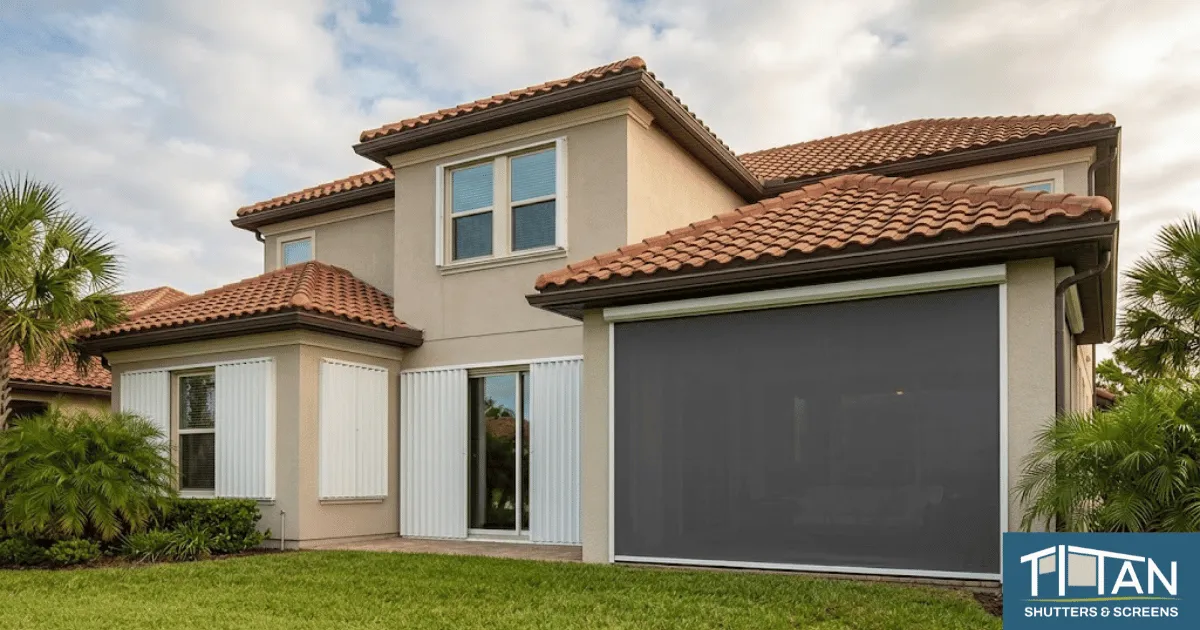
The homes that come through hurricane season without a claim are not the homes with the most expensive single product. They are the homes where every opening is matched to the technology engineered for it. Aluminum shutters on the glass. Motorized screens on the lanai. Roll-downs on the second story. Each opening covered by what was designed to cover it. No gaps. No guesswork. No single product asked to do what it was never built to do.
The financial picture makes the plan more accessible than most homeowners expect. The insurance discount, the matching grant, and the tax exemption — three financial layers that most contractor proposals never mention in the same conversation — can reduce the effective cost of a comprehensive protection plan by 40 to 60 percent over the life of the system. This article puts the entire picture on one page.
The Short Answer
What is the best combination of hurricane protection for a Northeast Florida home?
A comprehensively protected Northeast Florida home uses AHT aluminum hurricane shutters on every glass opening — windows, sliding doors, French doors, and garage doors — and motorized MaxForce Hurricane Screens on every large outdoor opening — lanais, covered patios, and pergola enclosures. The combination addresses every exterior vulnerability on the property, qualifies for the maximum insurance discount under Florida Statute §627.0629 (10–30 percent on the wind and hurricane portion of the premium), and can be financed in part by the My Safe Florida Home Program matching grant of up to $10,000. Neither technology replaces the other. Together, they are the plan.
Layer One: Windows and Doors — The Shutter Foundation
Every glass opening on a Northeast Florida home is a potential breach point during a hurricane. Windows, sliding glass doors, French doors, and garage doors are the entry paths for wind, water, and debris. When one breach point fails, the internal pressure of the home changes — and that pressure change can lift the roof, blow out the opposite wall, and turn a survivable storm into a total-loss claim.
AHT (Advanced Hurricane Technology) aluminum shutters cover this layer. As we detailed in Article 3 of this series, AHT shutters come in four configurations — accordion, roll-down, hurricane panel, and Bahama — each engineered for specific opening types. Accordion shutters are the workhorse for standard windows and sliding doors. Motorized roll-downs are the standard for second-story windows and high openings where ladder work is unsafe. Hurricane panels are the budget-conscious option for homeowners willing to accept manual installation. Bahama shutters provide year-round shade and storm protection in the coastal architectural style of historic St. Augustine and Ponte Vedra Beach.
All four qualify for the opening protection credit under Florida Statute §627.0629. All four are tested to the Florida Building Code. AHT shutters are engineered specifically for the coastal salt-air conditions and structural profiles of Northeast Florida homes. Lead time runs 60 to 90 days from order to installed.
Shutters protect every glass opening on the home. What they do not protect — what they were never designed to protect — is the thirty-foot lanai opening, the pergola, the outdoor kitchen, or the pool cage. That is Layer Two.
Layer Two: Outdoor Openings — The Screen Complement
The large outdoor openings that define Northeast Florida living — lanais, covered patios, pergola enclosures, and pool cage perimeters — require a different category of protection. These openings are too wide for aluminum shutters. They demand a flexible, wind-load-rated barrier that can span up to 25 feet and handle design pressures of ±200 PSF.
The Fenetex MaxForce Hurricane Screen with the new silent spring-track architecture —announced on June 2 and detailed in Article 5— covers this layer. Florida Product Approval FL 8637R11. Rated to 185 MPH HVHZ wind loads. Twitchell OmegaTex ballistic-grade fabric blocking up to 95 percent of UV rays. Silent operation. Self-adjusting alignment. Tight, taut fabric appearance 365 days a year. Lifetime warranty with backward compatibility across every Fenetex generation.
And as Article 7 demonstrated, the screen that locks the lanai before a hurricane also provides daily privacy, bug control, UV protection, dust filtration, and rain shielding. The storm protection is the certification. The daily living is what earns the investment back.
MaxForce screens also qualify for the §627.0629 opening protection insurance credit when properly installed and documented on the OIR-B1-1802 wind mitigation form. Lead time runs up to 90 days from order to completion.
Florida Statute §627.0629
“Insurance carriers shall offer premium discounts for opening protection that meets the Florida Building Code wind mitigation standards.” The discount applies to the wind and hurricane portion of the homeowner’s premium and ranges from 10 to 30 percent. A single unprotected opening can disqualify the full credit.
The Financial Picture That Changes the Math
Most homeowners evaluate the cost of hurricane protection by looking at the number on the proposal. That is the installed price. It is not the effective cost. Three financial layers reduce the effective cost — and most contractor proposals never present all three in the same conversation.
Layer 1: The insurance discount (§627.0629)
Florida Statute §627.0629 requires insurance carriers to offer the opening protection credit for systems that meet the Florida Building Code wind mitigation standards. The credit is documented on the OIR-B1-1802 wind mitigation form. Both AHT aluminum shutters and Fenetex MaxForce Hurricane Screens (FL 8637R11) qualify. The discount ranges from 10 to 30 percent on the wind and hurricane portion of the homeowner’s premium. On a typical Northeast Florida home where that portion runs $3,000 to $6,000 annually, the credit represents $300 to $1,800 per year in verified savings. Over the life of the home, the protection pays for itself through insurance reduction alone — typically within 8 to 15 years.
The critical detail: the §627.0629 credit requires every opening on the property to be protected. A single unprotected opening — a lanai that has no screen, a window that has no shutter — can disqualify the full opening protection credit. This is why the comprehensive approach is not just the safest strategy. It is the most financially rewarding one. Homes that protect every glass opening with shutters but leave the lanai exposed may not qualify for the full credit. The two-technology combination closes every gap.
Layer 2: The My Safe Florida Home Program
The My Safe Florida Home Program, administered by the Florida Division of Emergency Management, offers matching grants of up to $10,000 for eligible homeowners to install wind mitigation improvements. The match is dollar-for-dollar: the homeowner pays half, the state pays half, up to the cap. Eligibility requires a homestead single-family home with an insured value of $700,000 or less. The program operates on a fiscal-year funding cycle, and demand consistently exceeds available funds. Early application is critical.
For a homeowner installing both AHT shutters and MaxForce screens, the My Safe Florida Home grant can offset a meaningful portion of the total project cost. Combined with the annual insurance discount, the effective out-of-pocket cost drops significantly from the number on the original proposal.
Layer 3: Permanent sales tax exemption
As of August 2025, qualifying hurricane preparedness items are permanently exempt from Florida state sales tax. This is not a limited-window promotion. It is a permanent exemption. Ask your installer which components of your protection project fall under the exemption and ensure the savings are reflected on your invoice.
The three layers together — the annual insurance discount, the one-time matching grant, and the permanent tax savings — can reduce the effective cost of a comprehensive shutter-and-screen installation by 40 to 60 percent over the life of the system. The installed price on the proposal is the starting number. It is not the final number.
The HOA Picture Under HB 293
Florida House Bill 293 (2024) removed HOA authority to block the installation of hurricane protection products on residential properties. This applies to both aluminum shutters and motorized hurricane screens. HOAs in Nocatee, Ponte Vedra Beach, World Golf Village, Silverleaf, and across every master-planned community in St. Johns, Duval, and Flagler counties cannot deny a homeowner’s request to install hurricane protection.
HOAs retain limited authority over color and style consistency. AHT shutters are available in multiple powder-coat colors. MaxForce screens are available in 6 screen fabric colors and multiple frame colors with optional custom powder coating. Between the two product lines, virtually any HOA aesthetic requirement can be met while maintaining full storm protection.
One more thing worth knowing: Hurricane Matthew (2016) and Hurricane Milton (2024) both demonstrated the same pattern in Northeast Florida: the homes whose interiors survived were the homes with shutters on the glass. The homes whose outdoor investments survived were the homes with screens on the lanai. The homes that filed no claims were the homes that had both. The combination is not redundant. It is the only approach that covers every exterior vulnerability on the property. The building inspectors recommend it. The insurance carriers reward it. The homeowners who have lived through a storm while fully protected do not go back.
Your Comprehensive Plan — The June Action Steps
The comprehensive approach is not the most expensive approach. It is the most complete one. The insurance discount rewards it. The state grant helps fund it. The tax exemption reduces the cost of it. And the homeowner who invests in both layers — shutters on the glass, screens on the lanai — owns a property that is comprehensively protected for the storm and comprehensively functional for the other 360 days of the year.
Hurricane season is underway. Peak season begins in mid-August. The window for installing both technologies before the storms arrive is open right now. It will not stay open much longer.
Protection is not a product. It is a plan.
Frequently Asked Questions
Do I need both hurricane shutters and motorized screens?
For comprehensive protection, yes. Aluminum hurricane shutters protect glass openings — windows, sliding doors, French doors, and garage doors. Motorized hurricane screens protect large outdoor openings — lanais, covered patios, pergola enclosures, and pool cage perimeters. Neither technology was designed to do the other’s job. The combination covers every exterior vulnerability on the property and qualifies for the maximum §627.0629 insurance discount. A single unprotected opening can disqualify the full credit.
How much does a complete shutter-and-screen installation cost?
Cost varies based on the number and size of openings, the shutter types selected, and the structural condition of existing outdoor structures. The installed price on the proposal is the starting number. Three financial layers reduce the effective cost: the §627.0629 insurance discount (10–30 percent annually on the wind and hurricane portion of the premium), the My Safe Florida Home matching grant (up to $10,000), and the permanent sales tax exemption on qualifying hurricane preparedness items. Combined, these layers can reduce the effective out-of-pocket cost by 40 to 60 percent over the life of the system.
Can I install shutters and screens at the same time?
Yes. A comprehensive assessment evaluates every opening on the property simultaneously, and the proposal can include both AHT aluminum shutters and MaxForce Hurricane Screens in a single project scope. Permits for both can be coordinated through the same process. Installation scheduling depends on manufacturing lead times — 60 to 90 days for shutters, up to 90 days for screens — but both can be installed within the same project window.
Does the My Safe Florida Home Program cover both shutters and screens?
The My Safe Florida Home Program covers wind mitigation improvements, including hurricane shutters. Program specifics regarding motorized screen eligibility should be confirmed during the application process, as program requirements and covered improvements may be updated with each fiscal-year cycle. The matching grant of up to $10,000 applies to eligible improvements on homestead single-family homes insured at $700,000 or less. Contact the program or your certified installer for current eligibility guidance.
What happens if I leave one opening unprotected?
A single unprotected opening can disqualify the full opening protection credit on the OIR-B1-1802 wind mitigation form. More critically, a single unprotected opening during a hurricane creates a breach point that changes the internal pressure dynamics of the home — which can cause cascading structural failures even when every other opening is protected. Comprehensive protection means every opening. The §627.0629 discount rewards it. The physics require it.
