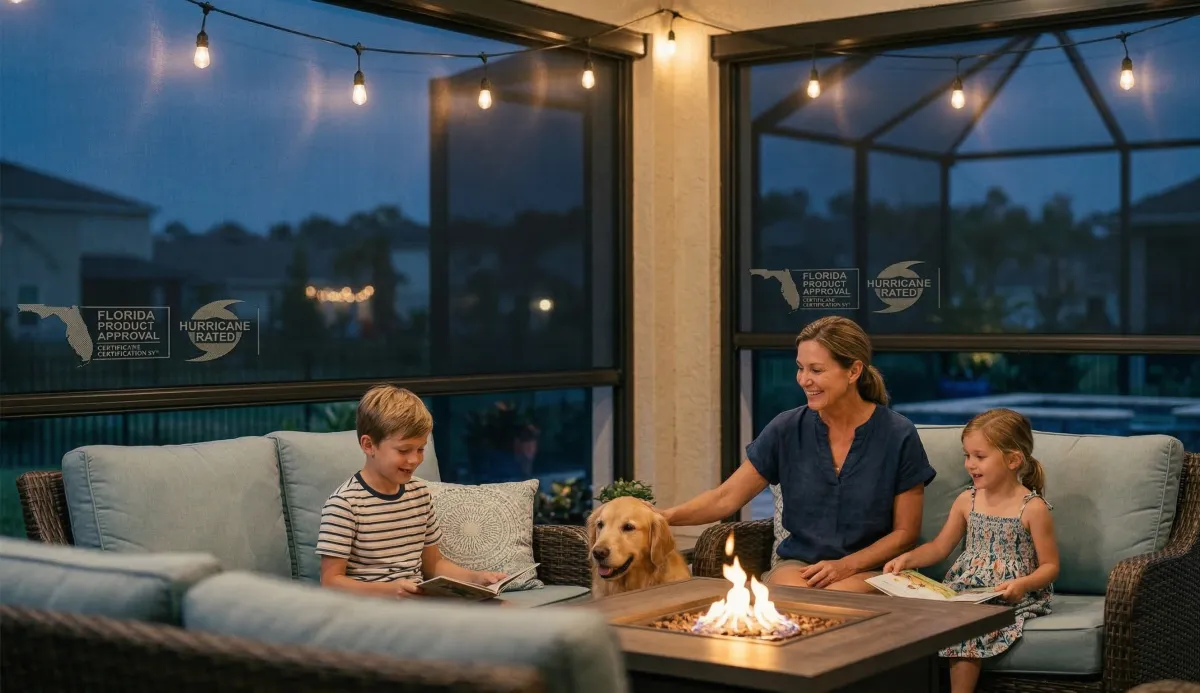
Finally Bug-Free: How Motorized Screens Are Reclaiming Nocatee and Ponte Vedra Lanais
You know the moment.
It is the first week of May. The temperature has climbed just enough to feel like summer. You walk out to your lanai with a glass of something cold, settle into the chair you bought specifically for evenings like this, and within three minutes you are swatting at your neck, slapping your ankle, and retreating back inside with the sliding glass door closing behind you.
That is the moment. The one that happens every year in St. Augustine, Nocatee, Ponte Vedra Beach, and across every community in St. Johns County and Flagler County. The moment when the outdoor space you invested thousands of dollars in — the lanai, the patio, the outdoor kitchen, the pergola — stops being yours and starts belonging to the mosquitoes, the no-see-ums, and the sand gnats that own Northeast Florida from May through October.
Most homeowners respond with a familiar rotation: citronella candles that do not work in any meaningful way, DEET-based sprays that leave skin sticky and furniture stained, monthly pest control subscriptions that reduce the population in the yard but cannot build a wall around the lanai, and eventually the quiet resignation that their outdoor space is a three-season amenity at best — usable in winter and early spring, abandoned by Memorial Day.
There is a better answer. It is permanent. It deploys at the press of a single button. And it turns your lanai from a seasonal compromise into a year-round room.
Why Northeast Florida's Insect Problem Is Worse Than Most Homeowners Expect
If you moved to St. Johns County from somewhere north of the Carolinas, the insect situation in Northeast Florida probably caught you off guard. The mosquitoes were expected. The no-see-ums were not.
No-see-ums — technically biting midges of the family Ceratopogonidae, but universally known in Florida as no-see-ums or sand gnats — are tiny enough to pass through standard screen mesh. A traditional screen enclosure with 18x14 mesh keeps out mosquitoes and larger flying insects. It does almost nothing against no-see-ums. Their bites are disproportionately painful for their size, leave welts that can last for days, and are most active at dawn and dusk — the exact hours when Northeast Florida homeowners most want to be outside.
The geography of St. Johns County amplifies the problem. Nocatee's retention ponds, man-made lakes, and preserved wetlands create ideal mosquito breeding habitat within walking distance of nearly every home in the community. Ponte Vedra Beach sits between the Atlantic Ocean and the Intracoastal Waterway — marshland on both sides, with tidal flats that produce no-see-ums in staggering numbers during warm months. St. Augustine's historic neighborhoods border salt marshes and the Matanzas River, where biting midges thrive in the brackish water and organic sediment.
This is not a problem that citronella solves. It is not a problem that a monthly yard spray eliminates. Those approaches reduce the population in the yard — which has value — but they cannot create a sealed barrier around the outdoor living space where you actually spend your time. The insects breed in the water sources surrounding your community, not in your personal yard. Your neighbor's drainage ditch, the community retention pond 200 yards away, the marsh preserve behind the back fence — those are the sources. And no amount of personal yard treatment can control them.
The only way to reclaim a lanai, a covered patio, or a pergola from Northeast Florida's insect population is a physical barrier that seals the space when you want protection and opens completely when you do not. That is what a motorized retractable screen does.
How Motorized Screens Eliminate the Insect Problem — Not Just Reduce It
A Fenetex motorized retractable screen is not a screen door. It is not a panel you clip into a track. It is a precision-engineered system that seals a lanai, patio, or pergola opening from the top of the header to the floor, locked into side-retention tracks on both edges, with a weighted bottom bar that holds the fabric taut against the surface below.
When deployed, the screen creates a complete insect barrier — no gaps at the sides, no slack at the bottom, no openings where no-see-ums or mosquitoes can enter. The Fenetex insect screen mesh is engineered specifically for the Florida market, with an aperture tight enough to block no-see-ums, sand gnats, mosquitoes, and virtually every other biting insect common to Northeast Florida's coastal and wetland-adjacent communities.
When retracted, the screen disappears into a flush-mounted aluminum housing at the top of the opening. The lanai returns to its fully open state — unobstructed views, unrestricted airflow, no visible hardware. You have not permanently altered the aesthetic of your outdoor space. You have added a deployable barrier that is there when you want it and invisible when you do not.
The deployment mechanism is motorized — a single button press on a wall switch, a handheld remote, or a smart home app. Screens deploy in under 30 seconds for a standard lanai opening. There is no manual cranking, no clips to secure, no wrestling with a panel in the dark while mosquitoes bite your arms. You press a button. The screen deploys. The insects are gone.
For homeowners in Nocatee, Ponte Vedra Beach, and the master-planned communities across St. Johns County, where the lanai is the most-used room in the house from October through April and the most-avoided room from May through September, this changes the math on outdoor living entirely.
The Recurring Cost You Are Already Paying — And the One You Can Eliminate
Most homeowners in St. Johns County are already spending money on the mosquito problem. They just may not have added it up.
Monthly mosquito spray services in the Northeast Florida market typically run $70 to $150 per treatment, applied every three to four weeks during peak season. Over a seven-month insect season — May through November — that represents $490 to $1,050 annually. Over five years, $2,450 to $5,250. Over a decade, $4,900 to $10,500. And those treatments reduce the population in your yard. They do not seal your lanai.
Citronella candles, plug-in repellent devices, DEET sprays, and other consumer-grade insect deterrents add another $200 to $500 per year for an active household — products that need constant replenishment and deliver inconsistent results.
Traditional fixed screen enclosures, if you have one, carry their own recurring costs. Standard 18x14 mesh does not block no-see-ums. It degrades under Florida's UV exposure and requires panel replacement every five to eight years. And as we discussed in our hurricane preparedness series, a fixed screen enclosure has zero wind rating — meaning every significant storm brings the risk of a $2,000 to $8,000 rescreening bill.
A motorized retractable screen is a one-time investment that eliminates all three cost categories. It blocks every insect that Northeast Florida produces. It retracts to protect itself from UV degradation when not in use. And the hurricane-rated Fenetex MaxForce system — if you choose to combine insect protection with storm protection in a single screen — retracts before a storm and deploys afterward, eliminating the rescreening cycle entirely.
The financial comparison is not close. The motorized screen pays for the mosquito spray it replaces, the rescreening it prevents, and the outdoor living time it reclaims — all simultaneously.
What Dusk Looks Like With Motorized Screens
The best way to understand the value of a motorized screen on a Northeast Florida lanai is to imagine Tuesday at 7:15 PM in June.
Without screens: You are inside. The sliding glass door is closed. You can see the lanai furniture through the glass, the pool beyond it, maybe the sunset coloring the sky over the tree line. You would like to be out there. But the mosquitoes arrived at 6:30, the no-see-ums followed at 7:00, and the outdoor space is unusable until they disappear sometime after midnight. You spent $45,000 building a lanai you cannot use for half the year.
With motorized screens: At 6:15 PM, as the light begins to soften, you press a button on your phone or speak a command to Alexa. The Fenetex screens deploy across the lanai openings in under 30 seconds — silently, cleanly, locking into the side-retention tracks. By the time you walk out with dinner, the lanai is sealed. The view is preserved — the screen mesh allows full outward visibility while blocking 91 percent of UV and every insect trying to enter. There is a breeze. There is no buzzing. You eat dinner outside on a Tuesday in June, which is something most of your neighbors gave up on years ago.
That is not a luxury scenario. That is a Tuesday. And it is the reason homeowners who install motorized screens consistently describe them as the single best improvement they have made to their outdoor space — not because of the hurricane protection, not because of the UV blocking, but because they got their evenings back.
Smart Home Integration: Screens That Deploy When Conditions Change
Fenetex motorized screens integrate with Alexa, Google Home, and Somfy through the Bond Bridge Pro system. This means deployment is not limited to a wall switch or a handheld remote — it extends to voice commands, smartphone control from anywhere, and automation routines that respond to real-time conditions.
For insect protection, the most useful automation is a time-based routine. Mosquitoes and no-see-ums in Northeast Florida follow a predictable daily cycle — low activity during midday, escalating sharply in the late afternoon, peaking at dusk. A homeowner can program their motorized screens to deploy automatically at 5:30 or 6:00 PM every day during insect season, ensuring the lanai is sealed before the first mosquito arrives. No button press required. No need to remember. The system handles it.
For homeowners who use their outdoor space for morning coffee and evening entertaining — which describes the majority of lanai owners in Nocatee, World Golf Village, and the Ponte Vedra corridor — a dual routine works well: screens deploy at dawn to block the early-morning no-see-um window, retract at mid-morning when insect activity drops, and deploy again in the late afternoon for the evening.
This is the kind of integration Titan configures during every motorized screen installation. We do not leave you with a remote and a manual. We set up the smart home connection, build the automation routines you want, and make sure the system is working before we leave your property.
Beyond Bugs: The Other Daily Benefits You Did Not Expect
Homeowners who install motorized screens for insect protection consistently discover benefits they did not anticipate — benefits that compound the daily value of the system well beyond bug season.
UV protection. Fenetex screen fabric blocks 91 percent of ultraviolet radiation. On a lanai facing west or south in St. Johns County, that translates to a measurable reduction in heat transfer through the screen opening. The lanai stays cooler. The sliding glass doors behind the screen absorb less solar heat. The air conditioning system inside the home works less during the hours when the screen is deployed. Multiple homeowners in Nocatee and Ponte Vedra have reported noticeable decreases in summer utility costs after motorized screen installation — not from insect protection, but from solar heat reduction.
Rain management. Florida's afternoon thunderstorms are a daily occurrence from June through September. A deployed motorized screen on a lanai deflects wind-driven rain that would otherwise soak furniture, flood outdoor rugs, and force a scramble to drag cushions inside. The screen does not stop all rain — it is a screen, not a wall — but it dramatically reduces the amount of wind-driven water that reaches the interior of the space. For homeowners with outdoor kitchens, this protection is particularly valuable.
Privacy. The Fenetex screen fabric provides a one-way visibility effect — you can see out clearly, but neighbors and passersby see a darkened screen surface from the outside. In the tightly spaced communities of Nocatee, Silverleaf, and the newer neighborhoods across St. Johns County, this privacy benefit is often cited as one of the most valued features of the system. You can use your lanai in the evening with lights on without feeling like you are on display.
Noise reduction. A deployed screen provides mild sound dampening — reducing wind noise, ambient neighborhood sound, and the echo effect common in hard-surfaced lanai enclosures. It is not soundproofing. It is a noticeable softening of the acoustic environment that makes conversation and relaxation more comfortable.
The May Decision: Why This Month Matters
May is the month when the insect reality of Northeast Florida announces itself. The mosquitoes return. The no-see-ums follow. And homeowners across St. Johns County face the same choice they face every year: surrender the outdoor space for another summer, or invest in the solution that makes it permanently usable.
Motorized retractable screens carry lead times of approximately 90 days from order to completed installation. A homeowner who starts the process in May will have screens installed by late July or early August — reclaiming the second half of summer and every season after that. A homeowner who waits until June pushes installation into September. A homeowner who waits until they cannot stand the mosquitoes anymore — which is usually mid-June — pushes installation into the fall.
The pattern repeats every year. The homeowners who act in spring are the ones who enjoy their outdoor space in summer. The ones who wait tell themselves the same thing every October: I should have done this months ago.
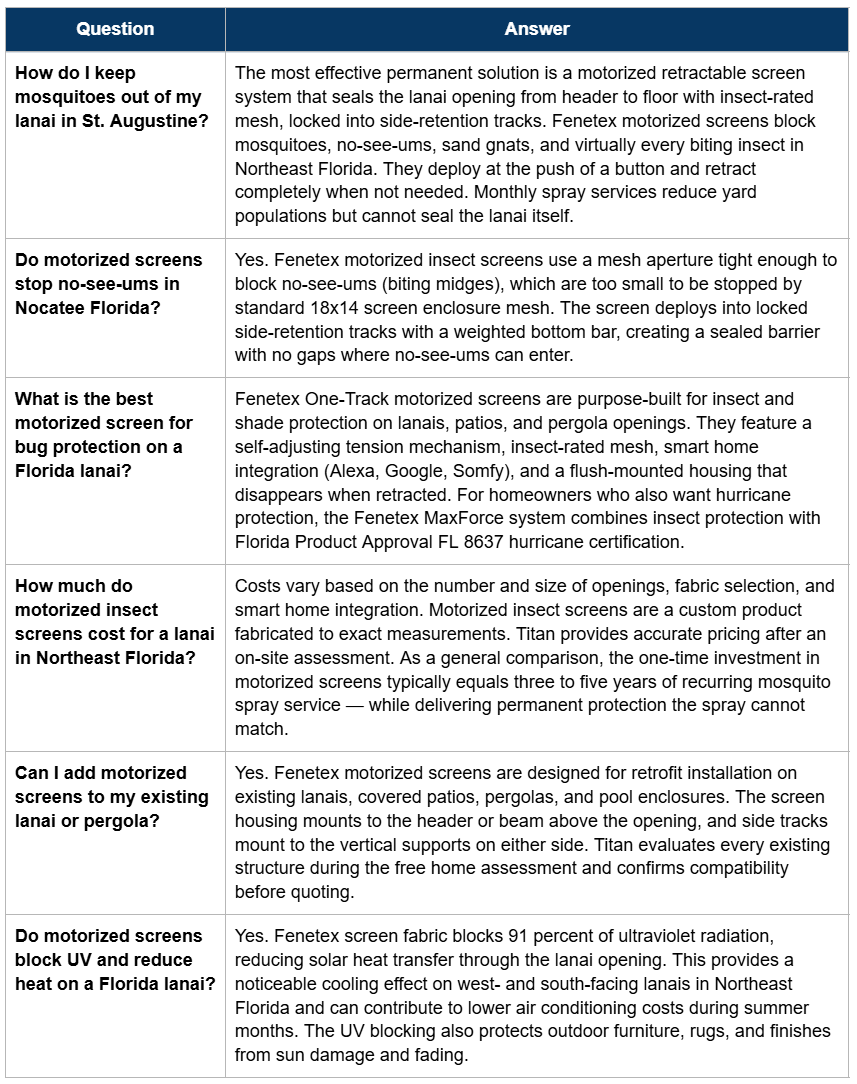
Frequently Asked Questions
Schedule Your Free Home Assessment
Serving St. Augustine · Nocatee · Ponte Vedra Beach · Palm Coast · Jacksonville · Northeast Florida
We walk your property, measure every lanai, patio, and pergola opening, and design a motorized screen system that eliminates your insect problem permanently — while adding UV protection, privacy, rain management, and optional hurricane-rated protection.
One visit. One quote. No obligation. And no more surrendering your outdoor space to mosquitoes every May.
Call or text: (904) 484-7580 | TitanShuttersandScreens.com
Read the full series:
